Key takeaways
- Steel gauge over drawer count: Lower gauge numbers mean thicker steel. A 16-gauge shell like the one on the HAUTMEC 72″ resists racking under heavy loads, while thin-walled economy boxes flex once the drawers fill up. If a listing hides the gauge, assume it’s thin.
- Slide mechanism: Ball-bearing runners glide smoothly under weight and stay aligned for years. Friction slides feel acceptable empty and bind the moment you load a drawer with wrenches. This is the single most common failure point.
- Casters and lock quality: Look for a stated total capacity, swivel casters on at least two corners, and brakes that engage positively. The WORKPRO’s 1,000 lb rating is a useful benchmark for a mid-size cabinet.
- Worktop material: A solid oak or hardwood top turns a cabinet into a genuine workbench and takes abuse gracefully. Powder-coated steel tops are easier to wipe down but louder and prone to visible scratching.
- Footprint and access: Measure your walking clearance before you buy. A 72″ unit is transformative in a two-car garage and unusable in a single bay — and detachable top boxes give you flexibility to split the unit later.
What's inside
Garage storage tends to fail quietly. A drawer starts sticking, the casters flat-spot under a load of sockets, and within a season the whole unit becomes a place where tools go to disappear. The frustration for most buyers isn’t choice — there are hundreds of steel boxes on the market — it’s that the specs that actually predict longevity (gauge thickness, slide type, weight rating per drawer) are buried while marketing shouts about drawer count. A five-drawer chest with stamped slides will lose to a three-drawer chest with ball bearings every single time.
This guide approaches tool storage the way we’d approach any piece of functional furniture: proportion, materials, and how it behaves in the room over years, not weeks. We’ve grouped the picks by the job they’re built for — full-wall workshop anchors, mid-size rolling cabinets, and portable chests that live in a truck bed or under a bench — and flagged the construction details worth paying for. Below are the models we’d recommend to a friend building out a garage in 2026.
As an Amazon Associate we earn from qualifying purchases.




How to Choose a Who Makes The Best Tool Chest (2026)
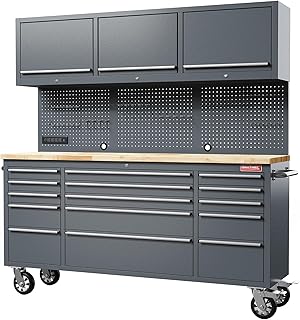
- Steel gauge over drawer count: Lower gauge numbers mean thicker steel. A 16-gauge shell like the one on the HAUTMEC 72″ resists racking under heavy loads, while thin-walled economy boxes flex once the drawers fill up. If a listing hides the gauge, assume it’s thin.
- Slide mechanism: Ball-bearing runners glide smoothly under weight and stay aligned for years. Friction slides feel acceptable empty and bind the moment you load a drawer with wrenches. This is the single most common failure point.
- Casters and lock quality: Look for a stated total capacity, swivel casters on at least two corners, and brakes that engage positively. The WORKPRO’s 1,000 lb rating is a useful benchmark for a mid-size cabinet.
- Worktop material: A solid oak or hardwood top turns a cabinet into a genuine workbench and takes abuse gracefully. Powder-coated steel tops are easier to wipe down but louder and prone to visible scratching.
- Footprint and access: Measure your walking clearance before you buy. A 72″ unit is transformative in a two-car garage and unusable in a single bay — and detachable top boxes give you flexibility to split the unit later.
The Best Who Makes The Best Tool Chest (2026)s Reviewed
Goplus 5-Drawer Rolling Tool Cabinet
A well-balanced entry point that covers the fundamentals: a detachable top box, protective drawer liners, a central lock bar, and lockable universal casters that let you spin it in tight quarters. It’s the pick for a home garage that needs organized storage without committing an entire wall.
WORKPRO 52″ Rolling Tool Chest with Workbench
The 1,000 lb capacity, integrated power strip, and adjustable-shelf side cabinet make this the most versatile mid-size option here — it functions as storage and a working surface simultaneously. The wooden top is the detail that elevates it above comparable all-steel cabinets at this size.
HAUTMEC 72″ Rolling Tool Chest (HT0428)
This is the serious workshop anchor: 16-gauge steel, 15 lockable drawers, three upper cabinets, a solid oak top, and a pegboard with 51 hooks for the tools you reach for hourly. Give it the clearance it needs and it replaces an entire wall of mismatched shelving.
Craftsman 3-Drawer Portable Chest
A classic for good reason — compact, genuinely portable, and honest about what it does. Best as a secondary chest for a specific trade kit or as a bench-top companion rather than a primary storage solution.
8-Drawer Rolling Tool Chest (Black)
Arrives assembled, which saves an evening, and the detachable top box, tray dividers, liners, and side hooks mean it’s organized from day one. The matte black finish reads cleaner in a finished garage than the usual red-and-chrome treatment.
Frequently Asked Questions
How many drawers do I actually need?
Most home users are well served by five to eight. Beyond that, you’re buying for a trade-specific tool collection — and shallow drawers that stay half-empty create more searching, not less.
Is a wooden top worth the premium?
If you plan to work on the cabinet, yes. Hardwood absorbs impact, won’t telegraph every scratch, and is quieter than steel. If the chest is purely for storage, skip it.
Can I move a loaded rolling chest safely?
Only on smooth, level flooring, and only if the casters are rated for the total load. Distribute heavy items in the lower drawers and release all brakes before pushing rather than dragging.
What about portable metal tool boxes?
A 24″ portable chest with ball-bearing runners and a top storage tray is ideal as a grab-and-go kit or for renters who can’t dedicate floor space. Treat it as a complement to a rolling cabinet, not a replacement.
Final Thoughts
For a dedicated workshop where the chest becomes the room’s center of gravity, the HAUTMEC 72″ is the clear investment — heavy-gauge steel, real oak, and enough organized capacity to last decades. The WORKPRO 52″ is the smarter buy for most garages, delivering a workbench surface and 1,000 lb capacity in a footprint you can live with, while the Goplus 5-drawer covers the essentials cleanly for anyone starting from scratch.