Key takeaways
- Resaw height, honestly measured: Most 14-inch saws clear roughly 6 inches under the guide, with riser blocks pushing that to about 12 inches. Decide before you buy whether you want tall resaw capability, since adding height to a light frame introduces flex that shows up as a wandering cut.
- Motor sizing over marketing: A genuine 1 to 1.75 HP induction motor on 115/230V will resaw hard maple all afternoon. Treat inflated horsepower claims with suspicion and look instead at amp draw, dual-voltage wiring, and whether overload protection is built in.
- Frame and table rigidity: Solid cast-iron tables and cast trunnions keep your miter and bevel settings honest under load. Stamped-steel components save money and cost you accuracy on the exact cuts furniture work depends on.
- Dual speeds if you cut mixed materials: Roughly 1,445 and 2,950 FPM covers the useful range, slow for brass, aluminum, and thick hardwood, fast for general woodworking. If you only cut wood, a single fast speed is not a real limitation.
- Guides, tensioning, and dust control: Ball-bearing guides above and below the table, a quick-release tension lever, and a 4-inch dust port turn a capable saw into a pleasant one. These are the features you touch every session.
What's inside
A 14-inch band saw sits at an odd intersection for anyone who builds furniture at home. It is big enough to resaw a plank of walnut into book-matched panels, patient enough to trace the curve of a cabriole leg, and quiet enough that you can run it in a garage shop without rattling the house. Yet most buyers arrive at this size category confused, because the spec sheets read nearly identically: same wheel diameter, same cast-iron promise, wildly different results at the blade. The gap usually comes down to frame rigidity, guide quality, and whether the motor holds speed when a 6-inch cut starts loading up.
This guide looks at 14-inch band saws through the lens of furniture work specifically, curved aprons, tapered legs, veneer-thin resawing, and the occasional bandsawn box. We weighed resaw capacity against real-world tension limits, compared dual-speed setups for hardwood versus non-ferrous stock, and paid attention to the unglamorous details that decide whether a saw feels precise on day 400: table flatness, trunnion design, dust extraction, and how easily the guides adjust without a full teardown.
As an Amazon Associate we earn from qualifying purchases.


How to Choose a/an 14 Band Saw (2026)
- Resaw height, honestly measured: Most 14-inch saws clear roughly 6 inches under the guide, with riser blocks pushing that to about 12 inches. Decide before you buy whether you want tall resaw capability, since adding height to a light frame introduces flex that shows up as a wandering cut.
- Motor sizing over marketing: A genuine 1 to 1.75 HP induction motor on 115/230V will resaw hard maple all afternoon. Treat inflated horsepower claims with suspicion and look instead at amp draw, dual-voltage wiring, and whether overload protection is built in.
- Frame and table rigidity: Solid cast-iron tables and cast trunnions keep your miter and bevel settings honest under load. Stamped-steel components save money and cost you accuracy on the exact cuts furniture work depends on.
- Dual speeds if you cut mixed materials: Roughly 1,445 and 2,950 FPM covers the useful range, slow for brass, aluminum, and thick hardwood, fast for general woodworking. If you only cut wood, a single fast speed is not a real limitation.
- Guides, tensioning, and dust control: Ball-bearing guides above and below the table, a quick-release tension lever, and a 4-inch dust port turn a capable saw into a pleasant one. These are the features you touch every session.
The Best 14 Band Saw (2026)s Reviewed
JET JWBS-14SFX-BLK, 1.75 HP
This is the saw to buy if resawing is central to your furniture work, with 1.75 HP behind a rigid cast frame and guides that hold alignment through repeated blade changes. The premium is real, but so is the difference in cut quality on wide hardwood panels.
Powermatic PWBS-14CS, 1-1/2 HP
Powermatic’s 14-inch classic earns its reputation on fit and finish: a heavy cast-iron table, an exceptionally smooth trunnion, and a tensioning system that stays put. It rewards makers who value repeatable setup over raw feature count.
WEN BA1411 Industrial, 14-Inch
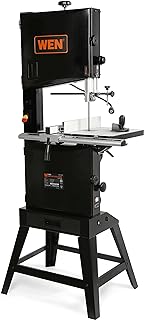
Dual-voltage 120V/240V wiring and two speeds make this the value pick for shops handling both wood and soft metals. Expect to spend an hour dialing in the guides and table on arrival, after which it cuts well above its price bracket.
JET JWBS-14CS, 1 HP
The 1 HP version of JET’s 14-inch platform is the sensible middle ground for curve work, joinery cuts, and moderate resawing up to about 6 inches. It accepts a riser block later if your projects grow.
WEN BA1487 with Stand
A two-speed 14-inch saw that arrives with its own stand, which matters more than it sounds when you are pricing a complete setup. Best suited to hobby furniture makers cutting stock under 4 inches thick.
Frequently Asked Questions
Do I need a riser block?
Only if you plan to resaw panels taller than about 6 inches. Riser kits add roughly 6 inches of capacity but require a longer blade, careful re-tensioning, and a frame stiff enough to support the added leverage.
What blade width should I start with?
Keep a 1/2-inch 3 TPI blade for resawing and a 1/4-inch 6 TPI blade for curves. Those two cover nearly all furniture work, and swapping between them takes under five minutes.
Is 115V enough, or should I wire for 230V?
115V is fine for saws up to about 1.5 HP on a dedicated 20-amp circuit. Rewiring to 230V reduces amp draw and voltage drop on long runs, which helps if your shop shares circuits.
Can a 14-inch band saw replace a table saw?
No, but it complements one. Band saws excel at curves, resawing, and safe rough cuts in thick stock, while table saws remain the tool for precise straight rips and repeatable sheet goods work.
Final Thoughts
For serious furniture making, the JET JWBS-14SFX-BLK offers the best balance of resaw power and long-term precision, while the Powermatic PWBS-14CS is the choice for makers who want machine-shop refinement in every adjustment. If budget leads the decision, the WEN BA1411 delivers dual-voltage, two-speed capability that handles most home-shop projects with room to grow.