Key takeaways
- Two-stage vs single-stage: A true two-stage pump compresses air twice, cooling it between passes, which yields higher sustained CFM and far less heat. Anything under about 60 gallons and 5 HP is almost certainly single-stage regardless of how it’s marketed.
- Match CFM to your thirstiest tool: Find the SCFM at 90 PSI rating on your most demanding tool, add 30 percent headroom, and buy above that. Impact wrenches sip; DA sanders, media blasters and spray guns drink continuously.
- Check your electrical before you check the price: Most two-stage units need a 230V circuit and a dedicated breaker. Budget for an electrician, or stay in the 120V range where oil-free vertical models live.
- Noise is a design constraint, not a footnote: Direct-drive oil-free pumps typically run 85 dB and up. Belt-drive and low-RPM designs land closer to 70 dB, which is the difference between a workshop you enjoy and one you avoid.
- Plan the footprint honestly: An 80-gallon vertical tank is roughly the volume of a tall refrigerator and needs floor anchoring plus drain clearance. Wheeled 20 to 30 gallon units tuck away; stationary units become architecture.
What's inside
A garage compressor is one of those purchases that gets made twice: once in a hurry, and once properly. The first attempt is usually a small pancake unit that handled a nail gun beautifully and then wheezed to a halt three minutes into sanding a door frame. The gap between “inflates tires” and “runs an air tool continuously” is enormous, and it’s measured in CFM and duty cycle rather than horsepower stickers or tank gallons.
This guide sorts through the two-stage stationary machines built for sustained work, alongside a few strong single-stage units worth knowing about if your needs are lighter or your electrical panel isn’t ready for 230V. We’ve noted which is which, because the label “2 stage” gets applied loosely online and the distinction genuinely changes what the machine can do.
As an Amazon Associate we earn from qualifying purchases.


How to Choose a 2 Stage Air Compressor For Home Garage (2026)
- Two-stage vs single-stage: A true two-stage pump compresses air twice, cooling it between passes, which yields higher sustained CFM and far less heat. Anything under about 60 gallons and 5 HP is almost certainly single-stage regardless of how it’s marketed.
- Match CFM to your thirstiest tool: Find the SCFM at 90 PSI rating on your most demanding tool, add 30 percent headroom, and buy above that. Impact wrenches sip; DA sanders, media blasters and spray guns drink continuously.
- Check your electrical before you check the price: Most two-stage units need a 230V circuit and a dedicated breaker. Budget for an electrician, or stay in the 120V range where oil-free vertical models live.
- Noise is a design constraint, not a footnote: Direct-drive oil-free pumps typically run 85 dB and up. Belt-drive and low-RPM designs land closer to 70 dB, which is the difference between a workshop you enjoy and one you avoid.
- Plan the footprint honestly: An 80-gallon vertical tank is roughly the volume of a tall refrigerator and needs floor anchoring plus drain clearance. Wheeled 20 to 30 gallon units tuck away; stationary units become architecture.
The Best 2 Stage Air Compressor For Home Garage (2026)s Reviewed
BILT HARD 60 Gallon 5HP 2-Stage
At 15 CFM at 90 PSI, this is the entry point where two-stage performance becomes genuinely affordable, and it will feed a sander or a small blast cabinet without cycling constantly. The oil-lubricated pump and ASME-certified tank signal serious intent, though expect a break-in period and plan on a 230V dedicated circuit.
Campbell Hausfeld 80 Gallon 2 Stage, 5 HP
The reference point for a permanently installed home shop, with a tank large enough that the motor rests between demands rather than running nonstop. Campbell Hausfeld’s parts availability and service network are the quiet advantage here, since a compressor is a decade-long relationship and rebuild kits matter more than spec sheets.
Campbell Hausfeld 60 Gallon, 3.7 HP
A well-judged middle path for garages that want stationary capacity without the 80-gallon commitment or the tallest footprint. It handles intermittent air tool work comfortably; if your projects skew toward continuous spraying, step up to the 5 HP two-stage instead.
Dewalt 30 Gallon Vertical, 2 HP
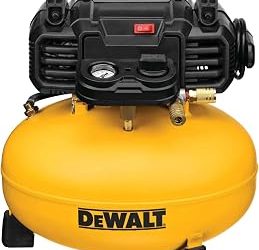
Single-stage, but the 6.2 SCFM at 90 PSI from an oil-lubed belt-drive pump makes it one of the more capable 120V-adjacent options for framing, trim, tire work and bursts of ratchet use. Choose it when you want real output on a modest footprint and don’t want to rewire the garage.
California Air Tools 20015HP Ultra Quiet 20 Gallon
Also single-stage, and the pick for anyone whose garage doubles as a workspace, gym or anything adjacent to living space, at roughly 70 dB rather than the usual roar. Output is modest, so treat it as a nailer, inflation and light-duty companion rather than a sander’s power source.
Frequently Asked Questions
Do I actually need two-stage for a home garage?
Only if you run air tools continuously. For nailers, inflation and occasional impact work, a good single-stage 20 to 30 gallon unit is the smarter buy and far easier to place.
What size tank should I get?
Tank size buffers demand; pump CFM determines what you can sustain. Sixty gallons is the practical floor for stationary work, but never let a large tank distract you from a weak CFM rating.
Oil-lubricated or oil-free?
Oil-lubricated pumps run cooler, quieter and last longer, at the cost of periodic oil changes. Oil-free suits infrequent use and cold storage where maintenance is likely to be skipped.
What maintenance keeps one alive?
Drain the tank after every session to prevent internal rust, change pump oil on schedule, and keep the intake filter clean. Neglected drains are the single most common cause of premature tank failure.
Final Thoughts
For most home garages making the jump to real air, the BILT HARD 60 Gallon 2-Stage delivers the best capability per dollar, while the Campbell Hausfeld 80 Gallon is the buy-once choice if you have the space, the 230V service and a decade of projects ahead. If quiet matters more than raw output, the California Air Tools 20015HP remains the most livable compressor you can put in a garage.