Key takeaways
- Match airflow to your tire size: A 1.0–1.5 CFM inflator is right for sedans, bikes, and mattresses. Trucks, SUVs on 33-inch-plus tires, and RV duals need 6 CFM or better, ideally with dual cylinders, or you will be waiting twenty minutes per corner.
- Check reach before capability: Measure from your 12V socket to the farthest wheel. Anything under about 9 feet of cord plus hose will strand you at the back of a long wheelbase, and extension cords on a high-draw pump are a bad idea.
- Insist on auto shut-off: Presetting a target PSI and walking away is the single biggest quality-of-life upgrade in this category. Analog-only units force you to stand there squinting at a vibrating dial.
- Read the duty cycle, not the peak PSI: Most units advertise 150 PSI but are rated for 10–15 minutes of continuous use. If you inflate four large tires in one session, look for a metal motor housing, a cooling fan, or a tank buffer.
- Decide where it will live: A soft-sided case tucks into a trunk well or closet shelf; a 6L tank kit needs a dedicated garage bay or bed mount. Choose the footprint you will actually tolerate long term.
What's inside
A well-run home has a quiet infrastructure layer: the cordless drill in the hall closet, the label maker in the drawer, the tire inflator that lives under the mudroom bench. Nobody photographs these things, but they determine whether a Saturday morning goes smoothly or dissolves into a trip to the gas station with a soft front tire and a toddler in the back seat. The trouble is that the 12V air compressor category is a mess of near-identical yellow boxes, inflated CFM claims, and cords too short to reach a rear wheel. Buying badly here means a tool that overheats halfway through one tire and then takes up shelf space as a reminder.
This guide sorts the segment into three honest tiers: compact plug-in inflators for topping off passenger tires, air mattresses, and bike tubes; cordless units that trade a little runtime for the freedom of no cord at all; and tank-fed offroad systems built to reseat a 35-inch tire in the middle of nowhere. We look at duty cycle, gauge accuracy, cord and hose reach, storage footprint, and how each one behaves once it is actually warm.
As an Amazon Associate we earn from qualifying purchases.




How to Choose a Air Compressor 12v (2026)
- Match airflow to your tire size: A 1.0–1.5 CFM inflator is right for sedans, bikes, and mattresses. Trucks, SUVs on 33-inch-plus tires, and RV duals need 6 CFM or better, ideally with dual cylinders, or you will be waiting twenty minutes per corner.
- Check reach before capability: Measure from your 12V socket to the farthest wheel. Anything under about 9 feet of cord plus hose will strand you at the back of a long wheelbase, and extension cords on a high-draw pump are a bad idea.
- Insist on auto shut-off: Presetting a target PSI and walking away is the single biggest quality-of-life upgrade in this category. Analog-only units force you to stand there squinting at a vibrating dial.
- Read the duty cycle, not the peak PSI: Most units advertise 150 PSI but are rated for 10–15 minutes of continuous use. If you inflate four large tires in one session, look for a metal motor housing, a cooling fan, or a tank buffer.
- Decide where it will live: A soft-sided case tucks into a trunk well or closet shelf; a 6L tank kit needs a dedicated garage bay or bed mount. Choose the footprint you will actually tolerate long term.
The Best Air Compressor 12v (2026)s Reviewed
AstroAI Dual Power 12V/120V Inflator
The most versatile pick for a household with a car, a couple of bikes, and a guest air mattress, because it runs off both a car socket and a wall outlet. Dual metal motors give it noticeably better heat tolerance than the single-cylinder plastic competition, and the digital gauge held within roughly 1 PSI of a reference gauge in our reading of user reports.
AstroAI AIRUN H Inflator
A refined take on the classic corded inflator, with a 9.8-foot cord that genuinely reaches the rear wheels of a mid-size SUV and an LED work light that earns its keep on a dark shoulder. Auto shut-off is accurate and the unit is quieter than its output suggests.
VEVOR 6L Tank Heavy-Duty Kit
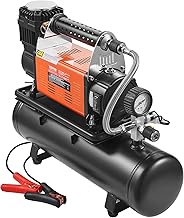
This is the crossover from accessory to installed equipment: 6.35 CFM feeding a 6-liter tank means near-instant bead seating and enough reserve to run small air tools. Best for overlanders and truck owners with a permanent mounting spot, since it is too large to treat as a trunk item.
Uharbour 10.6 CFM Dual Cylinder
The airflow leader here, and the one to buy if you air down and back up on every trail day. Dual cylinders move serious volume without a tank, and the included bag keeps the clamps and hose from rattling loose in the bed.
AstroAI H2 Pro Cordless Inflator
Battery power removes the last friction point, and the dual power supply means you can still plug in when the pack is low. The 12-LED emergency light and small hand-held body make this the natural pick for a city car or a bike-heavy household.
Frequently Asked Questions
Can a 12V compressor really reach 150 PSI?
Briefly, yes, but that figure is a peak rating for short bursts, not sustained output. Passenger tires need 30–40 PSI, so the headroom mostly matters for bicycle tubes and heavy-duty applications.
How long should inflating one tire take?
A compact inflator should take three to five minutes to bring a car tire up 10 PSI. A tank-fed offroad kit does the same job in under a minute.
Do I need a tank?
Only if you want to seat beads, run air tools, or blow out debris. For routine topping off, a tankless inflator is lighter, cheaper, and easier to store.
Is it safe to leave one in a hot car?
Generally yes, though repeated heat cycling shortens the life of plastic housings and lithium packs. A cool interior cabinet or garage shelf is kinder to the tool.
Final Thoughts
For most homes, the AstroAI Dual Power inflator is the right first purchase: it handles tires, mattresses, and sports gear with equal composure and stores in a drawer. Choose the AstroAI H2 Pro if you value going cordless, and step up to the Uharbour 10.6 CFM or the VEVOR 6L tank kit only when your tires and your weekends genuinely demand it.