Key takeaways
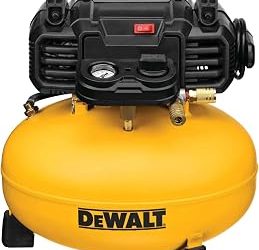
- Tank vs. tankless: An air tank, even a modest 3-liter, stores pressure so the motor cycles on and off instead of running continuously. That means steadier air, less pulsation in long passes, and a cooler motor. Tankless units are lighter and cheaper, but better suited to short detail sessions than a full furniture panel.
- Usable pressure range: Most decorative work sits between 15 and 30 PSI. Anything advertising 40 to 48 PSI gives you headroom for thicker acrylics, primers, and heavier pigment loads, which matters if you plan to spray furniture paint rather than illustration ink.
- Noise, measured honestly: Piston compressors in the 35 to 50 dB range are genuinely livable in a shared space. Listen for rubber feet and an isolated motor mount, since transmitted vibration through a table is often more irritating than the sound itself.
- Moisture trap and regulator: A water trap is non-negotiable in a basement or garage. Compressed air condenses, and a single droplet in a topcoat leaves a crater you will only see once the sheen dries. A regulator with a clear gauge lets you dial pressure per material.
- Duty cycle and cooling: Look for a cooling fan or an auto-shutoff thermal switch if you work in long stretches. Oil-free pistons are the standard here: no maintenance, no risk of oil mist contaminating a finish.
What's inside
The compressor is the part of an airbrush setup almost everyone underestimates. Designers and DIY refinishers obsess over needle sizes and paint brands, then pair a beautiful dual-action gun with a vibrating little pump that pulses air, spits moisture into the color coat, and stalls halfway through a dresser front. On small work, a weak compressor hides its flaws. On a cabinet door, a headboard, or a set of six dining chairs, it shows up as tiger stripes, orange peel, and a finish that reads homemade from across the room.
This guide looks at airbrush compressors through the lens of decorative work at home: painted furniture, stenciled millwork, refreshed hardware, textile art, and the occasional model or cake. We weigh tank capacity against pulsation, real noise levels against apartment living, and moisture control against the humidity of a garage or basement studio. Below are the units worth your bench space in 2026, along with the specs that actually change how a finish lays down.
As an Amazon Associate we earn from qualifying purchases.


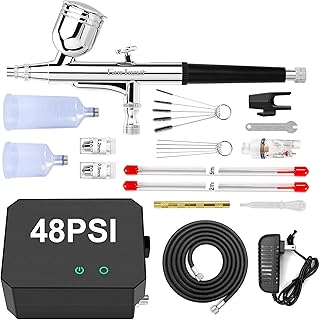
How to Choose an Air Compressor For Airbrush (2026)
- Tank vs. tankless: An air tank, even a modest 3-liter, stores pressure so the motor cycles on and off instead of running continuously. That means steadier air, less pulsation in long passes, and a cooler motor. Tankless units are lighter and cheaper, but better suited to short detail sessions than a full furniture panel.
- Usable pressure range: Most decorative work sits between 15 and 30 PSI. Anything advertising 40 to 48 PSI gives you headroom for thicker acrylics, primers, and heavier pigment loads, which matters if you plan to spray furniture paint rather than illustration ink.
- Noise, measured honestly: Piston compressors in the 35 to 50 dB range are genuinely livable in a shared space. Listen for rubber feet and an isolated motor mount, since transmitted vibration through a table is often more irritating than the sound itself.
- Moisture trap and regulator: A water trap is non-negotiable in a basement or garage. Compressed air condenses, and a single droplet in a topcoat leaves a crater you will only see once the sheen dries. A regulator with a clear gauge lets you dial pressure per material.
- Duty cycle and cooling: Look for a cooling fan or an auto-shutoff thermal switch if you work in long stretches. Oil-free pistons are the standard here: no maintenance, no risk of oil mist contaminating a finish.
The Best Air Compressors For Airbrush (2026) Reviewed
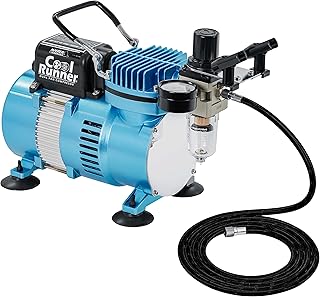
Master Airbrush TC-320 Cool Runner II
The TC-320 pairs a 1/5 HP motor with dual cooling fans, which is why it tolerates the kind of hour-long sessions a painted sideboard demands without thermal cutouts. It runs tankless, so expect a faint pulse at very low pressure, but the included regulator, water trap, and airbrush holder make it the most complete starting point for furniture-scale work.
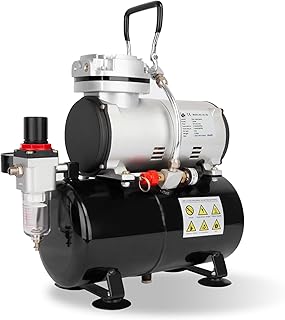
Timbertech AS186 with 3L Tank
The 3-liter tank is what separates this from entry-level pumps: air comes from storage rather than straight off the piston, giving you dead-steady flow across a wide panel. It is the pick if gradients, fades, and long unbroken passes are central to your work.
Timbertech ABPST08 Upgraded
Essentially the AS186 formula with a cooling fan added, which extends how long you can run before the motor asks for a break. Worth the small step up if your studio is warm or you batch-spray multiple pieces in a sitting.
Gaahleri Ambition Series GTS-06
A well-considered all-in-one kit with responsive air control and a compressor that stays quiet enough for evening work in a living space. Best for detail-driven projects, stencils, hardware, and small accent pieces, where precision matters more than raw volume.
Ultra-Quiet 27 PSI Portable Airbrush Kit
Seven preset pressure levels and a 35 dB rating make this the apartment-friendly choice, and the 0.3mm dual-action gun handles makeup, models, and cake work cleanly. The 27 PSI ceiling limits it with thicker furniture paints, so treat it as a fine-detail tool.
Frequently Asked Questions
What PSI should I use on painted furniture?
Start around 20 to 25 PSI for thinned acrylics and work up. Thicker chalk-style or furniture paints often need 30 PSI or more, plus a larger 0.5mm nozzle to avoid tip dry.
Do I really need a tank?
Not for small detail work. For panels, doors, and anything requiring a smooth continuous pass, a tank noticeably improves consistency and reduces motor wear.
Can I use one of these in an apartment?
Yes. Models in the 35 to 47 dB range read as background noise. Set the unit on a rubber mat or towel to stop vibration from carrying through furniture.
Is an airbrush enough for a whole piece of furniture?
For a nightstand, chair, or drawer fronts, comfortably. For a large armoire, expect slow going. An airbrush excels at detail, blending, and refinishing accents rather than full-surface coverage.
Final Thoughts
For most home studios doing real furniture work, the Master Airbrush TC-320 offers the best balance of power, cooling, and included accessories. Step to the Timbertech AS186 if tank-smooth airflow for long gradient passes is your priority, or choose the Gaahleri GTS-06 when quiet, precise detail work on accent pieces and hardware is the goal.