Key takeaways
- CFM at working pressure: Match the compressor’s delivered CFM—not just its peak rating—to your spray gun’s requirements. Extra capacity helps maintain a consistent fan pattern.
- Tank size: A larger tank provides a buffer for spraying and reduces constant cycling. Compact tanks suit small panels and touch-ups, while larger tanks are better for full-vehicle work.
- Moisture control: Compressing air creates condensation. Plan on a regulator, water separator, and, for demanding finishes, an air dryer or additional filtration near the gun.
- Noise and placement: Quiet operation is valuable in residential garages, but ventilation and distance still matter. Never operate a compressor in an enclosed, poorly ventilated space.
- Recovery and mobility: Fast recovery keeps pressure stable between passes. Wheels and a vertical footprint make larger models easier to position without sacrificing valuable floor area.
What's inside
Auto painting puts unusual demands on a compressor. A small unit may run an impact wrench or inflate tires without complaint, yet struggle to deliver the steady, clean airflow a spray gun needs. Pulsing pressure, moisture, and frequent motor cycling can turn a carefully prepared finish into an uneven one.
This guide focuses on the practical details that matter in a home garage or workshop: usable CFM at spray-gun pressure, tank capacity, noise, oil-free convenience, portability, and recovery speed. The best choice depends on your paint gun, project scale, available power, and tolerance for waiting between passes.
As an Amazon Associate we earn from qualifying purchases.


How to Choose a/an Air Compressor For Auto Painting (2026)
- CFM at working pressure: Match the compressor’s delivered CFM—not just its peak rating—to your spray gun’s requirements. Extra capacity helps maintain a consistent fan pattern.
- Tank size: A larger tank provides a buffer for spraying and reduces constant cycling. Compact tanks suit small panels and touch-ups, while larger tanks are better for full-vehicle work.
- Moisture control: Compressing air creates condensation. Plan on a regulator, water separator, and, for demanding finishes, an air dryer or additional filtration near the gun.
- Noise and placement: Quiet operation is valuable in residential garages, but ventilation and distance still matter. Never operate a compressor in an enclosed, poorly ventilated space.
- Recovery and mobility: Fast recovery keeps pressure stable between passes. Wheels and a vertical footprint make larger models easier to position without sacrificing valuable floor area.
The Best Air Compressor For Auto Painting (2026)s Reviewed
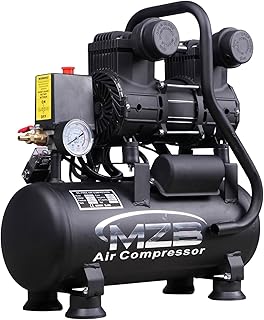
MZB 2.4-Gallon Ultra Quiet Air Compressor
The compact MZB is a sensible choice for detail work, spot repairs, trim, and occasional spray-painting projects where storage space is limited. Its oil-free design and quoted 5.65 CFM output are appealing for a home workshop, though the small tank means more frequent cycling during extended spraying.
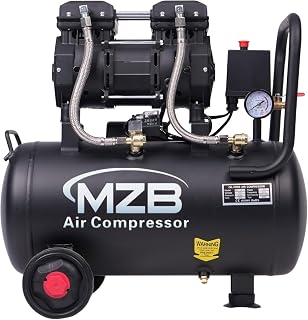
MZB 18.5-Gallon Upright Air Compressor
This upright MZB offers a more substantial air reserve than the compact model while retaining an oil-free, workshop-friendly format. Its vertical steel-tank layout is particularly attractive for garages where floor space is at a premium; confirm the actual delivered CFM against your spray gun before tackling large panels.
VEVOR 13-Gallon Air Compressor
With a 2 HP motor, 125 PSI maximum pressure, and quoted 4.6 SCFM at 90 PSI, the VEVOR sits comfortably in the versatile home-garage category. Its 66 dB quiet-operation claim, wheels, and thickened steel body make it easy to live with for auto repairs and smaller painting jobs, although serious continuous spraying may call for more reserve.
Klutch 29-Gallon Air Compressor
The Klutch is the strongest fit here for buyers prioritizing tank capacity and recovery over compactness. Its 29-gallon vertical tank, 2.5 HP motor, 175 PSI maximum pressure, and 5.1 CFM at 90 PSI provide a useful foundation for painting and pneumatic tools, while the large wheels and accessible drain improve day-to-day usability.
AAIN 6.3-Gallon Ultra Quiet Air Compressor
AAIN’s 6.3-gallon oil-free model balances portability with a more useful air cushion than a pancake-style compressor. The listed 6 CFM, 116 PSI maximum pressure, wheels, and approximately 70 dB operation suit hobby painting, carpentry, and repair work, provided the spray gun’s airflow demand remains within its real-world output.
Frequently Asked Questions
What size air compressor is best for auto painting?
For occasional touch-ups, a compact compressor can work with a low-CFM detail gun. Larger panels and more consistent finishes generally benefit from a tank around 20 gallons or more, along with enough delivered CFM to meet the gun manufacturer’s recommendation.
Can an oil-free compressor be used for automotive paint?
Yes. Oil-free compressors are convenient and eliminate oil contamination from the pump, but they do not remove water from compressed air. Use a quality regulator and moisture separator, and drain the tank regularly.
How much PSI do I need for a paint gun?
There is no universal setting. Follow the spray-gun manufacturer’s instructions and adjust pressure with the trigger pulled, because airflow changes under load. Excessive pressure can increase overspray and waste material.
Is a quiet compressor important in a home garage?
It can be. Lower noise makes setup and short projects more comfortable, especially near living spaces. Still, noise ratings do not replace proper ventilation, stable placement, and hearing protection when operating nearby for long periods.
Final Thoughts
The Klutch 29-Gallon is the most compelling choice for larger projects and stronger air reserve, while the VEVOR 13-Gallon offers a well-rounded middle ground for many home garages. For compact storage and lighter work, the MZB 2.4-Gallon is a practical starting point; whichever model you choose, pair it with proper moisture control and a spray gun whose CFM needs it can genuinely meet.