Key takeaways
- Airflow: Check the spray gun’s required CFM at its recommended PSI, then choose a compressor that comfortably exceeds that figure for steadier coverage.
- Tank capacity: A larger tank provides a useful buffer for panel work, while smaller tanks suit touch-ups but may cycle more often.
- Pressure control: Look for an adjustable regulator, reliable pressure gauge, and enough maximum PSI to support your chosen gun without operating at the limit.
- Air quality: Oil-free pumps reduce contamination concerns, but every paint setup should still use an inline moisture separator and appropriate filtration.
- Garage comfort: Noise, wheels, footprint, and recovery speed matter when the compressor shares space with furniture projects, storage, or daily parking.
What's inside
Painting a car at home demands more than a compressor that can simply inflate tires. A unit with inconsistent airflow can leave spray patterns uneven, force frequent pauses, and introduce moisture or oil into a carefully prepared finish.
This guide focuses on the practical details that matter in a home garage: usable CFM, tank capacity, noise, portability, oil-free operation, and recovery time. The goal is to help you match your spray gun and project size with a compressor that feels considered rather than oversized or underpowered.
As an Amazon Associate we earn from qualifying purchases.


How to Choose a/an Air Compressor For Car Painting (2026)
- Airflow: Check the spray gun’s required CFM at its recommended PSI, then choose a compressor that comfortably exceeds that figure for steadier coverage.
- Tank capacity: A larger tank provides a useful buffer for panel work, while smaller tanks suit touch-ups but may cycle more often.
- Pressure control: Look for an adjustable regulator, reliable pressure gauge, and enough maximum PSI to support your chosen gun without operating at the limit.
- Air quality: Oil-free pumps reduce contamination concerns, but every paint setup should still use an inline moisture separator and appropriate filtration.
- Garage comfort: Noise, wheels, footprint, and recovery speed matter when the compressor shares space with furniture projects, storage, or daily parking.
The Best Air Compressor For Car Painting (2026)s Reviewed
Klutch 29-Gallon Air Compressor
The Klutch 29-Gallon model is the strongest all-around choice here for larger panels and repeated spray work. Its vertical, oil-free design saves floor space while the substantial tank and 5.1 CFM at 90 PSI offer a more confident foundation for compatible paint guns. The large wheels and accessible drain also make it practical for a dedicated home workshop.
California Air Tools CAT-4610AC
For a quieter, more design-conscious garage, the California Air Tools CAT-4610AC is an appealing option. Its aluminum twin-tank layout is compact and portable, with an oil-free pump that suits finish-focused projects and general workshop tasks. Its smaller capacity is best for trim, spot repairs, and lighter-duty automotive painting rather than continuous full-vehicle spraying.
VEVOR 13-Gallon Air Compressor
The VEVOR 13-Gallon compressor balances a useful tank size with a relatively restrained 66dB operating level. Its 4.6 CFM at 90 PSI can support many detailing, repair, and spray-painting applications, provided the gun’s demand stays within that range. Wheels and a steel body add practicality for garages where tools need to move between projects.
MZB 6.4-Gallon Ultra Quiet Air Compressor
The MZB 6.4-Gallon compressor is a sensible middle-ground pick for occasional painting and general DIY. Its oil-free construction, wheels, and 70dB noise rating make it approachable for a multipurpose workspace, though the modest tank means more frequent cycling during broad coverage. It is better suited to panels, accents, and repair work than uninterrupted full-body spraying.
Baotree 8-Gallon Portable Air Compressor
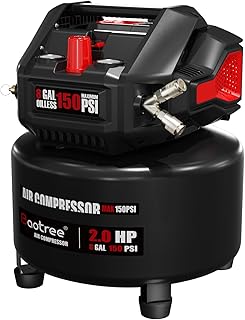
Baotree’s 8-Gallon portable compressor offers a compact format for car repair, woodwork, nailing, and smaller spray projects. With a 150 PSI maximum and 2.8 CFM at 90 PSI, it is most appropriate for touch-ups or low-demand guns rather than high-volume automotive applications. Choose it when portability and a smaller footprint outweigh long-run airflow.
Frequently Asked Questions
What size air compressor is best for car painting?
For small repairs and individual panels, a compressor with a tank around 6 to 13 gallons may be adequate if its delivered CFM matches the spray gun. Larger projects are more comfortable with a 20- to 30-gallon tank and stronger sustained airflow.
How much CFM does a spray gun need?
Requirements vary by gun type, nozzle, and operating pressure. Always use the manufacturer’s stated CFM at the recommended PSI, and choose a compressor with additional capacity so it is not running continuously at its maximum.
Is an oil-free compressor suitable for automotive paint?
Yes, an oil-free model can be a convenient choice for home painting because it reduces the risk of oil contamination. Moisture can still enter the air stream, so install a quality separator, drain the tank regularly, and use a final filter near the gun.
Can a portable tire inflator paint a car?
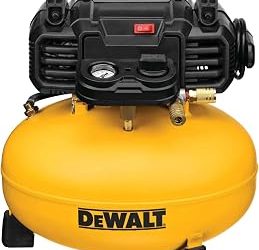
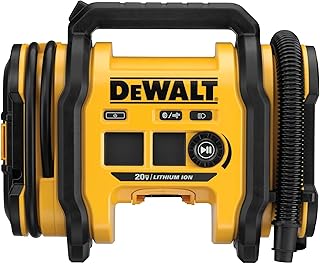
A compact inflator such as the DEWALT Tire Inflator is excellent for tires and small pneumatic tasks, but it is not a realistic choice for automotive spray painting. Spray guns need sustained airflow, while tire inflators are designed for intermittent, lower-volume use.
Final Thoughts
The Klutch 29-Gallon Air Compressor is the best fit for serious home-garage painting, while the California Air Tools CAT-4610AC stands out for quieter, lighter-duty work. For a balanced compromise between capacity, noise, and mobility, the VEVOR 13-Gallon model is a strong practical pick.