Key takeaways
- Duty cycle: This is the percentage of a cycle the motor can safely run. Most consumer single-stage units sit near 50%, meaning ten minutes on, ten minutes cooling. Anything advertised at 75% or higher is built with better thermal headroom, and a true 100% rating is the only spec that genuinely means “run it until you’re done.”
- CFM at 90 PSI: Ignore peak numbers and horsepower. Match delivered CFM to your tool’s demand plus roughly 30% margin. Brad nailers need very little, framing nailers more, and HVLP spray guns or sanders can pull 6 CFM or higher, which is beyond most portable units.
- Tank size and recovery: A larger tank buys you working time between cycles; fast recovery shortens the wait. For extended sessions a vertical 20 to 30 gallon tank is the sweet spot, giving you shop capacity without the horizontal footprint eating into your floor plan.
- Noise level: Standard direct-drive compressors run 85 to 90 dBA, loud enough to shut down conversation and irritate anyone in the house. Low-RPM units in the 60 to 70 dBA range are transformative if you work in a garage attached to living space or a converted studio.
- Oil-free versus lubricated: Oil-free pumps skip maintenance and never contaminate air lines, which matters enormously for finishing work. Oil-lubricated pumps run cooler and last longer under sustained load, but require regular oil changes and level checks.
What's inside
Anyone who has spent a weekend fitting crown molding, upholstering a bench, or spraying a coat of lacquer on a refinished dresser knows the sound of a compressor that can’t keep up. The gun starts to stutter, the finish goes uneven, and you stand around waiting for the tank to climb back to pressure. The problem is rarely the tool at the end of the hose. It’s a compressor sized for occasional tire top-offs being asked to run like a shop machine, cycling on and off until the motor gets hot and the pressure switch starts protesting.
Continuous use is really a question of duty cycle, recovery speed, and heat management, and most listings bury those numbers behind horsepower claims. This guide sorts through the models that actually hold up when the trigger stays down: vertical tanks with fast recovery for trim and finish work, ultra-quiet units you can run inside a finished space, and cordless inflators rated for back-to-back cycles. Below are the picks, then a breakdown of the specs worth reading before you buy.
As an Amazon Associate we earn from qualifying purchases.



How to Choose an Air Compressor For Continuous Use (2026)
- Duty cycle: This is the percentage of a cycle the motor can safely run. Most consumer single-stage units sit near 50%, meaning ten minutes on, ten minutes cooling. Anything advertised at 75% or higher is built with better thermal headroom, and a true 100% rating is the only spec that genuinely means “run it until you’re done.”
- CFM at 90 PSI: Ignore peak numbers and horsepower. Match delivered CFM to your tool’s demand plus roughly 30% margin. Brad nailers need very little, framing nailers more, and HVLP spray guns or sanders can pull 6 CFM or higher, which is beyond most portable units.
- Tank size and recovery: A larger tank buys you working time between cycles; fast recovery shortens the wait. For extended sessions a vertical 20 to 30 gallon tank is the sweet spot, giving you shop capacity without the horizontal footprint eating into your floor plan.
- Noise level: Standard direct-drive compressors run 85 to 90 dBA, loud enough to shut down conversation and irritate anyone in the house. Low-RPM units in the 60 to 70 dBA range are transformative if you work in a garage attached to living space or a converted studio.
- Oil-free versus lubricated: Oil-free pumps skip maintenance and never contaminate air lines, which matters enormously for finishing work. Oil-lubricated pumps run cooler and last longer under sustained load, but require regular oil changes and level checks.
The Best Air Compressor For Continuous Use (2026)s Reviewed
Klutch 29-Gallon Air Compressor
At 5.1 CFM at 90 PSI with a 175 PSI maximum, this is the one on the list with real capacity for sustained trim carpentry, upholstery stapling, and light spray work. The oil-free vertical design keeps the footprint tight against a wall, and the accessible tank drain means you’ll actually bleed the condensate instead of putting it off for a year.
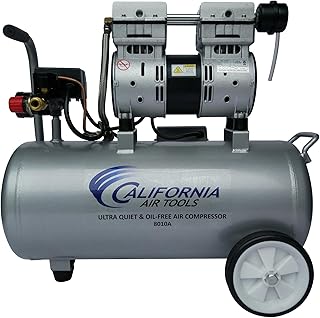
California Air Tools 8010A
Sixty dBA is roughly the volume of a dishwasher, which makes this the obvious choice if your workspace shares a wall with a bedroom or a client-facing room. The low-RPM motor also runs cooler than a comparable direct-drive unit, so it handles longer stretches gracefully, though 8 gallons and 1.0 HP means you should keep it to brad nailers, staplers, and inflation rather than continuous-demand tools.
Metabo HPT EC914S Pancake Compressor
Six gallons at 200 PSI with 4 CFM flow makes this the best job-site portable here, capable of feeding multiple nailers at once without collapsing. It’s the one to grab when the work moves around the house rather than staying at a bench.
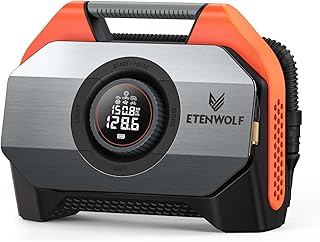
ETENWOLF VORTEX S6 Tire Inflator
The 100% duty cycle rating and dual-cylinder pump put this in a different category from typical cordless inflators, which overheat after one truck tire. With a 19200mAh pack it will cycle through a full set plus inflatables without a rest, and the LED backlight earns its keep in a dim garage.
OlarHike 12000mAh Tire Inflator
Dual power is the smart feature here: run it cordless for convenience or plug into 12V when the battery is down, which removes the usual anxiety about a dead inflator when you need it. The digital gauge holds pressure accurately enough for RV and truck tires at up to 150 PSI.
Frequently Asked Questions
Can any portable compressor really run continuously?
Very few. Most single-stage consumer compressors are rated near 50% duty cycle and need cooling time between cycles. For genuinely uninterrupted operation you want either a large tank with fast recovery so the motor rarely runs, or a unit specifically rated at 100%.
Do I need an oil-lubricated compressor for long sessions?
Not necessarily. Oil-lubricated pumps handle heat better over years of heavy use, but modern oil-free units with adequate tank capacity manage extended home projects fine and won’t risk oil misting into your finish.
Will an 8-gallon tank run a spray gun?
Generally no. Conventional HVLP guns often demand 6 CFM or more continuously, which exceeds what a 1 HP compressor delivers. Small touch-up and airbrush guns are workable; full furniture panels are not.
How much does noise level actually matter?
More than most buyers expect. The difference between 60 and 90 dBA determines whether you can work a full afternoon without hearing protection and without disrupting the rest of the house. If your shop is inside a living space, treat it as a primary spec.
Final Thoughts
For sustained bench work in a home shop, the Klutch 29-Gallon is the most capable pick here, with the CFM and recovery speed to keep finish tools running. If quiet operation matters more than raw output, the California Air Tools 8010A is hard to beat at 60 dBA, and the Metabo HPT EC914S remains the sharpest portable for nailing work that moves room to room.