Key takeaways
- Match CFM to your gun, not your tank: Check your spray gun’s requirement at 90 PSI and add roughly 30 percent headroom. An HVLP gun asking for 2.0 CFM will stall a compressor rated at exactly 2.0.
- Tank size buys you continuous passes: Two gallons handles chair legs, drawer fronts, and trim. Five to eight gallons lets you spray a tabletop or cabinet door edge-to-edge without waiting for the motor to catch up.
- Look for oil-free if you’re spraying finish: Oil-lubricated pumps can introduce contamination into the air line, which shows up as fisheyes in your topcoat. Oil-free removes that variable and skips maintenance.
- Decibels matter more than you think: Anything at or under 70 dB is conversation-level. Older direct-drive units run 85 dB and up, which rules out evening work in a shared space.
- Plan for moisture and regulation: Budget for an inline water separator and a decent regulator at the gun. Compressed air carries humidity, and humidity ruins gloss.
What's inside
Refinishing a mid-century sideboard or spraying a fresh coat of lacquer on a set of dining chairs is where a lot of home projects quietly fall apart. Not because of the paint, and not because of the gun, but because the compressor behind it can’t hold steady pressure. A tank that empties faster than it refills gives you spitting, orange peel texture, and lap marks down the middle of a panel you spent a weekend sanding. And if your workshop happens to be a garage attached to the house, the noise problem is just as real as the airflow one.
This guide looks at compressors through the lens of finish work on furniture and cabinetry rather than heavy shop use. We’ve weighted three things: sustained CFM at 90 PSI, tank capacity relative to how long you actually spray in one pass, and decibel level, because oil-free quiet models have gotten genuinely good. Below you’ll find picks that range from a compact unit for touch-ups and small pieces to a full kit that can carry a complete cabinet refinish.
As an Amazon Associate we earn from qualifying purchases.


How to Choose a/an Air Compressor For Paint Gun (2026)
- Match CFM to your gun, not your tank: Check your spray gun’s requirement at 90 PSI and add roughly 30 percent headroom. An HVLP gun asking for 2.0 CFM will stall a compressor rated at exactly 2.0.
- Tank size buys you continuous passes: Two gallons handles chair legs, drawer fronts, and trim. Five to eight gallons lets you spray a tabletop or cabinet door edge-to-edge without waiting for the motor to catch up.
- Look for oil-free if you’re spraying finish: Oil-lubricated pumps can introduce contamination into the air line, which shows up as fisheyes in your topcoat. Oil-free removes that variable and skips maintenance.
- Decibels matter more than you think: Anything at or under 70 dB is conversation-level. Older direct-drive units run 85 dB and up, which rules out evening work in a shared space.
- Plan for moisture and regulation: Budget for an inline water separator and a decent regulator at the gun. Compressed air carries humidity, and humidity ruins gloss.
The Best Air Compressor For Paint Gun (2026)s Reviewed
California Air Tools 8010 PK with LVLP Spray Kit
The most complete answer here: an 8-gallon steel tank, 1.0 HP oil-free pump, and a matched LVLP gun that’s already tuned to the compressor’s output, so you skip the guesswork of pairing components. At 60 dBA with wheels for moving it around a garage, it’s the pick for anyone refinishing full furniture pieces rather than doing touch-ups.
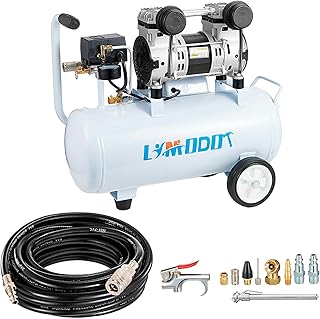
Quiet Oil-Free 5 Gallon Compressor with Hose Kit
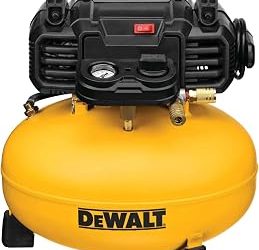
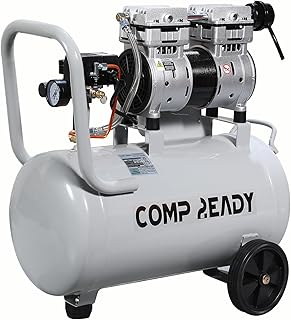
At 2.8 CFM @ 90 PSI, this is the sweet spot for most gravity-feed and HVLP guns used on furniture, with enough tank reserve to finish a door panel in one continuous pass. The included hose kit and 68 dB rating make it an easy first compressor if you’re also planning to run brad nailers for trim work.
BairDplus 3.2 Gallon Ultra Quiet Air Compressor
A 1.5 HP twin steel tank setup that recovers quickly, which is what actually keeps pressure stable mid-spray. It’s a sensible middle ground: more capable than the 2-gallon compacts, still light enough to carry out to a driveway when you want ventilation.
2 Gallon Portable Ultra Quiet Oil-Free Compressor (0.75 HP)
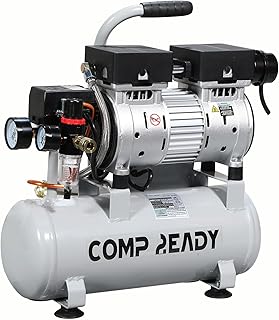
Rated 1.7 CFM @ 90 PSI at 60 dB, this is a detail tool: chair spindles, drawer pulls, small case goods, and repairs where you’re spraying in short bursts. Pair it with a low-consumption mini or detail gun and it performs well above its footprint.
2 Gallon Portable Compressor for Tire Inflation and Spray Painting
Functionally the same platform as the pick above and worth checking on availability and price, since the two trade positions often. Treat it as a small-project and tire-inflation dual-purpose unit rather than a primary finishing compressor.
Frequently Asked Questions
How much CFM do I actually need for a paint gun?
Most HVLP furniture guns want 2 to 4 CFM at 90 PSI, while detail and mini guns can run on under 2. Check the gun’s spec sheet first, then choose a compressor that exceeds it, because ratings are measured under ideal conditions.
Can I spray with a 2-gallon compressor?
Yes, for small pieces and short passes. On large flat surfaces the tank will drain before you finish, and the pressure drop is visible in the finish.
Do I need a moisture trap?
Effectively, yes. Water in the line is the most common cause of blemished topcoats, and an inline separator costs far less than resanding a tabletop.
Is oil-free less durable?
Modern oil-free pumps have shorter service lives than industrial oil-lubricated ones, but for intermittent home and hobby use the tradeoff strongly favors oil-free: no maintenance and no contamination risk.
Final Thoughts
For serious furniture refinishing, the California Air Tools 8010 PK is the clearest value because the tank, pump, and LVLP gun are already matched. If you want capable output without the bulk, the 5-gallon quiet oil-free unit with hose kit covers nearly every home project, and the 2-gallon 60 dB compact remains the right tool for detail work and small repairs.