Key takeaways
- Sustained CFM at 90 PSI: This is the only spec that predicts finish quality. Match or exceed your gun’s requirement by roughly 1.5x. Full-panel HVLP work realistically wants 5 CFM and up; anything under 4 CFM belongs to touch-up guns, airbrushes, and blending.
- Tank volume as a buffer, not a promise: A large tank buys you seconds of steady pressure while the pump catches up. Vertical 13 to 30-gallon tanks let you finish a panel without the motor kicking in mid-stroke; small twin tanks recover fast but cycle constantly.
- Noise, measured honestly: Garages share walls with living rooms. Units in the 60 to 70 dB range let you spray on a Saturday morning without negotiating. Traditional direct-drive pumps run closer to 90 dB and will end the conversation for you.
- Oil-free pumps and clean air: Oil-free heads remove one contamination pathway before it starts, which matters enormously for paint. Regardless of pump type, budget for a water separator and inline filter — humidity is the more common culprit behind fisheyes.
- Footprint and mobility: Vertical tanks reclaim floor space in a garage that’s already doing three jobs. Large-diameter wheels and a genuine handle mean the unit rolls out for a project and tucks back against the wall afterward.
What's inside
Spraying a car in a home garage sits at an awkward intersection of ambition and airflow. The gun on your bench might only ask for 4 or 5 CFM on paper, but a clearcoat pass doesn’t care about paper — it wants that volume delivered continuously, at a steady pressure, for as long as it takes to lay a wet edge across a fender. Undersize the compressor and the motor starts cycling mid-pass, pressure sags, atomization goes coarse, and you get the pebbled texture that tells everyone this was a driveway job. That’s the real problem: buyers shop by horsepower and tank badges when the number that decides the finish is sustained CFM at 90 PSI.
This guide sorts through six popular home-shop compressors and reads them the way a painter would — recovery time, duty cycle, noise in a space attached to a house, and whether the unit can actually feed a gun or is better suited to touch-ups and detail work. You’ll find a quick buying framework, honest reviews of the top five, and answers to the questions that come up once the primer’s mixed and the clock is running.
As an Amazon Associate we earn from qualifying purchases.



How to Choose an Air Compressor For Painting Cars At Home (2026)
- Sustained CFM at 90 PSI: This is the only spec that predicts finish quality. Match or exceed your gun’s requirement by roughly 1.5x. Full-panel HVLP work realistically wants 5 CFM and up; anything under 4 CFM belongs to touch-up guns, airbrushes, and blending.
- Tank volume as a buffer, not a promise: A large tank buys you seconds of steady pressure while the pump catches up. Vertical 13 to 30-gallon tanks let you finish a panel without the motor kicking in mid-stroke; small twin tanks recover fast but cycle constantly.
- Noise, measured honestly: Garages share walls with living rooms. Units in the 60 to 70 dB range let you spray on a Saturday morning without negotiating. Traditional direct-drive pumps run closer to 90 dB and will end the conversation for you.
- Oil-free pumps and clean air: Oil-free heads remove one contamination pathway before it starts, which matters enormously for paint. Regardless of pump type, budget for a water separator and inline filter — humidity is the more common culprit behind fisheyes.
- Footprint and mobility: Vertical tanks reclaim floor space in a garage that’s already doing three jobs. Large-diameter wheels and a genuine handle mean the unit rolls out for a project and tucks back against the wall afterward.
The Best Air Compressor For Painting Cars At Home (2026)s Reviewed
Klutch 29-Gallon Vertical Compressor
With 5.1 CFM at 90 PSI and a 175 PSI ceiling, this is the one unit here that comfortably feeds a full-size HVLP gun through a long panel without pressure sag. The oil-free vertical design keeps the footprint tight, and the accessible tank drain means the weekly moisture purge actually gets done rather than forgotten.
VEVOR 13-Gallon Quiet Compressor
A genuinely well-balanced choice for home paint work: 4.6 SCFM at 90 PSI is enough for most mid-size guns, and the claimed 66 dB operation makes it liveable in an attached garage. The thickened steel body and wheels give it a solidity the spec sheet doesn’t convey.
California Air Tools CAT-4610AC
The aluminum twin-tank format is built around quiet, and this unit delivers — it’s the model to pick if noise is your binding constraint. At 4.6 gallons it recovers rather than reserves, so treat it as a touch-up, blending, and small-parts sprayer rather than a full-body machine.
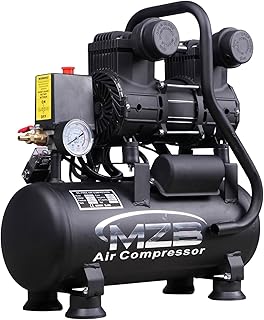
MZB 2.4-Gallon Ultra Quiet Compressor
An impressive 5.65 CFM from a 2.4-gallon frame at 70 dB, which makes it a strong pick for detail panels, bumpers, and trim pieces. The 115 PSI maximum is the limiting factor, so verify your gun’s inlet requirement before committing to it for anything larger.
15-Gallon Vertical Twin-Cylinder Compressor
The twin-cylinder pump moves 4.5 CFM at 90 PSI while staying near 66 dB, an unusually civil combination in a vertical tank. It’s the sensible middle path for someone painting a car once or twice a year alongside regular nail gun and inflation duty.
Frequently Asked Questions
How much CFM do I actually need to paint a car?
Check your spray gun’s rating and add roughly 50 percent headroom. Most home-shop HVLP guns list 4 to 7 CFM at 25 to 30 PSI inlet pressure, which points you toward a compressor delivering 5 CFM or more at 90 PSI for continuous panel work.
Can I paint a whole car with a small tank?
You can, but you’ll be painting in fragments and waiting for recovery, which is how visible lap lines and texture variation creep in. Small tanks excel at spot repairs, wheels, and interior parts.
Do I need a water separator?
Yes, without exception. Compressing air condenses moisture, and moisture in the line produces fisheyes and blush. A desiccant dryer plus an inline filter at the gun is the standard home-shop setup.
Is oil-free better for automotive paint?
For paint specifically, yes — it eliminates oil carryover at the source and requires less maintenance. Well-filtered oil-lubricated pumps also work, and they generally run quieter and longer, but they demand more discipline.
Final Thoughts
If you’re painting complete panels and want the finish to look intentional, the Klutch 29-Gallon is the honest answer — its 5.1 CFM output is the difference between spraying and fighting your equipment. The VEVOR 13-Gallon is the smarter buy for most home garages, balancing real spraying capability against noise and footprint, while the California Air Tools CAT-4610AC earns its place for anyone whose shop shares a wall with a bedroom and whose work is mostly touch-ups and detail passes.