Key takeaways
- Pressure headroom, not just max PSI: A compressor rated to 150 PSI will fill a 100 PSI tire comfortably. One rated to 120 PSI will struggle near the top of its range and take far longer. Aim for at least 40 PSI of headroom above your placard number.
- Duty cycle: Topping off six tires can take 20 minutes or more of continuous running. Look for a stated 100 percent duty cycle at your working pressure, or a documented run time with a cool-down interval you can live with.
- Power delivery: Cigarette-lighter plugs cap out near 15 amps, which limits performance. High-output compressors need direct battery clamps or a hardwired circuit. Confirm your rig has accessible battery terminals before buying a clamp-only kit.
- Hose and cord length: Measure from your battery bay to the rearmost inside dual. Anything under 20 feet of combined reach will have you moving the compressor mid-job. Kits sold specifically for motorhomes usually solve this with extension hoses.
- Chuck and gauge quality: Truck and RV valve stems often sit at awkward angles behind wheel covers. A dual-foot or 90-degree brass chuck saves real aggravation, and a digital gauge with auto-shutoff removes guesswork on a six-tire circuit.
What's inside
Anyone who has parked a motorhome at a rest stop at dusk, penlight in teeth, squinting at a valve stem tucked behind a dually fender, understands the specific frustration of RV tire maintenance. Class A and Class C rigs run cold pressures in the 80 to 110 PSI range, sometimes higher on the steer axle, and the majority of inflators sold as “heavy duty” quietly give up somewhere around 45 PSI. They will hum, warm up, and stall. Meanwhile the pressure differential across your axles keeps creeping, sidewalls flex more than they should, and fuel economy slides. On a vehicle carrying this much weight, that is not a minor annoyance.
This guide looks at portable compressors that actually reach and hold RV pressures, drawn from the models RV owners keep returning to. We weigh duty cycle, real airflow rather than marketing CFM, hose reach on a long wheelbase, and whether the thing survives a second season in a wet basement compartment. Below you will find quick picks, a buying framework, and short reviews of the five strongest options for 2026, spanning direct-to-battery workhorses and cordless units for lighter duty.
As an Amazon Associate we earn from qualifying purchases.




How to Choose a/an Air Compressor For Rv Tires (2026)
- Pressure headroom, not just max PSI: A compressor rated to 150 PSI will fill a 100 PSI tire comfortably. One rated to 120 PSI will struggle near the top of its range and take far longer. Aim for at least 40 PSI of headroom above your placard number.
- Duty cycle: Topping off six tires can take 20 minutes or more of continuous running. Look for a stated 100 percent duty cycle at your working pressure, or a documented run time with a cool-down interval you can live with.
- Power delivery: Cigarette-lighter plugs cap out near 15 amps, which limits performance. High-output compressors need direct battery clamps or a hardwired circuit. Confirm your rig has accessible battery terminals before buying a clamp-only kit.
- Hose and cord length: Measure from your battery bay to the rearmost inside dual. Anything under 20 feet of combined reach will have you moving the compressor mid-job. Kits sold specifically for motorhomes usually solve this with extension hoses.
- Chuck and gauge quality: Truck and RV valve stems often sit at awkward angles behind wheel covers. A dual-foot or 90-degree brass chuck saves real aggravation, and a digital gauge with auto-shutoff removes guesswork on a six-tire circuit.
The Best Air Compressor For Rv Tires (2026)s Reviewed
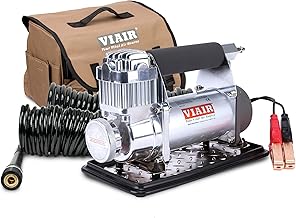
VIAIR 400P RV Portable Compressor Kit
Built specifically around Class C motorhome pressures, this is the reference point for RV inflation: a 150 PSI maximum, automatic shutoff, and a hose set long enough to reach inner duals without repositioning. It costs more than most, and the sealed-crankcase build and long service life are exactly where that money goes.
ALL-TOP Dual Cylinder 12V Air Compressor Kit
At 12.35 cubic feet per minute, this twin-cylinder unit moves air fast enough to make airing up after a dirt-road detour genuinely quick rather than a chore. The heavy battery leads and 150 PSI ceiling suit larger rigs, and the included storage bag keeps the hose and fittings from wandering off in a bay.
VIAIR 88P Portable Compressor Kit
The 88P is the compact, well-engineered choice for travel trailers, vans, and tow vehicles running tires up to 33 inches. It tops out at 120 PSI, so verify your placard pressure first, but for anything at 80 PSI or below it is dependable, quiet by class standards, and easy to stow.
ETENWOLF VORTEX S6 Cordless Inflator
A 19200mAh pack, dual cylinders, and a true 100 percent duty cycle make this the most capable cordless option here, with no cables to route and an LED backlight for roadside work after dark. Treat it as a top-off and emergency tool rather than a full six-tire aired-from-flat solution.
GSPSCN 12V Heavy Duty Dual Cylinder Inflator
All-metal construction and twin cylinders deliver quick fills at 150 PSI for noticeably less than the premium kits, which makes it a sensible backup to keep in a tow vehicle. Fit and finish are a step below VIAIR, but the performance-per-dollar is hard to argue with.
Frequently Asked Questions
Can a standard car tire inflator handle RV tires?
Usually not. Most car inflators peak near 35 to 50 PSI of usable output and overheat well before filling a 100 PSI tire. You need a compressor rated to 150 PSI with a substantial duty cycle.
Do I need to connect directly to the battery?
For high-output models, yes. A 12V socket cannot supply the current these compressors draw, and forcing it risks blown fuses or melted plugs. Alligator clamps or a dedicated hardwired circuit are the correct approach.
How often should I check RV tire pressure?
Before every travel day, measured cold, before the tires have rolled. RV tires lose pressure during storage and respond sharply to temperature swings, so a stored rig can drop noticeably between trips.
Will these inflate air suspension or air bags?
Many will, since 150 PSI models cover typical air bag ranges, but verify your specific system’s requirement and use the correct fitting. Dedicated onboard air is the better long-term answer for frequent adjustment.
Final Thoughts
For most motorhome owners the VIAIR 400P RV kit is the buy-once option, purpose-built for the pressures and reach a Class C demands. If you want more airflow for faster fills across six tires, the ALL-TOP dual cylinder kit delivers it for less, and the ETENWOLF VORTEX S6 earns a spot in the bay as a cordless companion for quick top-offs and roadside emergencies.