Key takeaways
- Match CFM to your gun, not the box: Check your spray gun’s requirement at its working PSI and add roughly 30 percent headroom. An LVLP gun may live happily on 2 to 4 CFM, while a conventional HVLP gun can ask for 10 or more.
- Tank size buys you continuous passes: Anything from 6 to 8 gallons lets you cover a tabletop or cabinet door without the motor cycling mid-stroke. Smaller 1 to 2.5 gallon tanks suit trim, chair frames, and touch-up work.
- Prioritize noise if you finish indoors: A 60 dBA unit sits near conversation level. That difference is the reason a compressor stays in your workspace instead of getting exiled to the driveway.
- Oil-free means less babysitting: No oil changes, no risk of oil mist reaching a wet finish, and reliable cold starts. Oil-lubricated pumps still win on duty cycle and longevity for heavy daily use.
- Plan for moisture and portability: Budget for an inline filter and water separator regardless of model, and weigh the machine honestly if it needs to move between a shop and a job site.
What's inside
Spraying a finish is where a furniture project either earns its keep or shows every shortcut. The gun is rarely the problem. What ruins a topcoat is a compressor that can’t hold pressure through a full pass, so the fan pattern thins out mid-panel and you’re left with stripes, dry spray, or orange peel on a piece you spent a weekend building. The other half of the problem is noise. Most of us are finishing in a garage, a basement, or a shared workshop, and a machine that screams at 90 decibels turns a calm afternoon of glazing a dresser into something you schedule around the neighbors.
This guide looks at compressors through a finishing lens rather than a construction one: sustained CFM at the pressure your gun actually wants, tank size versus how long you can spray before the motor kicks back on, and how livable the thing is in a space you also happen to like being in. Below are six machines worth your attention in 2026, from ultra-quiet oil-free units built around HVLP and LVLP work to twin-stack workhorses that double as nailer power for the build phase.
As an Amazon Associate we earn from qualifying purchases.



How to Choose an Air Compressor For Spray Gun (2026)
- Match CFM to your gun, not the box: Check your spray gun’s requirement at its working PSI and add roughly 30 percent headroom. An LVLP gun may live happily on 2 to 4 CFM, while a conventional HVLP gun can ask for 10 or more.
- Tank size buys you continuous passes: Anything from 6 to 8 gallons lets you cover a tabletop or cabinet door without the motor cycling mid-stroke. Smaller 1 to 2.5 gallon tanks suit trim, chair frames, and touch-up work.
- Prioritize noise if you finish indoors: A 60 dBA unit sits near conversation level. That difference is the reason a compressor stays in your workspace instead of getting exiled to the driveway.
- Oil-free means less babysitting: No oil changes, no risk of oil mist reaching a wet finish, and reliable cold starts. Oil-lubricated pumps still win on duty cycle and longevity for heavy daily use.
- Plan for moisture and portability: Budget for an inline filter and water separator regardless of model, and weigh the machine honestly if it needs to move between a shop and a job site.
The Best Air Compressors For Spray Guns (2026), Reviewed
California Air Tools 8010 PK Ultra Quiet Kit
The most complete answer here for furniture work: an 8-gallon oil-free tank running at 60 dBA, bundled with an LVLP gun so the pairing is already sorted. The tank capacity is what makes it special, giving you enough stored air to lay down a full cabinet face or dresser top in continuous passes.
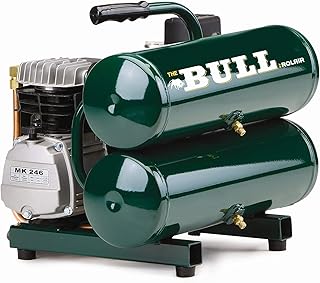
Rolair FC2002 Twin Stack
A 2 HP twin stack with genuine contractor-grade internals and overload protection with manual reset, which is the sort of detail that matters when a machine works hard for years. It’s louder than the quiet units, but the sustained output and durability make it the pick if the same compressor also has to drive nailers through a build.
Rolair JC10 Plus
Rolair’s 2.5-gallon electric compressor is the refined small-shop option, quiet enough to run beside you and built with a recovery rate that punches above its footprint. Best suited to detail spraying, chair frames, and finish carpentry rather than large flat panels.
Metabo HPT EC914S Pancake
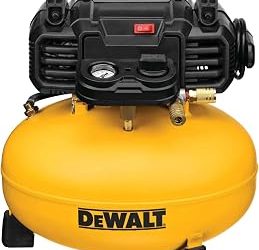
Six gallons, 200 PSI, and roughly 4 CFM flow makes this a genuinely versatile pancake that can run multiple nailers at once and still feed an LVLP gun comfortably. The higher max pressure means more usable stored air in the tank than the gallon count suggests.
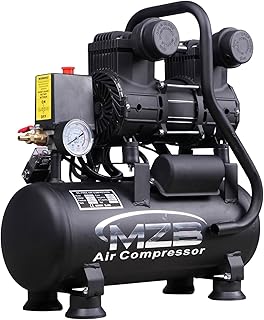
MZB 2.4 Gallon Ultra Quiet
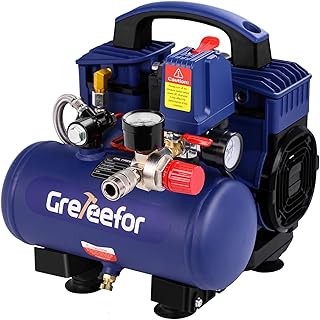
Impressive numbers for the size, with 5.65 CFM from twin steel tanks at a claimed 70 dB, aimed squarely at spray painting and refinishing. A strong value pick for hobbyists who want real spraying capability without dedicating half the garage to it.
Frequently Asked Questions
What CFM do I need to spray furniture?
Most LVLP and modern HVLP guns used for furniture want 2 to 6 CFM at 30 to 40 PSI. Confirm your gun’s spec sheet and choose a compressor that exceeds it, since ratings are usually measured under ideal conditions.
Is a small tank enough for spraying?
It can be for spindles, frames, and touch-ups. For large flat surfaces, a 6 to 8 gallon tank prevents the pressure drop that causes visible banding halfway through a pass.
Do I need an air dryer or filter?
Yes. Compressed air carries moisture, and a single water droplet in a lacquer or waterborne finish becomes a defect you’ll have to sand out. An inline filter and separator is inexpensive insurance.
Are oil-free compressors good for painting?
They’re arguably better for it, since there’s no chance of oil carryover contaminating your finish. The tradeoff is a shorter service life under heavy continuous use compared with oil-lubricated pumps.
Final Thoughts
For most people finishing furniture at home, the California Air Tools 8010 PK is the straightforward choice: quiet, enough tank to spray properly, and a gun included. Step up to the Rolair FC2002 if the compressor also has to earn its living driving nailers, and consider the Metabo HPT EC914S as the balanced middle ground that handles both jobs without much compromise.