Key takeaways
- CFM at 90 PSI: This single number decides whether your gun works. Most HVLP guns want 4 to 6 CFM sustained; LVLP and detail guns can live on 2 to 3. Match the compressor’s rated delivery to your gun’s requirement with headroom, not to its maximum pressure.
- Tank capacity versus duty cycle: A larger tank buys you longer uninterrupted passes, which is exactly where lap marks come from. Small tanks are fine for trim and hardware; cabinet fronts and full furniture pieces reward 8 gallons or more.
- Noise floor: Anything in the 60 to 70 dB range is conversational and livable indoors. Traditional direct-drive units run 85 dB and up, which means hearing protection, closed doors, and an unhappy household.
- Oil-free versus lubricated: Oil-free pumps eliminate the risk of oil carryover contaminating a finish and need no maintenance schedule. Lubricated pumps run cooler and last longer under heavy use, but demand an inline filter and discipline.
- Moisture management and mobility: Every compressor makes water. Budget for a filter or separator at the outlet, and look for a drain valve you can actually reach. Wheels and a balanced handle matter more than the spec sheet suggests once you are moving between rooms.
What's inside
Anyone who has refinished a mid-century sideboard or sprayed a fresh coat of eggshell across a set of cabinet doors knows the finish rarely fails at the gun. It fails at the air. A compressor that cannot hold steady pressure gives you spitting, orange peel, and dry edges, and no amount of technique will hide it. The frustration compounds indoors, where a shop-grade motor screaming at 90 decibels in a converted garage or spare room turns a satisfying weekend project into something you avoid.
This guide looks at air compressors through the lens of finish work in and around the home: quiet enough to run near living space, consistent enough to feed an HVLP or LVLP gun through a full door, and compact enough to store without surrendering half a garage bay. Below are six machines worth considering in 2026, followed by the specs that actually matter, honest notes on each, and answers to the questions that come up once the primer is mixed and the drop cloths are down.
As an Amazon Associate we earn from qualifying purchases.


How to Choose a/an Air Compressor For Spray Painting (2026)
- CFM at 90 PSI: This single number decides whether your gun works. Most HVLP guns want 4 to 6 CFM sustained; LVLP and detail guns can live on 2 to 3. Match the compressor’s rated delivery to your gun’s requirement with headroom, not to its maximum pressure.
- Tank capacity versus duty cycle: A larger tank buys you longer uninterrupted passes, which is exactly where lap marks come from. Small tanks are fine for trim and hardware; cabinet fronts and full furniture pieces reward 8 gallons or more.
- Noise floor: Anything in the 60 to 70 dB range is conversational and livable indoors. Traditional direct-drive units run 85 dB and up, which means hearing protection, closed doors, and an unhappy household.
- Oil-free versus lubricated: Oil-free pumps eliminate the risk of oil carryover contaminating a finish and need no maintenance schedule. Lubricated pumps run cooler and last longer under heavy use, but demand an inline filter and discipline.
- Moisture management and mobility: Every compressor makes water. Budget for a filter or separator at the outlet, and look for a drain valve you can actually reach. Wheels and a balanced handle matter more than the spec sheet suggests once you are moving between rooms.
The Best Air Compressor For Spray Painting (2026)s Reviewed
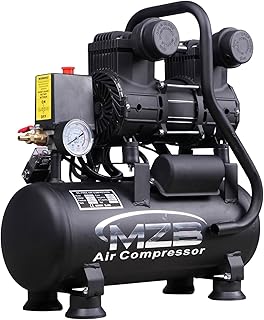
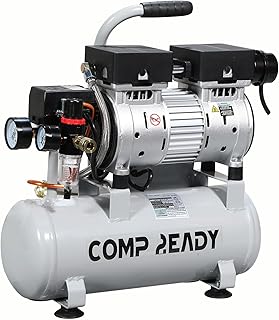
MZB 2.4 Gallon Ultra Quiet
A 1.2 HP oil-free pump rated at 5.65 CFM and 70 dB is an unusual pairing at this footprint, and it makes the MZB a genuinely apartment-friendly option for hardware, trim, and small case pieces. The 2.4-gallon tank will cycle often on larger panels, so treat it as a detail and touch-up machine rather than a cabinet-door workhorse.
VEVOR 13-Gallon
At 4.6 SCFM at 90 PSI with 66 dB operation and a thickened steel body on wheels, this is the most balanced pick here for anyone spraying whole furniture pieces. The 13-gallon reservoir lets a standard HVLP gun run through a tabletop without the pump kicking in mid-pass, and 125 PSI max gives comfortable regulator headroom.
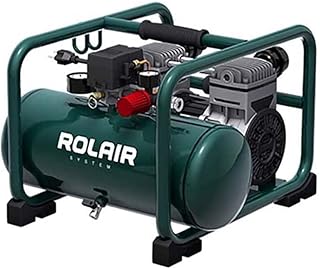
Rolair JC20
Rolair built its reputation on pumps that survive a decade of daily abuse, and the JC20 delivers that at 70 dB and a genuinely hand-carryable weight. It is the choice for someone who wants professional build quality and portability over raw tank volume, and it pairs beautifully with an LVLP gun.
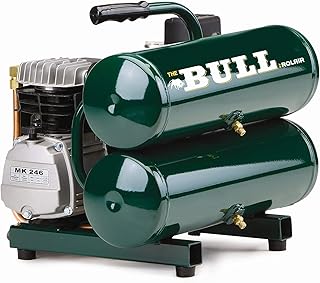
Rolair FC2002 Twin Stack
The twin-stack layout gives you meaningful air storage in a narrow, stackable footprint, and the overload protection with manual reset is the kind of detail that saves a motor on a long spray day. Louder than the JC20, so plan on running it in the garage with the door to the house closed.
18.5-Gallon Upright Oil-Free
If you refinish regularly and have vertical space to spare, this upright oil-free unit offers the most sustained air of the group with no oil-carryover risk to your topcoat. The vertical stance is a smart compromise for tight garages, though it is a park-it-and-leave-it machine rather than a portable one.
Frequently Asked Questions
How much CFM do I actually need for spray painting?
Check your gun, not the compressor. Full-size HVLP guns typically call for 4 to 6 CFM at 90 PSI sustained; LVLP and detail guns often run happily on 2 to 3. Buy roughly 30 percent above your gun’s rating so the pump is not running continuously.
Is a small tank a dealbreaker?
Not for small work. A 2 to 8 gallon tank handles hardware, spindles, trim, and touch-ups without complaint. Tank size becomes critical on continuous passes across wide flat surfaces, where cycling mid-pass shows up as visible banding.
Do I need an air dryer or filter?
Yes. Compressed air always carries moisture, and water droplets in a topcoat cause fisheyes and blush. A basic filter-regulator at the outlet plus a short whip hose is inexpensive insurance on any finish you care about.
Can I really run one of these indoors?
The 60 to 70 dB models here are comparable to a dishwasher and reasonable in a basement or garage adjacent to living space. Ventilation for solvent fumes, not noise, is the real indoor constraint.
Final Thoughts
For most home refinishing projects, the VEVOR 13-Gallon hits the best balance of sustained air, quiet operation, and mobility, making it the default recommendation for cabinet doors and full furniture pieces. Choose the Rolair JC20 if longevity and true portability matter more than tank size, and step up to the 18.5-gallon upright if refinishing is a regular part of how you work rather than an occasional weekend.