Key takeaways
- Inner diameter: A 1/4-inch bore handles brad nailers, staplers, and blow guns comfortably. Step up to 3/8-inch for framing nailers, impact wrenches, or any tool with sustained high air demand.
- Material: Hybrid polymer blends offer the best all-around balance of flexibility, weight, and memory-free coiling. Polyurethane is lighter still and ideal for overhead or ladder work, while rubber remains the most abrasion-tolerant on rough job sites.
- Length versus pressure drop: Longer runs mean more friction loss. A 25-foot hose keeps pressure crisp for detail work; if you need 100 feet of reach, favor a larger bore or accept a modest drop at the tool.
- Fittings and couplers: Brass or solid-machined industrial-style couplers seal better and survive more connect cycles than stamped alternatives. Confirm the plug profile matches your existing tools before buying.
- Cold-weather flexibility: If your compressor lives in an unheated garage or basement shop, look for hoses rated for sub-freezing use. Standard PVC turns rigid and kink-prone below about 40°F.
What's inside
Most of the airborne dust and drama in a home project traces back to a single overlooked component: the hose. You can spec a quiet pancake compressor, invest in a beautifully balanced 18-gauge brad nailer, and still fight your tools all afternoon because a stiff length of rubber keeps looping around a chair leg, scuffing a freshly finished floor, or coiling itself into a knot the moment temperatures drop. For anyone working indoors around finished surfaces, upholstery frames, or cabinetry, hose behavior matters as much as tool quality.
This guide looks at air compressor hoses through a practical, interiors-first lens: which materials stay supple in a cold garage, which diameters actually keep up with framing nailers versus finish tools, and where quick-connect fittings save you from leaks and lost pressure. Below are the hoses worth considering in 2026, along with the specifications that separate a genuinely pleasant workflow from a frustrating one.
As an Amazon Associate we earn from qualifying purchases.


How to Choose an Air Compressor Hose in 2026
- Inner diameter: A 1/4-inch bore handles brad nailers, staplers, and blow guns comfortably. Step up to 3/8-inch for framing nailers, impact wrenches, or any tool with sustained high air demand.
- Material: Hybrid polymer blends offer the best all-around balance of flexibility, weight, and memory-free coiling. Polyurethane is lighter still and ideal for overhead or ladder work, while rubber remains the most abrasion-tolerant on rough job sites.
- Length versus pressure drop: Longer runs mean more friction loss. A 25-foot hose keeps pressure crisp for detail work; if you need 100 feet of reach, favor a larger bore or accept a modest drop at the tool.
- Fittings and couplers: Brass or solid-machined industrial-style couplers seal better and survive more connect cycles than stamped alternatives. Confirm the plug profile matches your existing tools before buying.
- Cold-weather flexibility: If your compressor lives in an unheated garage or basement shop, look for hoses rated for sub-freezing use. Standard PVC turns rigid and kink-prone below about 40°F.
The Best Air Compressor Hoses of 2026, Reviewed
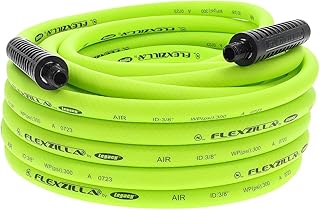
Flexzilla 3/8 in. x 50 ft. Hybrid Polymer Hose
Flexzilla remains the reference point for hybrid polymer hoses, with a lay-flat character that genuinely stays put instead of dragging your nailer across the room. The 3/8-inch bore and 300 PSI rating give you real headroom for high-consumption tools, and the ZillaGreen jacket makes it easy to spot on a cluttered floor.
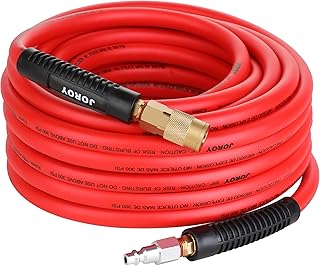
Hybrid 3/8-Inch x 50 Ft. Heavy Duty Hose with Brass Coupler and Plug
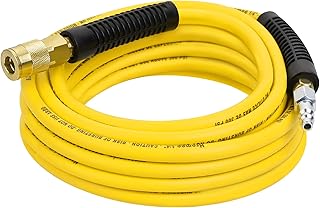
This one arrives ready to work: a 50-foot hybrid line with 1/4-inch brass coupler and plug already fitted, which removes the usual trip to the hardware store for adapters. It handles temperature swings without stiffening and resists kinking around furniture legs and doorframes, making it a sensible primary hose for a mixed-use home shop.
Hybrid 1/4-Inch x 25 Ft. Hose with Industrial Coupler Kit
For upholstery staplers, pin nailers, and cabinet installs, 25 feet of 1/4-inch hybrid is often the smarter choice: less bulk underfoot and far less to coil at the end of a session. The included industrial quick-connect kit means you can standardize your fittings across multiple tools from day one.
YOTOO Polyurethane Recoil Hose, 1/4 in. x 25 ft.
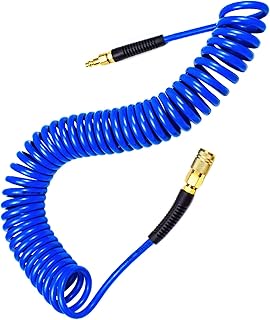
A recoil hose is the tidiest option for anyone working in a compact space or at a fixed bench, since it retracts on its own and never sprawls across a finished floor. The bend restrictors at each end address the classic weak point of coiled hoses, and the polyurethane construction keeps overall weight low for extended handheld work.
Reinforced Polyurethane 1/4 in. x 100 Ft. Hose Kit
When your compressor is parked in the garage and the work is happening two rooms away, 100 feet of reinforced polyurethane solves the reach problem without excessive weight. Expect some pressure loss at that length, so pair it with finish tools rather than a framing nailer running continuously.
Frequently Asked Questions
Do I need 3/8-inch or is 1/4-inch enough?
For finish nailers, staplers, inflation, and cleaning, 1/4-inch is entirely sufficient and much easier to manage indoors. Choose 3/8-inch if you run impact wrenches, framing nailers, sanders, or spray equipment that draws steady volume.
Is hybrid polymer really better than rubber?
For home and interior work, generally yes. Hybrid hoses weigh roughly a third less than comparable rubber, resist coil memory, and are far less likely to leave marks on finished floors, though rubber still holds an edge in raw abrasion resistance.
Will a longer hose hurt my tool’s performance?
Every additional length adds friction loss, typically a few PSI per 25 feet depending on bore and airflow. Intermittent tools like brad nailers barely notice; continuous-draw tools benefit from shorter runs or a larger diameter.
How should I store a hose to extend its life?
Drain residual moisture, coil it loosely in wide loops rather than tight figure-eights, and keep it off concrete in freezing conditions. Avoid hanging it on a narrow hook, which creates a permanent stress point at the bend.
Final Thoughts
For most home workshops, the Flexzilla 3/8 in. x 50 ft. hybrid is the safest all-purpose investment, delivering flexibility and airflow capacity that suit nearly every tool you’re likely to own. If you want a fitted, ready-to-connect setup, the Hybrid 3/8-Inch x 50 Ft. hose with brass coupler and plug is an excellent value, while the YOTOO polyurethane recoil hose is the neatest solution for bench-based furniture and upholstery work in tight quarters.