Key takeaways
- Connection size: Match the separator’s NPT ports to your hose, regulator, or existing manifold; adapters can work, but every transition adds bulk and potential leak points.
- Filtration stages: A particulate filter catches debris, while coalescing and desiccant stages address finer oil mist and moisture. Choose the level of drying that matches your tools.
- Drain style: Auto-drain models are convenient for frequent use, while semi-automatic units may be simpler for occasional workshop projects. Check that the bowl remains accessible.
- Pressure and airflow: Confirm the maximum PSI and rated CFM before buying. Spray guns, plasma cutters, and sandblasters can demand considerably more airflow than nailers.
- Installation position: Install the separator upstream of sensitive equipment and allow room to inspect the bowl, replace filter elements, and operate the drain safely.
What's inside
Moisture is one of the quiet troublemakers in a home workshop. It can leave spray finishes cloudy, introduce rust into pneumatic tools, disrupt plasma cutting, and shorten the life of air-line components. Even a capable compressor can deliver damp air when warm, compressed air cools inside the hose or pipe.
This guide looks at air compressor water separators through a practical, design-conscious lens: filtration stages, connection size, drainage, pressure handling, airflow, and the type of work each unit suits best. The goal is cleaner, more predictable compressed air without adding unnecessary complexity to your garage, studio, or utility space.
As an Amazon Associate we earn from qualifying purchases.




How to Choose a Air Compressor Water Separator (2026)
- Connection size: Match the separator’s NPT ports to your hose, regulator, or existing manifold; adapters can work, but every transition adds bulk and potential leak points.
- Filtration stages: A particulate filter catches debris, while coalescing and desiccant stages address finer oil mist and moisture. Choose the level of drying that matches your tools.
- Drain style: Auto-drain models are convenient for frequent use, while semi-automatic units may be simpler for occasional workshop projects. Check that the bowl remains accessible.
- Pressure and airflow: Confirm the maximum PSI and rated CFM before buying. Spray guns, plasma cutters, and sandblasters can demand considerably more airflow than nailers.
- Installation position: Install the separator upstream of sensitive equipment and allow room to inspect the bowl, replace filter elements, and operate the drain safely.
The Best Air Compressor Water Separators (2026) Reviewed
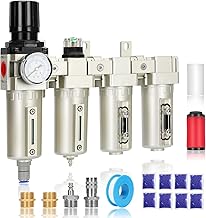
Best Overall: 3/4-Inch NPT Four-Stage Air Dryer
This 3/4-inch NPT industrial system is the most compelling choice for a busy workshop that needs substantial flow and broad protection. Its four-stage design combines filtration, regulation, and drying, while the automatic drain reduces routine maintenance during sanding, spray painting, and other moisture-sensitive work.
Best for Versatile Workshop Use: 1/2-Inch NPT Three-Stage Air Dryer
The 1/2-inch NPT Air Compressor Water Separator balances a substantial 0–240 PSI range with a three-stage layout that includes particulate, coalescing, and desiccant filtration. Its metal bowl and automatic drain give it a more serious, workshop-ready feel than lightweight inline traps, particularly for users switching between tools.
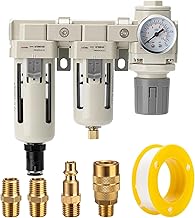
Best Compact Setup: 3/8-Inch NPT Double Air Filter Dryer
With double filtration, an air-pressure regulator, and both auto-drain and semi-auto-drain functionality, this 3/8-inch model is a sensible fit for smaller compressors and tighter installations. Its 0–150 PSI range is well suited to routine pneumatic tools, detailing, and light spray work where a compact footprint matters.
Best Inline Option: LE LEMATEC AI303
The LE LEMATEC Air Compressor Water Separator AI303 is designed for straightforward placement near a paint gun, plasma cutter, or other point of use. Its 1/4-inch NPT inline format and auto-draining pneumatic dryer make it especially attractive when you want localized moisture control without rebuilding the entire air line.
Best High-Flow Choice: 1/2-Inch NPT Four-Stage Air Dryer
Rated at up to 141 CFM, this 1/2-inch NPT four-stage air dryer is aimed at demanding applications such as plasma cutting and spray painting. The 0–240 PSI rating, industrial filtration arrangement, and automatic drain make it a strong option where airflow capacity and oil-and-water separation are more important than a minimal installation.
Frequently Asked Questions
What does an air compressor water separator do?
It removes condensed water and, depending on the design, particulate contamination and oil mist from compressed air. This helps protect tools and improves the consistency of finishes, cutting, and other air-powered work.
Where should I install a water separator?
For general protection, install it after the compressor and receiver tank, where the air has had time to cool. A second small inline separator can be useful directly before a paint gun or other particularly sensitive tool.
Is a water separator the same as an air dryer?
Not always. A basic separator primarily removes liquid condensate, while a multi-stage air dryer may also use coalescing or desiccant filtration to reduce finer moisture and oil contamination. The product specifications reveal how comprehensive the drying system is.
How often should I drain the separator?
Automatic drains can handle routine condensate, but they still deserve periodic inspection. Manually drained bowls should be checked frequently during humid weather or heavy use, and filter elements should be replaced according to the manufacturer’s guidance.
Final Thoughts
For a full-featured workshop, the 3/4-inch NPT Four-Stage Air Dryer is the strongest all-rounder. The LE LEMATEC AI303 is the neatest choice for point-of-use protection, while the 1/2-inch NPT Four-Stage Air Dryer stands out when high airflow is central to the project.