Key takeaways
- Match CFM, not horsepower: A dryer rated below your compressor’s actual output becomes a bottleneck and stops drying effectively. Check your compressor’s CFM at 90 PSI, then choose a dryer rated at or above that figure with a little headroom.
- Filtration vs. refrigeration: Coalescing filters and water separators pull out bulk liquid and particulates. Refrigerated dryers actually lower the dew point, which is what you need for spray finishing, media blasting, or anything running continuously in humid conditions.
- Drain style matters more than you think: Manual drains are fine if you’re disciplined. Semi-auto and fully automatic drains are far better if you’re not, because a full bowl passes water straight through as if the filter weren’t there.
- Port size and thread standard: 1/4″ NPT suits light-duty lines and single tools. 3/8″ and 1/2″ NPT handle higher flow without pressure drop. Confirm NPT, not BSPP, before you order fittings.
- Element quality and serviceability: Look for brass or sintered elements rated around 5 microns, replaceable bowls, and gauges you can actually read. Polycarbonate bowls are standard and inexpensive, but keep them away from solvents and direct heat.
What's inside
Compressed air looks clean. It isn’t. Every time a compressor pulls in a lungful of room air, it pulls in the humidity riding along with it, then squeezes that vapor into liquid water as the tank cools. That water travels down the line and shows up exactly where you don’t want it: fisheyes in a freshly sprayed cabinet door, rust blooming inside a plasma cutter consumable, a pneumatic stapler that hesitates halfway through a run of trim. If you’ve ever pulled a beautiful piece out of the shop only to find the finish has gone cloudy overnight, moisture in the air line was almost certainly the culprit.
An air dryer is the fix, and the good news is that “dryer” covers a wide range of hardware, from a compact point-of-use water separator that bolts onto your compressor outlet to a refrigerated system that chills air below its dew point before it ever reaches your tools. This guide breaks down the options worth your money in 2026, who each one actually suits, and how to read the specs that matter. Whether you’re finishing furniture in a two-car garage or running a small production shop, there’s a right-sized answer below.
As an Amazon Associate we earn from qualifying purchases.


How to Choose a Air Dryer For Compressor (2026)
- Match CFM, not horsepower: A dryer rated below your compressor’s actual output becomes a bottleneck and stops drying effectively. Check your compressor’s CFM at 90 PSI, then choose a dryer rated at or above that figure with a little headroom.
- Filtration vs. refrigeration: Coalescing filters and water separators pull out bulk liquid and particulates. Refrigerated dryers actually lower the dew point, which is what you need for spray finishing, media blasting, or anything running continuously in humid conditions.
- Drain style matters more than you think: Manual drains are fine if you’re disciplined. Semi-auto and fully automatic drains are far better if you’re not, because a full bowl passes water straight through as if the filter weren’t there.
- Port size and thread standard: 1/4″ NPT suits light-duty lines and single tools. 3/8″ and 1/2″ NPT handle higher flow without pressure drop. Confirm NPT, not BSPP, before you order fittings.
- Element quality and serviceability: Look for brass or sintered elements rated around 5 microns, replaceable bowls, and gauges you can actually read. Polycarbonate bowls are standard and inexpensive, but keep them away from solvents and direct heat.
The Best Air Dryer For Compressor (2026)s Reviewed
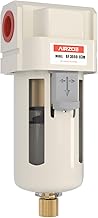
AIRZOE AF3000-03 Air Compressor Water Separator
The cleanest entry point for most home shops: a 3/8″ NPT separator with a 5-micron brass element and a semi-auto drain that purges as pressure drops, so you’re not babysitting a bowl. It won’t lower dew point, but for nailers, impact tools, and light spraying it removes the liquid water that causes most visible defects.
VEVOR 85CFM Refrigerated Air Dryer
This is the serious option, a genuine refrigerated system sized for 15HP and 20HP compressors and running on standard 110–120V, with automatic drainage and a color screen that reports dew point and status at a glance. If you’re finishing furniture at volume or running a busy cabinet shop, it delivers the consistently dry air that filters alone can’t.
Schulz Refrigerated Air Dryer, 35 CFM
Schulz has a long track record in compressed air, and this 35 CFM unit is the sweet spot for 7.5HP and 10HP compressors, arriving with a pre-filter already matched to the system. It’s the pick for anyone who wants refrigerated performance without stepping up to industrial footprint or wiring.
BLCH AF2000-02Z 1/4″ Air Line Dryer
Compact, manual-drain, and rated 0–160 PSI with a 5-micron element, this is the one you mount at the tool rather than at the tank. Ideal as a second line of defense on an airbrush, HVLP gun, or detail sander where even a trace of moisture shows up in the work.
AIRZOE AC3110-03 Filter and Regulator Combo
Two filtration stages plus an integrated regulator and 0–145 PSI gauge in one 3/8″ NPT body, which saves both money and wall space compared to piecing it together. The semi-auto drain and brass element carry over from the AF3000, making this the most practical single upgrade for a shared shop line.
Frequently Asked Questions
Do I really need a refrigerated dryer?
Not if you’re driving nailers and inflating tires. Yes, if you’re spray finishing, plasma cutting, or media blasting, or if your shop sits in a humid climate where filters fill faster than you can drain them.
Where should the dryer be installed?
Downstream of the tank and as far from the pump as practical, so the air has cooled and condensed before it reaches the filter. A short cooling loop of hard line ahead of the dryer improves results noticeably.
Can I stack multiple filters?
Yes, and it’s good practice. A three-stage system such as the 1/2″ NPT industrial dryer with regulator and auto drain handles bulk water, particulates, and oil aerosol in sequence, which is exactly what spray equipment wants.
How often do elements need replacing?
Inspect quarterly under normal use. Brass and sintered elements clean and reuse well; replace them when pressure drop climbs or the surface stops rinsing clear.
Final Thoughts
For most home workshops, the AIRZOE AC3110-03 combo is the best value on this list, giving you filtration and regulation in one tidy unit. Step up to the Schulz 35 CFM refrigerated dryer if you’re finishing regularly and want dew point control, or the VEVOR 85CFM system if your compressor and your ambitions are both larger.