Key takeaways
- Rough opening and ceiling height: Measure the framed opening before anything else. The 22.5″ x 54″ footprint is the industry standard and fits between 24″-on-center joists, but confirm your ceiling falls inside the ladder’s stated range, typically 7’8″ to 10’3″ for a 10-foot unit. Too short and the ladder lands with a hard drop; too tall and it won’t reach.
- Load rating and duty type: Look for 350 to 375 lb capacity, and prioritize Type IAA designations. That rating covers you plus a heavy bin, which is the realistic use case rather than body weight alone.
- Material and weight: Aluminum stays light enough for one-person operation and won’t warp in an unconditioned attic. Fiberglass is the choice near electrical work. Wood looks warmer in a finished hallway but demands more maintenance and adds swing weight.
- Step geometry and handrails: Wide, flat treads with a deliberate anti-slip surface beat narrow round rungs every time, especially descending with your hands full. On step stools, a fixed or rotating handrail is the difference between confident and cautious.
- Installation and air sealing: Plan for two people and a few hours. Then weatherstrip and insulate the door panel. An unsealed attic hatch is one of the largest thermal leaks in a conditioned home, and skipping this step undoes the upgrade.
What's inside
Attic access is the last unstyled threshold in most homes. We spend months choosing a stair runner or a vanity light, then climb into overhead storage on a borrowed extension ladder braced against a hallway wall. The result is a space that stays functionally sealed off: holiday bins get shoved just past the opening, insulation goes uninspected, and hundreds of square feet quietly go unused because getting up there feels like a project.
A properly specified pull-down ladder changes that calculation. This guide covers what actually matters when sizing a drop-down unit to your rough opening and ceiling height, how load ratings and duty classifications translate to real-world stability, and where a compact step stool serves you better than a full attic system. Below are the pull-down ladders and companion climbers worth considering in 2026, chosen for build quality, sane geometry, and installations that look intentional rather than improvised.
As an Amazon Associate we earn from qualifying purchases.


How to Choose a Attic Ladder (2026)
- Rough opening and ceiling height: Measure the framed opening before anything else. The 22.5″ x 54″ footprint is the industry standard and fits between 24″-on-center joists, but confirm your ceiling falls inside the ladder’s stated range, typically 7’8″ to 10’3″ for a 10-foot unit. Too short and the ladder lands with a hard drop; too tall and it won’t reach.
- Load rating and duty type: Look for 350 to 375 lb capacity, and prioritize Type IAA designations. That rating covers you plus a heavy bin, which is the realistic use case rather than body weight alone.
- Material and weight: Aluminum stays light enough for one-person operation and won’t warp in an unconditioned attic. Fiberglass is the choice near electrical work. Wood looks warmer in a finished hallway but demands more maintenance and adds swing weight.
- Step geometry and handrails: Wide, flat treads with a deliberate anti-slip surface beat narrow round rungs every time, especially descending with your hands full. On step stools, a fixed or rotating handrail is the difference between confident and cautious.
- Installation and air sealing: Plan for two people and a few hours. Then weatherstrip and insulate the door panel. An unsealed attic hatch is one of the largest thermal leaks in a conditioned home, and skipping this step undoes the upgrade.
The Best Attic Ladder (2026)s Reviewed
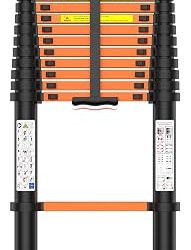
10 Ft Aluminum Attic Ladder Pull Down System
A straightforward aluminum pull-down built for the standard 22.5″ x 54″ opening and ceilings from 7.6 to 10.25 feet, rated to 350 lb. The spring assist is well tuned, so the door comes down controlled rather than dropping, which matters in a tight hallway.
LITE 10-Foot Aluminium Attic Ladder (AP2240MS)
The most confident pick here: Type IAA construction with a 375 lb rating and tight tolerances on the hinge arms, which is where cheaper units develop flex and rattle. Worth the premium if you access your attic weekly or store anything heavy.
Aluminum Pull Down Loft Stairs, Manual Lifting
Manual lift instead of spring assist keeps the mechanism simple and the price down, with a 375 lb capacity and coverage for 7’8″ to 10’3″ ceilings. A sensible choice for garages, workshops, and secondary access points where a slightly heavier pull is a fair trade.
Urackify 4 Step Ladder
Tested well past 800 lb, this folding four-step handles the jobs a full attic ladder shouldn’t be deployed for: reaching a pull cord, swapping a smoke detector, or accessing the top of a pantry. Wide anti-slip treads and a real handrail, and it stores flat against a closet wall.
Little Giant Jumbo Step, 2-Step Stool
Stair-like treads, a rotating handrail, and a tool tray in an aluminum two-step rated to 375 lb. The stability is genuinely uncommon at this height, and the finish is clean enough to leave out in a laundry or mudroom.
Frequently Asked Questions
Will a standard attic ladder fit my opening?
Most pull-down units are built for a 22.5″ x 54″ rough opening framed between joists at 24″ on center. Measure the framed dimensions, not the trim, and verify your finished floor-to-ceiling height before ordering.
Can I install one by myself?
Technically yes, realistically no. These assemblies are awkward and heavy overhead, and alignment determines how the door seats for the next decade. Bring a second person or hire it out.
Does an attic ladder cause heat loss?
An uninsulated hatch does. Add weatherstripping around the frame and an insulated cover or panel on the attic side, and the assembly performs close to the surrounding ceiling.
Do I need a full ladder or just a step stool?
If you access storage regularly, install the pull-down system. If you mostly need reach for fixtures and high shelves, a stable stool like the Little Giant MightyLite 8 ft fiberglass stepladder covers more ground for less commitment.
Final Thoughts
For most homes, the LITE 10-Foot Aluminium Attic Ladder is the one to buy: Type IAA rigidity, 375 lb capacity, and hardware that holds its alignment. The 10 Ft Aluminum Pull Down System is the value alternative with a smoother spring action, and the Little Giant Jumbo Step earns its place downstairs for everything that doesn’t require going up.