Key takeaways
- Match length to your saw, exactly: Blade length is not negotiable. A 93-1/2″ blade will not tension on a saw calling for 44-7/8″, and forcing it damages the wheels. Check your saw’s manual or measure your current blade before ordering anything.
- Let material thickness set your TPI: Keep at least three teeth in the cut at all times. Thick hardwood and deep resaw cuts want low tooth counts (3–4 TPI) for aggressive chip clearance; thin-wall tube and sheet metal need 14–18 TPI or the teeth will strip.
- Choose bimetal for metal, carbon for wood: Bimetal blades weld a high-speed-steel edge to a flexible backer, surviving heat that ruins carbon steel. For dry hardwood, a well-made carbon or spring-steel blade cuts smoother and costs a fraction as much.
- Width dictates curve radius: A 1/2″ blade tracks tight arcs for chair backs and cabriole legs; 3/4″ resists deflection and delivers straighter resaw faces. Buy the widest blade your task allows, and a narrow one for the shapes.
- Buy multi-packs and variable pitch: Blades are consumables. Three- and five-packs cut cost per cut significantly, and variable-pitch designs (10/14 or 12/14 TPI) suppress the harmonic chatter that leaves ripple marks on visible edges.
What's inside
Anyone who builds furniture long enough arrives at the same quiet realization: the saw gets the credit, but the blade does the work. A mid-tier band saw fitted with the right blade will out-cut a premium machine wearing the wrong one, every time. Yet blade selection is where most shoppers stall out, staring at a wall of numbers — 93-1/2 inches, 4 TPI, .035 thick, wavy set, positive rake — with no clear sense of which figures actually govern the cut. The result is a drawer full of half-used blades and a persistent suspicion that the saw is to blame.
This guide untangles that. Below you’ll find blades for the two jobs that dominate a furniture-focused shop: resawing and curve work in hardwood on a stationary saw, and clean metal cuts on a portable band saw for hairpin legs, brackets, and steel frame stock. We cover what tooth count and set geometry mean in practice, how bimetal construction changes the economics of a blade, and which specific blades hold their edge past the first weekend. Each pick is matched to a real task, not a spec sheet.
As an Amazon Associate we earn from qualifying purchases.



How to Choose a/an Band Saw Blade (2026)
- Match length to your saw, exactly: Blade length is not negotiable. A 93-1/2″ blade will not tension on a saw calling for 44-7/8″, and forcing it damages the wheels. Check your saw’s manual or measure your current blade before ordering anything.
- Let material thickness set your TPI: Keep at least three teeth in the cut at all times. Thick hardwood and deep resaw cuts want low tooth counts (3–4 TPI) for aggressive chip clearance; thin-wall tube and sheet metal need 14–18 TPI or the teeth will strip.
- Choose bimetal for metal, carbon for wood: Bimetal blades weld a high-speed-steel edge to a flexible backer, surviving heat that ruins carbon steel. For dry hardwood, a well-made carbon or spring-steel blade cuts smoother and costs a fraction as much.
- Width dictates curve radius: A 1/2″ blade tracks tight arcs for chair backs and cabriole legs; 3/4″ resists deflection and delivers straighter resaw faces. Buy the widest blade your task allows, and a narrow one for the shapes.
- Buy multi-packs and variable pitch: Blades are consumables. Three- and five-packs cut cost per cut significantly, and variable-pitch designs (10/14 or 12/14 TPI) suppress the harmonic chatter that leaves ripple marks on visible edges.
The Best Band Saw Blade (2026)s Reviewed
Timber Wolf 1/2″ x 93-1/2″, 4 TPI
This is the resaw blade woodworkers quietly recommend to each other. The low-tension silicon steel runs cool and tracks true through 6″ of maple, and 4 TPI clears chips fast enough that you can feed at a natural pace instead of babying the cut.
Lenox Classic Tuff Tooth 93″ x 3/4″, 18 TPI
A bimetal blade with wavy set and positive rake, built for thin metal on a stationary saw. The 3/4″ width keeps it from wandering, and the aggressive rake angle bites rather than burnishes, which is exactly what you want cutting steel stretchers and angle iron.
LENOX Portable Band Saw Blades, 44-7/8″ x 1/2″, 14 TPI (5-Pack)
The default choice for full-size portable band saws, and the five-pack is the reason. At 14 TPI it handles conduit, rebar, and box tube without stripping teeth, and Lenox’s edge retention means you’re changing blades because of the job, not fatigue.
DEWALT DW3983C 32-7/8″, 18 TPI (3-Pack)
Sized for compact portable saws and fitted with 18 TPI for thin-wall material, this three-pack is the practical pick for shops fabricating steel furniture frames. Cuts come off clean enough to go straight to deburring.
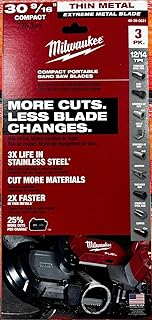
Milwaukee 48-39-0631 Compact Extreme, 12/14 TPI (3-Pack)
Milwaukee’s variable-pitch geometry earns its name on thick stock, where the alternating tooth spacing kills vibration and stops the blade from grabbing. If your compact saw spends its life on solid bar and heavy tube, this is the upgrade.
Frequently Asked Questions
How do I know what blade length my saw takes?
Your manual lists it, and most saws print it on a label near the wheel housing. If neither is available, remove the existing blade and measure its full loop with a tape.
Why does my blade wander during resaw cuts?
Usually insufficient tension, a dull blade, or a blade too narrow for the depth. Check tension first, then step up to a wider blade before adjusting your fence.
Can I cut wood with a metal-cutting blade?
You can, but the high tooth count clogs quickly and leaves a burnished, burned surface. Keep dedicated blades for each material.
How long should a band saw blade last?
Anywhere from a few hours to many months, depending on material and feed rate. Replace it when you find yourself pushing harder or seeing burn marks.
Final Thoughts
For hardwood furniture work, the Timber Wolf 1/2″ 4 TPI is the blade that changes how your saw feels — start there. If you’re fabricating metal frames and legs, the LENOX 44-7/8″ 14 TPI five-pack covers everyday portable-saw duty, while the Milwaukee 48-39-0631 handles the thick stock that defeats standard blades.