Key takeaways
- Tooth count first: For wood, aim for 2–4 TPI. Low tooth counts create the deep gullets needed to clear a long chip from a 6″ cut. Anything above 6 TPI will pack, overheat, and burn in solid hardwood, no matter how good the steel is.
- Width and beam strength: Wider is straighter. Use the widest blade your saw’s wheels and guides will accept — usually 1/2″ on 10–14″ saws, 3/4″ or 1″ on 17″-plus machines. Narrow blades deflect under feed pressure and cause the classic bowed cut.
- Measure your blade length, don’t guess: Lengths here range from 70-1/2″ to 154″ and are not interchangeable. Check your saw’s manual or measure your current blade before ordering, and confirm the throat depth supports the resaw height you want.
- Steel type matters less than geometry: Bimetal blades last far longer in metal and abrasive material, but a well-set carbon or silicon-steel blade with correct tooth spacing will out-cut a fine-pitch bimetal in wood every time. Match the blade to the material.
- Tension behaviour: Low-tension silicon steel blades are forgiving on lighter benchtop saws that can’t reach 15,000+ PSI. If your saw has a modest frame, a low-tension blade will track truer than a stiff bimetal you can’t properly tension.
What's inside
Anyone who has tried to split a thick board into two clean panels knows the frustration: the cut wanders, the face comes off the saw shaped like a potato chip, and what should have been a bookmatched cabinet door becomes firewood. Resawing is the single most demanding job a band saw does, and nine times out of ten the blade is what fails, not the machine. Underpowered tooth geometry, too many teeth for the depth of cut, or a blade too narrow to resist beam-loading will all produce the same barrelled, burned mess.
This guide is written for people making furniture at home rather than production shops — slicing 8/4 walnut into drawer fronts, harvesting shop-sawn veneer for a slab console, or thinning stock for bent lamination. Below are the blades worth your money in 2026, plus the specification logic that tells you which one actually fits your saw and your work. A note upfront: several popular Lenox blades are bimetal metal-cutting products, and I’ve flagged where that matters.
As an Amazon Associate we earn from qualifying purchases.


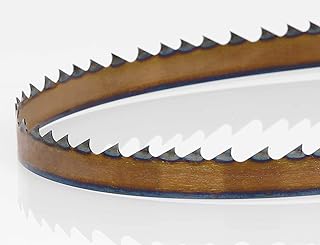
How to Choose a Band Saw Blades For Resawing (2026)
- Tooth count first: For wood, aim for 2–4 TPI. Low tooth counts create the deep gullets needed to clear a long chip from a 6″ cut. Anything above 6 TPI will pack, overheat, and burn in solid hardwood, no matter how good the steel is.
- Width and beam strength: Wider is straighter. Use the widest blade your saw’s wheels and guides will accept — usually 1/2″ on 10–14″ saws, 3/4″ or 1″ on 17″-plus machines. Narrow blades deflect under feed pressure and cause the classic bowed cut.
- Measure your blade length, don’t guess: Lengths here range from 70-1/2″ to 154″ and are not interchangeable. Check your saw’s manual or measure your current blade before ordering, and confirm the throat depth supports the resaw height you want.
- Steel type matters less than geometry: Bimetal blades last far longer in metal and abrasive material, but a well-set carbon or silicon-steel blade with correct tooth spacing will out-cut a fine-pitch bimetal in wood every time. Match the blade to the material.
- Tension behaviour: Low-tension silicon steel blades are forgiving on lighter benchtop saws that can’t reach 15,000+ PSI. If your saw has a modest frame, a low-tension blade will track truer than a stiff bimetal you can’t properly tension.
The Best Band Saw Blades For Resawing (2026)s Reviewed
Timber Wolf 3423VPC 105″ × 3/4″ Low Tension Resaw Blade
This is the purpose-built option in the group and the one I’d reach for on a 17″ saw cutting veneer from figured stock. The variable positive-rake pitch and low-tension silicon steel body produce a genuinely quiet, flat cut with minimal drift, which means less thickness lost at the planer afterward.
Lenox Classic Pro 106″ × 1″ (5–8 TPI)
The widest blade here, and that 1″ body gives outstanding resistance to deflection on tall cuts. At 5–8 TPI it’s coarse enough to work in thick softwoods and mid-density hardwoods, though the variable pitch is aimed at metal — expect to slow your feed rate and clear dust often in deep wood cuts.
Lenox Diemaster 2 154″ × 1/2″ (6 TPI, Hook Tooth)
Hook-tooth geometry with a positive rake is the right idea for aggressive stock removal, and at 6 TPI this is the closest a Diemaster 2 gets to woodworking duty. Best suited to large-wheel saws thanks to its 154″ length, and genuinely excellent if you also cut aluminium or brass hardware for your builds.
AYAO 70-1/2″ × 1/2″ 4 TPI
The value pick for small benchtop machines like the Rikon 10-305 or Craftsman 921400, and the only blade here with a true woodworking pitch. Four TPI at 1/2″ wide is about the practical limit for those saws, so keep resaw heights modest and let the blade feed itself.
Lenox Classic Tuff Tooth 93″ × 3/4″ (10–14 TPI)
A well-made bimetal blade with a hardened, wear-resistant edge — but 10–14 TPI is a metal-cutting pitch, and it will burnish and burn if you push it through 4″ of oak. Buy this one for tubing, stock, and steel fittings on your 14″ saw, not for panel work.
Frequently Asked Questions
What TPI is best for resawing hardwood?
Two to four TPI. You want roughly 3–6 teeth engaged in the cut at any time, and in a 5″ tall board even a 4 TPI blade has plenty. Fine pitches clog with dust, which is the primary cause of burning.
Can I resaw with a 1/2″ blade?
Yes, and on most home-shop saws you have no choice. Keep the blade properly tensioned, use a light feed rate, and accept slightly thicker sawn stock so you have material to plane away.
Why does my cut drift even with a new blade?
Usually blade drift from uneven set, or guides and tension that aren’t dialled in. Test-cut a scrap along a straight line, note the angle your saw naturally wants to follow, and either correct the setup or skew your fence to match.
Are bimetal blades worth it for woodworking?
Only if the tooth pitch is coarse enough. Bimetal’s advantage is edge life in abrasive and metallic material; in clean hardwood a good carbon-steel resaw blade cuts better for less money.
Final Thoughts
For genuine resawing on a mid-size or larger saw, the Timber Wolf 3423VPC is the clear first choice — it’s designed for the job and rewards you with panels that need minimal cleanup. If your saw takes 106″ blades and you want maximum beam strength across mixed materials, the Lenox Classic Pro 1″ is the versatile pick, while the AYAO 4 TPI remains the sensible, affordable answer for 10″ benchtop saws.