Key takeaways
- Engine displacement, not peak amps: Peak amperage is a marketing number. Check the gas and diesel liter ratings instead — a 6L diesel rating covers most trucks, while a 4-cylinder sedan is comfortably served by anything in this class.
- Compressor pressure and duty cycle: 150 PSI is the practical ceiling for passenger tires and comfortable for bike and sports gear. Look for auto-shutoff so you can set a target pressure and walk away instead of hovering with a gauge.
- Battery capacity and recharge speed: Watt-hours tell you how many inflations you get between charges. USB-C Power Delivery input at 60W or higher means you can top the unit off with the same charger your laptop uses — one fewer cable in the drawer.
- Footprint and finish: Compact bricks tuck into glove boxes and entry-bench cubbies; larger wheeled units want dedicated shelf space. Consider where it will actually live before you buy on capability alone.
- Safety architecture: Reverse-polarity protection, spark-proof clamps, and thermal cutoffs should be standard. A boost or override mode is a useful backstop for batteries too depleted for the unit to detect automatically.
What's inside
The garage is the last room most of us get around to curating, and it shows. Tools live in a milk crate, the tire gauge has been missing since last spring, and the moment a battery dies on a cold morning there’s a scramble for jumper cables and a neighbor with patience. A combo unit — jump starter plus air compressor in one housing — collapses two bulky problems into a single object you can actually find a home for, whether that’s a shelf in the mudroom, a drawer in the entry bench, or the cargo well of the car itself.
This guide looks at the 2026 crop of battery charger and air compressor combos through the lens of everyday livability: how much space they occupy, how honest their specs are, and whether they’re pleasant enough to keep within reach rather than buried. Below you’ll find the models worth considering, followed by the specs that actually matter and a short buying framework so you can match a unit to your vehicle and your storage reality.
As an Amazon Associate we earn from qualifying purchases.



How to Choose a Battery Charger And Air Compressor Combo (2026)
- Engine displacement, not peak amps: Peak amperage is a marketing number. Check the gas and diesel liter ratings instead — a 6L diesel rating covers most trucks, while a 4-cylinder sedan is comfortably served by anything in this class.
- Compressor pressure and duty cycle: 150 PSI is the practical ceiling for passenger tires and comfortable for bike and sports gear. Look for auto-shutoff so you can set a target pressure and walk away instead of hovering with a gauge.
- Battery capacity and recharge speed: Watt-hours tell you how many inflations you get between charges. USB-C Power Delivery input at 60W or higher means you can top the unit off with the same charger your laptop uses — one fewer cable in the drawer.
- Footprint and finish: Compact bricks tuck into glove boxes and entry-bench cubbies; larger wheeled units want dedicated shelf space. Consider where it will actually live before you buy on capability alone.
- Safety architecture: Reverse-polarity protection, spark-proof clamps, and thermal cutoffs should be standard. A boost or override mode is a useful backstop for batteries too depleted for the unit to detect automatically.
The Best Battery Charger And Air Compressor Combo (2026)s Reviewed
WOLFBOX MV16A 3000A Jump Starter with Air Compressor
A genuinely small 59.2Wh package that still hits 160 PSI and 3000A, making it the easiest of this group to keep in a car permanently. The 65W fast charging is the quiet standout — it recharges over USB-C quickly enough that you’re never waiting on it before a trip.
AstroAI S8 Air Jump Starter with Air Compressor
Rated for engines up to 9.0L gas and 6.5L diesel, the S8 handles larger SUVs and trucks without feeling oversized in the hand. Cordless auto-shutoff inflation and a clear digital readout make routine tire top-offs a two-minute job rather than a chore.
DEWALT DXAEPS14 2000 Amp Jump Starter with Compressor
This is less a gadget than a portable power station, adding 500W AC output and USB-A/USB-C charging to the jump and inflate functions. Bulky and heavy by design — worth it if you want one unit that also runs a work light, laptop, or small tool during an outage.
GOOLOO A3 12V 3000A Portable Jump Starter with Air Compressor
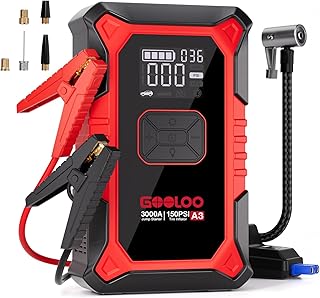
The A3 leans on GOOLOO’s Supersafe protection circuitry and a boost mode for deeply drained batteries, which is exactly the scenario that defeats cheaper units. Its 150 PSI auto-off compressor and integrated LED light round out a balanced, no-drama package.
4500A Jump Box with 150PSI Tire Inflator (8.5L Gas/7.0L Diesel)
The highest-rated starting output here, with headroom for 8.5L gas and 7.0L diesel engines that suits large trucks and diesel vans. A sensible pick if you maintain a heavier vehicle and want margin rather than a bare-minimum match.
Frequently Asked Questions
Can one of these replace a trickle charger?
No. Jump starters deliver a short, high-current burst to crank an engine; they don’t slowly recondition a battery. If your car sits for weeks at a time, pair a combo unit with a dedicated maintainer.
How often should I recharge the unit?
Every three months is a reasonable rhythm, even unused. Lithium packs self-discharge slowly, and a unit at 40% may not have the reserve to both start a car and inflate a tire.
Is 150 PSI enough for my tires?
Comfortably. Passenger cars typically run 30–36 PSI and light trucks under 80 PSI, so 150 PSI provides substantial margin and faster fill times at normal pressures.
Can I leave it in the car year-round?
In moderate climates, yes. Extreme heat and deep freezes both shorten lithium cell life, so in harsh conditions store the unit indoors and bring it out for trips.
Final Thoughts
For most households, the WOLFBOX MV16A is the smartest buy — small enough to live in the car, fast to recharge, and capable well beyond what a typical sedan or crossover demands. Step up to the AstroAI S8 if you’re covering a full-size SUV or diesel truck, and choose the DEWALT DXAEPS14 if you want a single unit that doubles as backup AC power for the house.