Key takeaways
- Stationary or handheld: A benchtop saw with a stand is what you want for curves, resawing, and furniture work — the workpiece moves, you stay put. Handheld deep-cut saws are the opposite: the tool travels to the material, which suits cutting pipe, angle iron, and oversized stock, not shaping a cabriole leg.
- Throat and depth capacity: Throat depth (the distance from blade to frame) caps how wide a panel you can cut. A 10-inch saw handles most small-furniture and box work. Handheld models quote a 5-inch or 3-3/8-inch cutting capacity, which refers to the largest stock the jaw will swallow.
- Speed control: Two-speed benchtop saws let you drop into a slower band speed for non-ferrous metal and hardwood. Variable-speed handhelds are more forgiving still, since matching feed rate to material is the single biggest cause of chewed blades early on.
- Blade support and tension: Look for adjustable guide bearings above and below the table, plus a tension mechanism you can reach without tools. Poor guides mean blade drift, and blade drift is why beginners assume they can’t cut a straight line.
- Dust and footprint: Wood band saws throw fine dust downward — a 2-1/2-inch port that mates with a shop vac keeps a garage or basement space usable. Also measure your bench: cordless handhelds and saws with wheeled or removable bases store far more politely than a fixed stand.
What's inside
Curved chair backs, tapered table legs, a bandsawn box with a lid that fits like it grew there — the cuts that give handmade furniture its character rarely come from a circular blade. That’s the wall most beginners hit. You’ve built the flat-pack-beating bookcase, you’ve squared up a workbench, and then a design calls for a gentle arch or a resawn veneer, and suddenly every tool in the shop says no. A band saw is the piece that unlocks that vocabulary, but the buying process is muddy: half the search results are handheld metal-cutting units built for plumbers, the other half are cabinet-sized machines priced like a used car.
This guide sorts that out. We looked at the models beginners actually land on in 2026 — benchtop saws with stands for shaping wood, and portable deep-cut units for anyone trimming stock, conduit, or reclaimed steel for mixed-material builds — and judged them on cut capacity, blade tracking, vibration under load, and how quickly a first-timer can get a straight cut without a tuning tutorial. Below you’ll find the shortlist, a plain-language buying framework, and honest notes on where each machine belongs in a home shop.
As an Amazon Associate we earn from qualifying purchases.


How to Choose a Beginner Band Saw (2026)
- Stationary or handheld: A benchtop saw with a stand is what you want for curves, resawing, and furniture work — the workpiece moves, you stay put. Handheld deep-cut saws are the opposite: the tool travels to the material, which suits cutting pipe, angle iron, and oversized stock, not shaping a cabriole leg.
- Throat and depth capacity: Throat depth (the distance from blade to frame) caps how wide a panel you can cut. A 10-inch saw handles most small-furniture and box work. Handheld models quote a 5-inch or 3-3/8-inch cutting capacity, which refers to the largest stock the jaw will swallow.
- Speed control: Two-speed benchtop saws let you drop into a slower band speed for non-ferrous metal and hardwood. Variable-speed handhelds are more forgiving still, since matching feed rate to material is the single biggest cause of chewed blades early on.
- Blade support and tension: Look for adjustable guide bearings above and below the table, plus a tension mechanism you can reach without tools. Poor guides mean blade drift, and blade drift is why beginners assume they can’t cut a straight line.
- Dust and footprint: Wood band saws throw fine dust downward — a 2-1/2-inch port that mates with a shop vac keeps a garage or basement space usable. Also measure your bench: cordless handhelds and saws with wheeled or removable bases store far more politely than a fixed stand.
The Best Beginner Band Saws (2026) Reviewed
WEN 10-Inch Two-Speed Band Saw with Stand (BA3962)
This is the one to buy if furniture is the goal: a genuine 10-inch throat, a 6-inch cut height for resawing, and a two-speed drive that shifts from wood to soft metal. The included stand and a table that bevels to 45 degrees make it a complete starter setup rather than a project you have to finish yourself.
DEWALT 20V MAX Band Saw, 5-Inch Capacity (DCS374B)
The cordless deep-cut standard, and the sensible choice for anyone building with steel tube, black pipe, or salvaged industrial parts. The 5-inch capacity swallows most stock in one pass, and the integrated hang hooks are a genuinely thoughtful touch when you’re working off a ladder or a scaffold.
DEWALT 20V MAX XR Brushless Bandsaw (DCS378B)
Lighter and more balanced than its bigger sibling, with a brushless motor that stretches runtime meaningfully. The 3-3/8-inch capacity is the tradeoff, but for one-handed cuts on conduit, threaded rod, and small angle iron, this is the more comfortable tool over a long session.
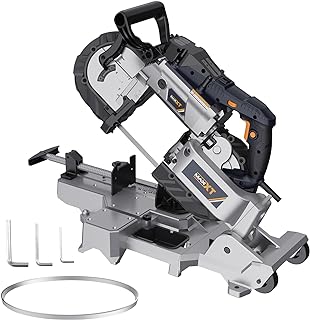
VEVOR Portable Band Saw, 5-Inch Variable Speed
A corded 10-amp alternative that costs a fraction of the cordless options and never needs a battery mid-cut. The removable alloy steel base is the standout feature, converting it into a small stationary saw for repetitive cuts, and the 0–45 degree adjustment covers basic mitering.
DOVAMAN Portable Band Saw, 10A Variable Speed
Well-specified for a first deep-cut saw: variable speed, a 0–45 degree bevel, a base for benchtop use, and two blades so you can learn on one without fear. Fit and finish trail the DEWALTs, but for occasional metal work it’s honest value.
Frequently Asked Questions
Can a band saw cut both wood and metal?
Yes, with the right blade and speed. Benchtop wood saws handle aluminum and brass at their slow setting with a fine-tooth bimetal blade. Deep-cut handhelds are metal-first tools that can also cut PVC and wood, though they lack a table for controlled curves.
Is a 10-inch band saw big enough for furniture?
For chairs, side tables, boxes, and shelving, comfortably. You’ll feel the limit when resawing wide boards for bookmatched panels or cutting large templates — that’s when 14-inch machines start to matter.
How often do blades need replacing?
More often than you’d expect, and that’s normal. Blades are consumable, inexpensive, and the fastest way to fix disappointing cuts. Keep a spare of each tooth count you use and swap at the first sign of burning or wander.
Do I need dust collection right away?
A shop vac connected to the lower port covers you at the start. Fine wood dust is a real respiratory concern in enclosed home shops, so pair it with a proper respirator rather than relying on airflow alone.
Final Thoughts
For shaping wood and building furniture, the WEN 10-Inch Two-Speed is the clear starting point — stand included, no upgrades needed to make your first curved cut. If your work leans toward metal and mixed-material pieces, the DEWALT DCS374B is the deep-cut benchmark, with the VEVOR Portable offering most of the same capability on a corded budget.