Key takeaways
- Footprint when stored: Measure the wall you actually have free, not the wall you wish you had. A rolling-stand saw collapses to roughly the profile of a folding chair; a benchtop unit can live on a shelf. Both beat a fixed cabinet base in a shared garage.
- Fence quality above all: The single feature that separates cabinet-saw-quality cuts from frustration is a fence that stays parallel. Rack-and-pinion systems track both ends of the fence at once and are worth prioritizing over raw motor specs.
- Rip capacity vs. your project scale: Cabinet doors and case sides need 24 inches or more to the right of the blade. Around 32 inches lets you rip a sheet of plywood in half without a track saw detour. Craft-scale work needs a fraction of that.
- Blade diameter and cut depth: Ten-inch blades handle 4x material and thick hardwood; 8-1/4-inch saws trade about a half inch of depth for meaningful weight savings. Micro saws top out near a half inch, which is plenty for basswood, acrylic, and thin ply.
- Dust management indoors: A small shop is usually a shared shop. Look for a shrouded blade and a dust port sized to a standard shop-vac hose, and plan to run the vacuum rather than a chip collector.
What's inside
Anyone who has tried to fit a real cabinet saw into a one-car garage knows the math rarely works. A traditional cabinet saw wants 800 pounds of floor space, a 220-volt circuit, and roughly eight feet of clearance on every side for infeed and outfeed. In a small shop that doubles as a bike storage area, a laundry nook, or the place where holiday decorations live, that footprint is a non-starter. The compromise most woodworkers actually make is a cabinet-grade result from a saw that folds, rolls, or sits on a bench.
This guide looks at the machines that deliver cabinet-saw precision in a small-shop footprint: heavy-duty jobsite saws with rack-and-pinion fences that hold a setting like a stationary machine, plus a handful of benchtop micro saws for anyone cutting model stock, veneer, or PCB material rather than framing lumber. We’ve weighted rip capacity, fence repeatability, dust control, and how quickly the saw disappears when the floor needs to be a floor again.
As an Amazon Associate we earn from qualifying purchases.


How to Choose a Cabinet Table Saw For Small Shop (2026)
- Footprint when stored: Measure the wall you actually have free, not the wall you wish you had. A rolling-stand saw collapses to roughly the profile of a folding chair; a benchtop unit can live on a shelf. Both beat a fixed cabinet base in a shared garage.
- Fence quality above all: The single feature that separates cabinet-saw-quality cuts from frustration is a fence that stays parallel. Rack-and-pinion systems track both ends of the fence at once and are worth prioritizing over raw motor specs.
- Rip capacity vs. your project scale: Cabinet doors and case sides need 24 inches or more to the right of the blade. Around 32 inches lets you rip a sheet of plywood in half without a track saw detour. Craft-scale work needs a fraction of that.
- Blade diameter and cut depth: Ten-inch blades handle 4x material and thick hardwood; 8-1/4-inch saws trade about a half inch of depth for meaningful weight savings. Micro saws top out near a half inch, which is plenty for basswood, acrylic, and thin ply.
- Dust management indoors: A small shop is usually a shared shop. Look for a shrouded blade and a dust port sized to a standard shop-vac hose, and plan to run the vacuum rather than a chip collector.
The Best Cabinet Table Saw For Small Shop (2026)s Reviewed
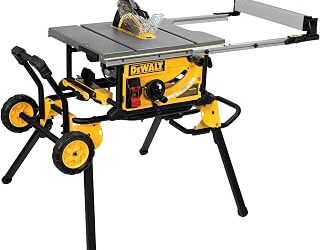
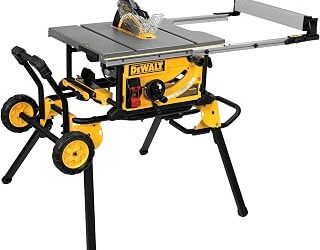
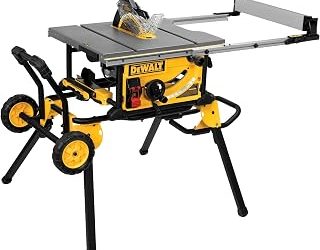
DEWALT DWE7491RS 10-Inch Table Saw with Rolling Stand
This is the closest thing to a cabinet saw that will still fold flat against a wall: 32-1/2 inches of rip capacity, a 15-amp motor at 4,800 RPM, and a rack-and-pinion fence that returns to the same setting cut after cut. The foldable rolling stand is the quiet hero, letting one person move a genuinely capable saw across a garage floor without a helper.
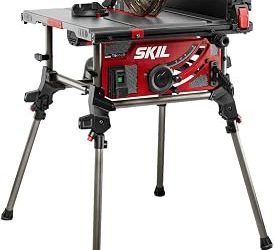
SKIL TS6307-00 15 Amp Portable Jobsite Saw
SKIL’s take pairs a 10-inch blade with a folding stand and one feature small shops appreciate more than they expect: a self-aligning rip fence with a rack-and-pinion drive, plus onboard storage that keeps the miter gauge and push stick from wandering. A strong choice if you want ten-inch capability without the premium tier price.
DEWALT DWE7485 8-1/4 in. Compact Jobsite Saw
The compact sibling gives up about a half inch of cut depth and several pounds, which matters if your saw lives on a shelf and gets lifted onto a bench for each session. The fence system and build quality carry over, making it the pick for trim, cabinetry, and sheet-good work in tight quarters.
MXBAOHENG Mini Table Saw S3
A precision benchtop unit for miniatures, model railroad stock, and inlay work, with a half-inch cut depth, seven-speed variable power, and an adjustable angle table. It is not a substitute for a full-size saw, but for fine hobby cutting it offers control no ten-inch machine can match.
Mini Table Saw 96W Dual Motor
The dual-motor design keeps blade speed steadier through denser material, and 12mm of depth with 0–90° tilt covers most craft and model-making needs. Four multi-material blades handle wood, PCB, acrylic, and plastic, which makes it a versatile desktop companion to a larger saw.
Frequently Asked Questions
Can a jobsite saw really replace a cabinet saw?
For furniture-scale work in a small shop, largely yes. Modern rack-and-pinion fences deliver repeatable accuracy; what you sacrifice is mass, which means less vibration damping and slightly more attention required on heavy rips.
Do I need a 220-volt circuit?
No. Every saw here runs on standard 120-volt household power, which is a major reason they suit garages and basements without electrical work.
How much clearance do I need around the saw?
Aim for eight feet of infeed and outfeed for full sheets, but a folding stand lets you roll the saw into an open doorway or driveway for the occasional big cut and store it compactly otherwise.
Is a mini table saw worth owning alongside a full-size one?
If you build models, do inlay, or cut thin acrylic, yes. Small blades and variable speed produce cleaner edges on delicate stock than a ten-inch saw can.
Final Thoughts
For most small shops, the DEWALT DWE7491RS is the machine to buy once: cabinet-grade fence accuracy, 32-1/2 inches of rip capacity, and a rolling stand that reclaims your floor in seconds. The SKIL TS6307-00 is the value alternative with much of the same capability, while the DEWALT DWE7485 suits anyone who needs to lift and store the saw between sessions. Add the MXBAOHENG Mini S3 only if fine craft work is part of your routine.