
Key takeaways
- 【Three shooting modes】Tracking shooting: Adjust the red knobs…
- 【Two shooting modes】-One is video shooting, which allows…
- 【Remote control】 You can use the remote control…
The best camera sliders for cinematic video are 24-inch carbon fiber sliders for most mirrorless shooters, 36 to 47-inch heavy-duty sliders for full cinema rigs, and compact 16-inch motorized sliders for solo travel creators, because length determines your move duration, weight capacity determines stability, and bearing design determines smoothness.
Our top picks
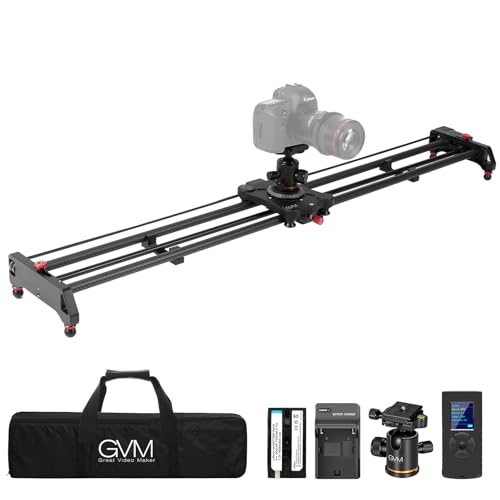 GVM 48"/120CM Carbon Fiber Motorized Camera Slider
- 【Three shooting modes】Tracking shooting: Adjust the red knobs…
- 【Two shooting modes】-One is video shooting, which allows…
- 【Remote control】 You can use the remote control…
 IFOOTAGE PICO Motorized Camera Slider
- COMPACT MOTORIZED CAMERA SLIDER FOR CREATORS Take smooth…
- 2-AXIS MOTION WITH 360° PAN Create dynamic push-ins,…
- MADE FOR DJI POCKET 3 AND LIGHTWEIGHT CAMERA…
 NEEWER 3 Wheels Wireless Video Camera Dolly
- The wireless remote control can change speed &…
- Wheel angle 180°adjustable, you can achieve creative circle…
- 1/4" to 3/8" convertible screw is suitable for…
| Product | Key specs | |
|---|---|---|
| GVM 48"/120CM Carbon Fiber Motorized Camera Slider | 【Three shooting modes】Tracking shooting: Adjust the red knobs… 【Two shooting modes】-One is video shooting, which allows… 【Remote control】 You can use the remote control… | Check price |
| IFOOTAGE PICO Motorized Camera Slider | COMPACT MOTORIZED CAMERA SLIDER FOR CREATORS Take smooth… 2-AXIS MOTION WITH 360° PAN Create dynamic push-ins,… MADE FOR DJI POCKET 3 AND LIGHTWEIGHT CAMERA… | Check price |
| NEEWER 3 Wheels Wireless Video Camera Dolly | The wireless remote control can change speed &… Wheel angle 180°adjustable, you can achieve creative circle… 1/4" to 3/8" convertible screw is suitable for… | Check price |
 Fotodiox Pro SlideCam 800-32" Video Slider Stabilizer Fotodiox Pro SlideCam 800-32" Video Slider Stabilizer | Full featured professional camera slider for heavy duty… Very smooth ball bearing slide system that can… Use on a tripod, or on a flat… | Check price |
As an Amazon Associate we earn from qualifying purchases at no extra cost to you.
What Makes a Slider Cinematic
Cinematic movement is slow, level, and vibration-free. Unlike handheld gimbals that float, a slider creates motivated parallax where the foreground shifts against the background on a perfectly straight or curved axis. Three specs decide if you get that look:
- Smoothness: Determined by bearing type. Fluid-damped bearings and flywheel systems resist micro-jitters. Basic ball bearings without damping will show stutter at very slow speeds.
- Leveling and Rigidity: A slider that flexes under load creates a vertical dip in the middle of the move. Rigidity matters more than weight capacity alone.
- Usable Travel: Advertised length is not travel distance. End caps and carriage size reduce usable travel by 2 to 4 inches.
Comparison: Length, Capacity, and Portability
Choosing by budget alone leads to the wrong slider. A $150 slider that cannot hold your rig level is more expensive than a $400 slider that can. Use actual specs to match your camera package.
| Type and Example | Rail Length | Usable Travel | Max Load (Horizontal) | Weight of Slider | Best For |
|---|---|---|---|---|---|
| Compact Motorized (e.g., Edelkrone SliderONE v2, Zhiyun Micro 2) | 16 in / 40 cm | 12-14 in / 30-35 cm | 4.5 – 7 lbs / 2-3.2 kg | 2.2 – 3.5 lbs / 1-1.6 kg | Mirrorless + prime, travel vlogging, tabletop product video |
| Mid-Size Manual Carbon (e.g., iFootage Shark Slider Nano, Neewer Carbon 31″) | 24-31 in / 60-80 cm | 20-27 in / 51-68 cm | 15 – 22 lbs / 6.8-10 kg | 4.5 – 7 lbs / 2-3.2 kg | A7S III / FX3 / R5 with cage, 24-70mm, small LED |
| Heavy-Duty Long Rail (e.g., Kessler Pocket Dolly 3, Rhino Slider EVO Carbon) | 36-47 in / 90-120 cm | 32-42 in / 81-107 cm | 25 – 40 lbs / 11-18 kg | 8.5 – 13 lbs / 3.8-5.9 kg | Cinema cameras (RED, Canon C70, Sony FX6) with follow focus and monitor |
| Motorized Belt-Drive Kit (e.g., Edelkrone Slide Module, iFootage Shark Slider S1) | 24-47 in / 60-120 cm | Same as rail minus 3 in | 10 – 20 lbs / 4.5-9 kg | Adds 1.8 – 3 lbs / 0.8-1.4 kg to base slider | Repeatable timelapse, motion control, parallax interviews |
Slider Length and Room Size Reality
Length is not just about a longer move, it is about whether you can use it where you shoot. A 47-inch slider needs at least 55 inches of flat surface to mount with clamps and leave clearance for the carriage to travel without hitting a wall. In a typical 10×12 ft home studio or bedroom, that means you cannot place a long slider across a standard 30×60 inch desk and expect a full-length move. You will lose 6 to 8 inches at each end to light stands, C-stands, or tripod legs.
For apartments and small home offices, a 24-inch slider is the practical maximum for desk-top product shots and interview B-roll. It fits across two light-duty tripods or a single 75mm bowl tripod without overhang. A 36-inch or longer slider requires two tripods with leveling bowls or dedicated slider stands, which adds about 24 inches to your overall footprint and often blocks a standard 28 to 32-inch doorway if left assembled.
Weight Capacity and What It Really Means
Manufacturers list horizontal load, which assumes the slider is perfectly level on a flat surface. Tilt the slider 30 degrees for a diagonal move and capacity drops by 30 to 40 percent. Mount it vertically for a jib-like move and most 24-inch sliders are only rated for 3 to 6 lbs.
Calculate your true payload: Camera body (1.5-3 lbs) + lens (1-3 lbs) + cage and handle (1-1.5 lbs) + monitor or phone (0.5-0.8 lbs) + fluid head if used (1.5-3 lbs). A Sony FX3 rig with a SmallRig cage, Atomos monitor, and 24-70mm f/2.8 often weighs 7 to 9 lbs before a tripod head. That immediately rules out compact 7-lb-rated motorized sliders for horizontal work with a head attached.
Material and Bearing Trade-Offs
Two choices affect smoothness and longevity more than brand: rail material and bearing system.
| Construction | Weight | Rigidity / Flex | Smoothness at Slow Speeds | Durability Issue |
|---|---|---|---|---|
| Aluminum Rails + Steel Rods | Heaviest, 6-13 lbs | Very rigid, minimal center dip under 20 lbs | Good if flywheel is included, can stick in cold | Anodizing wears, rods can dent if dropped |
| Carbon Fiber Rails | 20-30% lighter than aluminum | Excellent stiffness-to-weight, best for travel | Very smooth with sealed bearings | Carbon can crack on hard impact, not dent – inspect after drops |
| Modular Track / FlexTrak Style | Lightest per inch | Least rigid over 36 inches, needs center support | Depends on wheel tension, requires regular adjustment | Wheels flatten if stored under tension |
| Belt-Drive Motorized System | Adds motor and battery weight | Adds no rigidity, relies on base rails | Most consistent at ultra-slow speeds for timelapse | Belt stretch and motor noise after 2-3 years of heavy use |
For cinematic video, sealed roller bearings with adjustable tension and a flywheel or fluid damper are worth the extra cost over loose ball-bearing sliders. They eliminate the start-stop jerk that ruins a slow push-in. Carbon fiber is worth it if you fly or hike with gear. If the slider lives permanently in a home studio on tripods, aluminum offers the same stability for usually $100 to $200 less.
Decision Matrix: Pick by Your Situation
Match your shooting situation to the right format instead of trying to buy one slider for everything.
| Your Situation | Recommended Length and Type | Why |
|---|---|---|
| Small apartment, desk setup, mirrorless camera for YouTube and product shots | 16-24 inch manual or compact motorized, carbon fiber if possible | Fits on a single tripod or desktop, stores in a closet, handles 4-10 lbs easily |
| Solo creator who needs parallax interviews and B-roll without an assistant | 24-inch motorized belt-drive (usually $300-$600 for the motor module, slider separate) | Programmable in/out points, repeatable speed, lets you operate camera and slider from an app |
| Filmmaker with cinema rig over 15 lbs or using a fluid head on the carriage | 36-inch aluminum or carbon heavy-duty manual slider, rated 25 lbs+ | Prevents center sag and bearing bind; allows mounting a 75mm or 100mm bowl head directly |
| Renter or frequent traveler who packs light | 24-inch carbon slider under 5 lbs that folds to 18 inches or less | Fits in a checked suitcase or backpack, avoids extra baggage fees and doorway storage issues |
| Timelapse and real estate shooter | 31-47 inch motorized with intervalometer control | Longer travel creates visible movement over hours, motor prevents manual bumps between frames |
Setup, Portability, and What Wears First
Sliders are deceptively awkward to move. Box weight for a 36-inch Kessler or Rhino system is typically 10 to 16 lbs and the box is 38 to 50 inches long, so it will not fit in a standard compact car trunk without folding seats down. Even a 24-inch slider in a padded case is 26 to 30 inches long and will not fit in a carry-on.
Assembly realities: Nearly all sliders require leveling. Built-in bubble levels are often off by 1 to 2 degrees. Use a hot-shoe level on the carriage and adjustable tripod legs. If you mount a slider on two tripods, you need two identical tripods with center columns removed or leveled with a ball head at each end, otherwise the slider twists.
What wears first is not the rail, it is the carriage tension and the belt. Wheels and bearings develop play after 12 to 18 months of weekly use, showing as a slight side-to-side wobble at the ends of travel. Belt-drive sliders develop slack that causes a lag at the start of a move. Look for models with tool-free tension adjustment and replaceable belts or wheels, which extends life from 2 years to 5+ years. Keep rails covered when not in use. A single grain of sand in a bearing will create a catch point that ruins slow moves until cleaned.
Budget Picks Without the Hype
Under $200: Manual Aluminum Sliders
Usually $80 to $180. Best represented by Neewer, SmallRig, and GVM 24 to 31-inch aluminum sliders. You get a usable 18 to 26 inches of travel with basic bearings. Smooth enough for faster pushes (2 to 4 seconds) but harder to keep consistent on a 10-second slow dolly without a flywheel. Good as a first slider for mirrorless cameras under 8 lbs if you add a small fluid head you already own.
$250 to $600: Carbon Mid-Size and Entry Motorized
Usually $250 to $500 for manual carbon, $300 to $600 for compact motorized units. This is the sweet spot for cinematic work in 2026. iFootage Shark Slider Nano, Edelkrone SliderONE, and Rhino EVO Carbon fall here. You get adjustable damping, lighter carry weight, and true 15 to 22 lb capacity. Motorized options in this range provide app-controlled speed from 0.2 to 2 inches per second, which is critical for achieving those barely-moving background shifts that feel cinematic.
$650 to $1200+: Heavy-Duty and Motion Control
Usually $650 to $1200 for long manual cinema sliders, more with motion control kits. Kessler Crane and higher-end Rhino and Edelkrone motor bundles sit here. You are paying for zero flex at 30+ lbs, 100mm bowl compatibility, and repeatable motion control for keyframed moves. Necessary only if your rig regularly exceeds 15 lbs or you need to repeat the exact same move for composite shots.
How to Get a Stable Move Every Time
Mounting matters more than price. Use this order: Level your tripods first, then mount the slider, then level the carriage. Tighten all locks, then back them off a quarter-turn and re-level. Over-tightening twists the rails.
For a level sliding shot on uneven floors, set the slider on two tripods with the carriage in the center before loading the camera. If the carriage drifts, the slider is not level, not that the bearings are bad. Add a 3 to 5 lb sandbag to the lower tripod legs when using a long slider with a heavy camera to prevent tip-over when the carriage hits the end.
For vertical or inclined moves, never rely on friction locks alone. Use a counterweight or motor brake rated for your load. A 9-lb rig on a 30-degree incline generates about 4.5 lbs of sliding force, which will overpower a basic brake.
Frequently Asked Questions
Do I need a fluid head on top of the slider?
Only if you want to pan or tilt while sliding. For a straight push-in or lateral move, mounting the camera directly to the carriage with a ball head is more stable and saves 1.5 to 3 lbs of payload. If you do add a fluid head, subtract its weight from your slider’s capacity and expect to need a 25-lb-rated slider for a 10-lb camera package.
Is a curved slider more cinematic than a straight one?
Curved sliders create an automatic arc that keeps a subject centered, which looks natural for interviews and tabletop product video without panning. Straight sliders give you more versatile travel and are easier to mount on tripods. For general use, a straight slider with a fluid head gives you both options.
Can I get smooth results without a motor?
Yes, if the slider has a flywheel or fluid damper and you practice a consistent hand speed. Use two hands, push from the carriage base rather than the camera, and start your move before you hit record so you can trim the initial acceleration. Motors help most for moves longer than 6 seconds or for timelapse where human consistency is impossible.





