Key takeaways
- Treat PSI claims skeptically: Listings advertising 4,000 to 5,000 PSI are quoting a theoretical peak, not sustained output. For automotive paint you want roughly 1,200 to 2,000 PSI at the nozzle. Anything genuinely higher belongs on concrete, not clearcoat.
- Watch GPM as closely as pressure: Flow rate does the rinsing. A machine at 1.7 GPM clears a soap layer noticeably faster than one at 1.2 GPM, even at identical pressure, because volume is what carries debris away.
- Insist on a real foam cannon: A dedicated cannon produces clinging foam that softens road film for several minutes before you touch the car. A soap-injection nozzle alone produces a thin rinse that mostly runs off.
- Measure your reach before you buy: Hose length determines whether you circle the car or drag the unit behind you. Thirty-plus feet lets you work from a fixed position; a 20-foot hose means repositioning at every panel.
- Think about where it lives: Vertical footprint, onboard cord and hose storage, and weight under 30 pounds matter more in a shared garage than any performance figure. A washer you have to excavate is a washer you stop using.
What's inside
A car that looks freshly detailed has less to do with elbow grease than most people assume. The real culprit behind swirl marks and dull paint is the sponge-and-bucket ritual itself, which drags grit across clearcoat every time you wipe. Pressure washing flips the order of operations: lift the dirt off first, touch the paint last. The trouble is that the category has become a numbers arms race, with listings shouting five-figure PSI claims that have little to do with how a machine actually behaves in a driveway on a Saturday morning.
This guide takes a curator’s view rather than a spec-sheet one. We looked at the machines that make sense for a residential setting: quiet enough not to alienate the neighbors, compact enough to live beside the bikes and the recycling bins, and gentle enough that you can point them at a bumper without wincing. Below are the electric washers worth your storage space in 2026, plus the handful of specs that genuinely predict good results.
As an Amazon Associate we earn from qualifying purchases.




How to Choose a Car Wash Pressure Washer (2026)
- Treat PSI claims skeptically: Listings advertising 4,000 to 5,000 PSI are quoting a theoretical peak, not sustained output. For automotive paint you want roughly 1,200 to 2,000 PSI at the nozzle. Anything genuinely higher belongs on concrete, not clearcoat.
- Watch GPM as closely as pressure: Flow rate does the rinsing. A machine at 1.7 GPM clears a soap layer noticeably faster than one at 1.2 GPM, even at identical pressure, because volume is what carries debris away.
- Insist on a real foam cannon: A dedicated cannon produces clinging foam that softens road film for several minutes before you touch the car. A soap-injection nozzle alone produces a thin rinse that mostly runs off.
- Measure your reach before you buy: Hose length determines whether you circle the car or drag the unit behind you. Thirty-plus feet lets you work from a fixed position; a 20-foot hose means repositioning at every panel.
- Think about where it lives: Vertical footprint, onboard cord and hose storage, and weight under 30 pounds matter more in a shared garage than any performance figure. A washer you have to excavate is a washer you stop using.
The Best Car Wash Pressure Washer (2026)s Reviewed
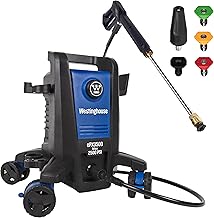
Westinghouse ePX3500
The most complete electric package here: 2,500 max PSI paired with 1.76 GPM, which is the flow rate that separates a satisfying rinse from a tedious one. The anti-tipping base and steel wand feel like they were designed by someone who has actually knocked a washer over mid-job, and the onboard soap tank spares you a separate bottle.
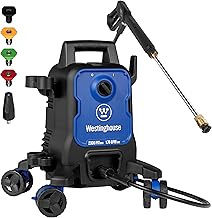
Westinghouse ePX3100
Mechanically the ePX3500’s sibling, trading 200 PSI for a lower price while keeping the same 1.76 GPM flow and five-nozzle set. For cars specifically, this is the smarter buy of the pair, since paint work rarely benefits from the extra pressure but always benefits from the volume.
CRAFTSMAN CMEPW1700
At 1,700 PSI and 1.2 GPM, this is the gentlest option in the group and the one we would hand to a first-timer or anyone protecting a ceramic coating. It is compact, genuinely light, and forgiving, though the modest flow means longer rinse passes on a large SUV.
Adjustable 5000 PSI Electric Washer with 33 ft Hose
Ignore the headline number and focus on the 33-foot hose and adjustable pressure dial, which together are what make this practical for cars: you set output low, park the unit, and work the whole vehicle without moving it. The included foam cannon is decent, and the blue housing is less visually loud than most.
Bright Green Power Washer with Foam Cannon
A sensible entry point with four quick-connect nozzles and a foam cannon included, so nothing else needs buying on day one. Build quality is fair rather than exceptional, but for a car or two plus occasional patio duty, the value proposition is hard to argue with.
Frequently Asked Questions
Will a pressure washer damage my car’s paint?
Not if you use a 25- or 40-degree nozzle, stay about a foot from the surface, and never use the zero-degree red tip on a vehicle. Damage almost always comes from tip selection and proximity, not from the machine’s rating.
Do I still need to hand wash afterward?
For a truly clean finish, yes: foam, rinse, then a light two-bucket wipe with a microfiber mitt. The washer’s job is removing the abrasive material before anything touches your paint.
Electric or gas for home car washing?
Electric, without much debate. Gas units deliver pressure well beyond what paint tolerates, plus noise, fumes, and maintenance you do not need in a driveway.
Can I connect one to an apartment tap?
Most electric washers need roughly 2 GPM of supply from a standard spigot. Balcony taps and utility sinks often fall short, and a few models support bucket feed, so check the manual before assuming.
Final Thoughts
If you want one washer that handles the car and everything else around the house, the Westinghouse ePX3500 is the confident pick, with the ePX3100 delivering nearly identical results for less. Those prioritizing gentleness and easy storage over raw output should look at the CRAFTSMAN CMEPW1700 instead.