Key takeaways
- Match diameter to bay count: A single bay is comfortable with 60 to 72 inches. Two bays want 80 inches or a pair of 65s. Three bays, a deep shop, or anything over 800 square feet calls for a 96-inch HVLS blade span — one large slow fan always beats two small fast ones for coverage.
- Read CFM, not speed count: Airflow volume is the number that determines whether you feel a breeze at the workbench. Look for 6,000 CFM minimum in a garage, and treat anything above 7,000 as genuinely capable of turning over the air in a large space.
- Insist on a DC motor: DC motors draw roughly 60 to 70 percent less power than AC equivalents, run noticeably quieter, and give you fine speed control plus reversibility. That reverse mode matters more than people expect — winter downdraft pulls warm air off the ceiling and back to floor level.
- Check the downrod and ceiling angle: Garages often have sloped or trussed ceilings and 10 to 14 feet of height. Fans shipping with multiple downrod lengths and sloped-ceiling adapters save you a hardware run. Aim for 8 to 9 feet of blade clearance from the floor, and confirm your garage door track path.
- Confirm damp rating and lighting needs: Uninsulated garages swing in humidity, so a damp-rated housing is a baseline, not an upgrade. Decide early whether you want integrated LEDs or a bare fan — if your shop lights are already good, a no-light fan is simpler and cheaper.
What's inside
A garage is the one room in the house that never gets designed. It gets filled. Shelving goes up, a workbench goes in, the car takes the middle, and by August the whole space sits ten degrees hotter than the kitchen with air that refuses to move. Box fans on the floor push dust around at ankle height. Portable units eat outlet space and vibrate off their perch. What the room actually needs is volume — slow, wide, continuous air movement across a high ceiling — and that means a fan sized for the cubic footage, not for a bedroom.
This guide covers the fans built for that job: large-diameter, high-CFM models running quiet DC motors, most of them damp rated for uninsulated bays and covered outdoor runs. I’ve focused on the sizing math that actually matters, the mounting details people discover too late, and six specific fans worth your attention in 2026 — from a compact 65-inch for a single bay up to 96-inch HVLS sweeps that handle a shop or three-car garage on a single unit.
As an Amazon Associate we earn from qualifying purchases.



How to Choose a/an Ceiling Fan For Garage (2026)
- Match diameter to bay count: A single bay is comfortable with 60 to 72 inches. Two bays want 80 inches or a pair of 65s. Three bays, a deep shop, or anything over 800 square feet calls for a 96-inch HVLS blade span — one large slow fan always beats two small fast ones for coverage.
- Read CFM, not speed count: Airflow volume is the number that determines whether you feel a breeze at the workbench. Look for 6,000 CFM minimum in a garage, and treat anything above 7,000 as genuinely capable of turning over the air in a large space.
- Insist on a DC motor: DC motors draw roughly 60 to 70 percent less power than AC equivalents, run noticeably quieter, and give you fine speed control plus reversibility. That reverse mode matters more than people expect — winter downdraft pulls warm air off the ceiling and back to floor level.
- Check the downrod and ceiling angle: Garages often have sloped or trussed ceilings and 10 to 14 feet of height. Fans shipping with multiple downrod lengths and sloped-ceiling adapters save you a hardware run. Aim for 8 to 9 feet of blade clearance from the floor, and confirm your garage door track path.
- Confirm damp rating and lighting needs: Uninsulated garages swing in humidity, so a damp-rated housing is a baseline, not an upgrade. Decide early whether you want integrated LEDs or a bare fan — if your shop lights are already good, a no-light fan is simpler and cheaper.
The Best Ceiling Fan For Garage (2026)s Reviewed
72″ Black 8-Blade Fan with Remote and App Control
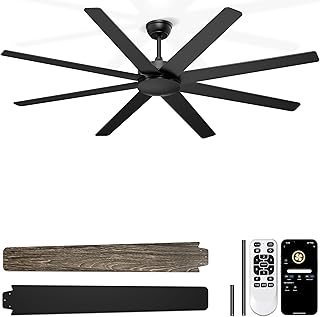
At 7,138 CFM this is the strongest airflow you’ll find under an 80-inch span, and the eight-blade layout keeps the air feeling steady rather than choppy. App control is the quiet luxury here — start the fan from inside the house so the garage is already livable when you walk out.
ZMISHIBO 65″ 6-Speed Fan
The right answer for a single bay or a garage with tighter ceiling height, moving 6,116 CFM without the visual bulk of a commercial sweep. Its matte black finish and clean blade profile make it one of the few garage fans I’d happily hang in a living room or over a covered patio.
ZMISHIBO 80″ Fan with 3-CCT LED
An 80-inch span with a 24W selectable-temperature LED, which makes it the natural pick if your garage lighting is a single sad fixture. The dual-finish blades give it more character than most utility fans, and the damp rating covers unconditioned bays confidently.
ZMISHIBO 96″ Industrial Fan, 8 Aluminum Blades
Eight aluminum blades on a whisper-level DC motor, shipped with three downrods so flat and sloped ceilings are both covered out of the box. This is the fan for a three-car garage or workshop where you want one unit doing all the work.
96″ HVLS Commercial Shop Fan
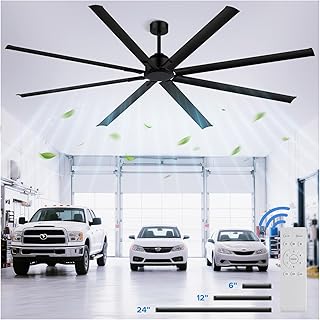
Built on genuine HVLS principles — huge diameter, low rotation speed, wide gentle coverage instead of a concentrated blast. Reversible operation and six speeds make it a year-round fixture in gyms, shops, and garages with serious ceiling height.
Frequently Asked Questions
What size ceiling fan does a two-car garage need?
Plan on 80 inches for standard two-car dimensions, or step up to 96 inches if the ceiling is above 12 feet or the space doubles as a workshop. Undersizing is the most common regret.
Do I need a damp-rated fan in an enclosed garage?
Yes. Most garages are uninsulated and unconditioned, which means real humidity swings and condensation on cold mornings. A damp rating protects the motor housing and wiring.
Can these fans mount on a sloped or trussed ceiling?
Several of these ship with sloped-ceiling adapters and multiple downrods. Verify the maximum supported slope angle for your specific ceiling before ordering, and always mount to a fan-rated brace or joist.
Is a DC motor worth paying more for?
In a garage, absolutely. You get dramatically lower power draw, near-silent operation at low speeds, and reverse mode for winter heat recirculation — three things AC motors handle poorly.
Final Thoughts
For most two-car garages, the ZMISHIBO 80″ with integrated LEDs solves airflow and lighting in one install. If you want maximum air in a compact footprint, the 72″ 8-blade with app control delivers the highest CFM per inch of span here, while large shops and three-bay garages should go straight to the 96″ HVLS commercial fan and be done with the problem.