Key takeaways
- Raised rim: A rim of 0.5–1 inch can contain drips from a bottle or jar.
- Water-resistant base: Rubber, silicone, coated metal, and sealed plastic are safer around oil and vinegar than unfinished wood.
- Drainage control: Outdoor caddies may benefit from drain holes, but indoor table caddies are easier to manage with a solid removable tray.
- Non-slip feet: Four rubber feet reduce sliding and protect polished or lacquered tables.
- Washable inserts: A lift-out tray lets you clean under bottles instead of wiping around them.
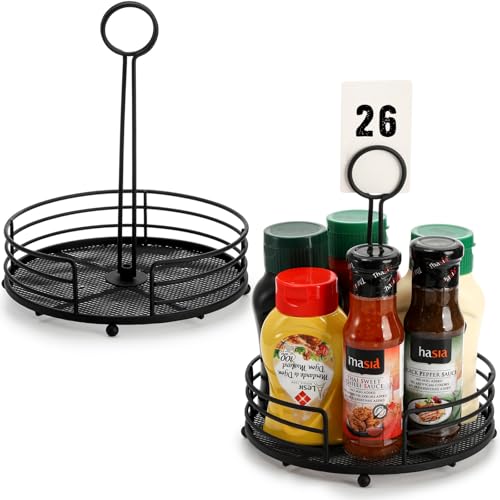
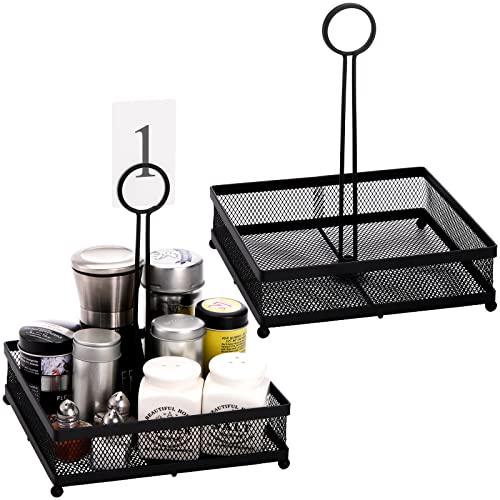
The best condiment caddy for table use is a compact, wipe-clean carrier with a stable base, enough room for the bottles you actually use, and a handle that lets you move everything without squeezing sauces together.
For most dining tables, choose a caddy about 8–12 inches wide, 5–8 inches deep, and no taller than 10 inches. That size usually holds four to six standard bottles or jars while leaving practical elbow room. A larger caddy can be useful for outdoor meals or buffet service, but it may crowd a small table and become heavy when filled.
Our top picks


As an Amazon Associate we earn from qualifying purchases at no extra cost to you. Ratings are shown as listed on Amazon.
Quick picks by dining situation
| Situation | Best caddy type | Useful specifications | Why it fits |
|---|---|---|---|
| Small apartment or two-person table | Narrow handled caddy | 8–10 inches wide; 4–5 inch depth; four compartments | Stores essentials without taking over the center of a compact table |
| Children, pets, or frequent spills | Low, lipped plastic or powder-coated metal caddy | Raised edge of at least 0.5 inch; washable inserts; broad base | Resists tipping and contains small leaks better than an open wooden tray |
| Formal dining room | Solid wood or finished metal organizer | 10–12 inches wide; felt or rubber feet; coordinated finish | Looks intentional and can hold salt, pepper, oil, and serving utensils |
| Outdoor dining or patio table | Rust-resistant metal or weather-resistant plastic caddy | Drainage or removable tray; 2–4 pound filled-load capacity | Handles moisture, sun, and messier condiments more easily |
| Large family meals | Wide multi-compartment carrier | 12–16 inches wide; six to eight compartments; reinforced handle | Keeps more items together, though it needs a larger table footprint |
What dimensions work best on a dining table?
Measure the usable table surface rather than the tabletop’s outside dimensions. A caddy should leave a clear area for plates, glasses, and serving dishes. As a practical guide, allow at least 18 inches of table width per person at a rectangular table. A centered condiment caddy should generally occupy no more than one-third of the table’s narrow dimension.
On a 36-inch-wide table, a caddy up to about 10 inches deep leaves roughly 13 inches of working space on each side. On a 30-inch-wide table, a 6–8 inch depth is more comfortable. For a 24-inch round café table, a compact four-slot caddy under 9 inches wide is safer than a broad tray.
Height matters too. Bottles should be visible without blocking conversation or sightlines across the table. A 6–9 inch height suits most dining settings. Tall oil bottles, pepper mills, and squeeze bottles may require a 10–12 inch carrier, but place those toward the back of a rectangular table so guests can still see one another.
Compartment layouts: fixed slots or flexible storage?
Fixed compartments
Fixed slots keep bottles upright and stop them from sliding into one another when the caddy moves. They work well when your regular set includes similarly sized salt and pepper shakers, hot sauce, ketchup, and mustard. Check the opening dimensions: a slot around 2.5–3 inches wide accommodates many common bottles, while larger condiment jars may need 3.5–4 inches.
The drawback is wasted space. A narrow bottle in a large fixed compartment can tip, while a wide jar may not fit at all. Fixed dividers also create more corners to clean.
Open trays with removable dividers
Adjustable or removable dividers are more adaptable for households that change condiments seasonally. They can accommodate a tall olive-oil bottle, a small jam jar, or a bundle of chopsticks. Look for dividers that lock firmly into grooves; loose inserts can rattle and allow glass containers to collide.
Mixed layouts
A mixed design often offers the best balance: two or three bottle slots, one wider jar compartment, and a flat section for packets or utensils. This is particularly useful for families because it separates frequently handled squeeze bottles from small seasoning containers.
Handle design and carrying safety
A handle is useful only if it provides enough clearance for your fingers and stays rigid under load. Look for an opening at least 1 inch high and 3–4 inches wide. A centered handle keeps the caddy balanced, while a handle attached near the upper sides reduces twisting as you lift it.
For a fully loaded carrier, aim for a handle rated for at least 5 pounds, even if the caddy normally weighs less. Four glass bottles, a salt grinder, and a jar can quickly reach 3–4 pounds. A wooden or metal handle fixed with screws is generally more durable than a thin molded loop. Rounded edges are preferable, especially when children help set the table.
A caddy with two side handles can be easier to control when wide or heavily loaded. However, it needs more clearance around the body and may be less convenient to slide into a pantry. If the carrier will remain on the table, a single centered handle usually uses space more efficiently.
Spill resistance is more than a raised edge
Condiment caddies rarely make bottles leak-proof; their job is to limit the spread of a leak and simplify cleanup. The most useful features are a removable liner, sealed or rounded interior corners, and a base that does not absorb liquid.
- Raised rim: A rim of 0.5–1 inch can contain drips from a bottle or jar.
- Water-resistant base: Rubber, silicone, coated metal, and sealed plastic are safer around oil and vinegar than unfinished wood.
- Drainage control: Outdoor caddies may benefit from drain holes, but indoor table caddies are easier to manage with a solid removable tray.
- Non-slip feet: Four rubber feet reduce sliding and protect polished or lacquered tables.
- Washable inserts: A lift-out tray lets you clean under bottles instead of wiping around them.
Avoid fabric-lined interiors for wet condiments unless the lining can be removed and machine-washed. Fabric absorbs oil and may retain odors. Unsealed bamboo or wood also needs caution: repeated exposure to vinegar, oil, and tomato-based sauces can stain it and cause swelling at joints.
Material comparison
| Material | Advantages | Trade-offs | Best use |
|---|---|---|---|
| Solid wood | Warm appearance, sturdy, easy to coordinate with dining furniture | Needs sealed surfaces; can stain, swell, or split if repeatedly soaked | Dry indoor dining and decorative table settings |
| Engineered wood with laminate or veneer | Usually lighter and less expensive; consistent finish | Damaged edges can allow moisture into the core; fasteners may loosen over time | Occasional indoor use on a protected table |
| Powder-coated metal | Rigid, stain-resistant, and easy to wipe clean | Can scratch surfaces if feet are missing; may dent if dropped | Busy kitchens, families, and heavier bottles |
| Stainless steel | Resists rust and odors; suitable for damp environments | Shows fingerprints and may feel less decorative | Outdoor dining or frequent washing |
| Plastic or polypropylene | Lightweight, inexpensive, and often dishwasher-safe | May become brittle in sunlight; lighter models can tip when loaded unevenly | Children, patios, rentals, and everyday cleanup |
How to choose for children, pets, or frequent moving
Choose a low center of gravity rather than simply the largest capacity. A wide base at least 2 inches broader than the upper storage area is more stable than a tall, narrow basket. Keep the heaviest items in the center or lowest portion, and avoid placing uncapped oil or glass jars in a carrier that will be moved by a child.
For pets, a caddy with a closed or semi-closed lower body can reduce access to dropped packets and bottle caps. For frequent moving between kitchen and dining room, stay below about 5 pounds when filled. Beyond that weight, a caddy becomes awkward to carry with one hand and more likely to be set down abruptly.
Assembly, cleaning, and durability details
Most wooden and metal caddies require only handle attachment, but inspect the connection before loading glass. Screws should sit flush, joints should not flex, and the handle should remain centered when lifted. If a caddy arrives flat-packed, allow for its final assembled width when checking cupboard space. A 10-inch carrier may need a shelf opening of at least 11 inches for comfortable removal.
The parts most likely to wear first are the handle fasteners, protective feet, finish around the base, and any removable divider clips. Rubber feet can harden or detach after repeated washing, while laminated wood edges can lift if water enters a seam. Wipe spills promptly, avoid soaking wood, and dry metal caddies before storing them.
Final buying checklist
- Measure the table and reserve at least 18 inches of width per diner.
- Choose a footprint no deeper than 6–8 inches for a small table and about 10–12 inches for a larger one.
- Match compartment openings to your widest bottle or jar, not your smallest shaker.
- Prefer a centered, rigid handle with at least 1 inch of finger clearance.
- Look for a raised rim, non-slip feet, and a removable washable liner.
- Select sealed wood for appearance, metal for rigidity, or plastic for easy cleanup and low weight.
- Keep the filled carrier under approximately 5 pounds if it will be moved often.
For most households in 2026, a 9–12 inch powder-coated metal or washable plastic caddy with four to six compartments, a 0.5-inch-or-higher rim, and a reinforced centered handle is the safest all-purpose choice. Choose sealed solid wood instead when appearance matters more than maximum spill resistance, and select a narrow four-slot design whenever table space is limited.