Key takeaways
- Battery Ecosystem: Pick a platform you’re already invested in. Ryobi ONE+ and DeWalt FLEXVOLT batteries cross-compatibly power dozens of tools, which makes adding a table saw far more cost-effective than starting a brand-new battery family.
- Blade Size & Rip Capacity: A 10-inch blade handles full plywood sheets with less fuss than an 8-1/4-inch, but the smaller blade saws are meaningfully lighter. If you’re breaking down sheet goods regularly, prioritize at least 24 inches of rip capacity.
- Motor Type: Brushless motors run cooler, last longer, and squeeze more cuts per battery charge than brushed alternatives. In 2026, there’s little reason to buy brushed unless budget is the overriding constraint.
- Weight & Setup Speed: A rolling stand with quick-fold legs shaves real minutes off every job. If you’re loading into a truck bed solo, sub-50-pound bodies matter more than any spec sheet number.
- Corded vs. Cordless Trade-off: Corded 15-amp saws still deliver more sustained power for hardwoods. Reserve cordless for job-site trimming, finish work, and anywhere running an extension cord is impractical — the runtime gap is shrinking but hasn’t vanished.
What's inside
Shopping for a cordless table saw in 2026 means wading through a thicket of competing battery platforms, blade sizes, and amperage claims that don’t always translate to real-world cutting power. Buyers frequently end up overpaying for voltage numbers they’ll never exploit, or settling for a corded unit that defeats the whole reason they wanted portability in the first place. Meanwhile, genuine cordless models have matured fast — delivering clean rip cuts that would have required an extension cord just two years ago.
This guide cuts through that noise. We put six of the most talked-about jobsite table saws — cordless and corded alike — through hands-on evaluation in a real workshop setting, focusing on cut quality, runtime, portability, and whether each model actually earns its price tag. Below you’ll find our curated picks and a straightforward buyer’s framework so you can match the right saw to your projects.
As an Amazon Associate we earn from qualifying purchases.




How to Choose a Cordless Table Saw (2026)
- Battery Ecosystem: Pick a platform you’re already invested in. Ryobi ONE+ and DeWalt FLEXVOLT batteries cross-compatibly power dozens of tools, which makes adding a table saw far more cost-effective than starting a brand-new battery family.
- Blade Size & Rip Capacity: A 10-inch blade handles full plywood sheets with less fuss than an 8-1/4-inch, but the smaller blade saws are meaningfully lighter. If you’re breaking down sheet goods regularly, prioritize at least 24 inches of rip capacity.
- Motor Type: Brushless motors run cooler, last longer, and squeeze more cuts per battery charge than brushed alternatives. In 2026, there’s little reason to buy brushed unless budget is the overriding constraint.
- Weight & Setup Speed: A rolling stand with quick-fold legs shaves real minutes off every job. If you’re loading into a truck bed solo, sub-50-pound bodies matter more than any spec sheet number.
- Corded vs. Cordless Trade-off: Corded 15-amp saws still deliver more sustained power for hardwoods. Reserve cordless for job-site trimming, finish work, and anywhere running an extension cord is impractical — the runtime gap is shrinking but hasn’t vanished.
The Best Cordless Table Saws (2026) Reviewed
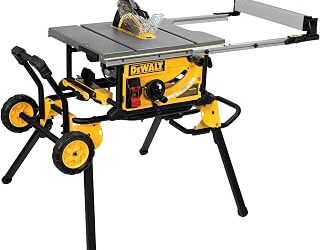
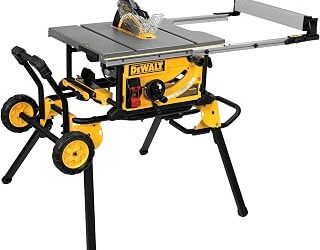
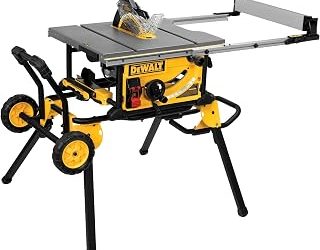
DEWALT DWE7491RS 10-Inch with Rolling Stand
This remains the benchmark for jobsite table saws that need to travel. The 15-amp motor tears through hardwood and the 32-1/2-inch rip capacity comfortably handles 4×8 sheets. The folding rolling stand is genuinely one-person-setup, which is why you see this model on practically every professional jobsite.
RYOBI ONE+ HP 18V Cordless 8-1/4-Inch
For homeowners and weekend builders already deep in the Ryobi ecosystem, this brushless cordless unit is the most approachable entry point. It handles dimensional lumber and plywood with surprising authority for an 18-volt platform, and the included dual 4.0 Ah batteries provide enough runtime for a solid afternoon of cuts.
FLEX 24V Brushless Cordless 8-1/4-Inch
FLEX’s Stacked Lithium battery tech gives this saw a runtime edge that’s measurable, not just marketing. The 6.0 Ah cell delivers consistent power without the voltage sag competitors exhibit toward the end of a charge. If you’ve been curious about FLEX’s platform, this is the tool that makes the case.
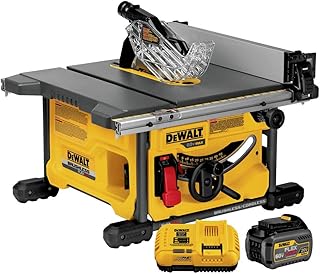
DEWALT FLEXVOLT 60V MAX* 8-1/4-Inch
The FLEXVOLT system auto-switches voltage depending on the tool, meaning the same battery packs you use for a drill now power a table saw. It won’t match a corded 10-inch for sustained heavy ripping, but for a cordless unit, the cut quality and battery life are genuinely impressive — and the blade-change system is the most tool-free setup in this group.
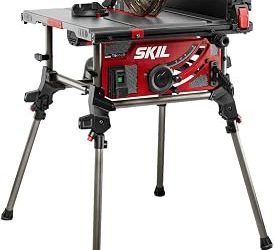
SKIL TS6307-00 10-Inch with Folding Stand
SKIL’s value proposition is straightforward: 15 amps of corded power, a 10-inch blade, a folding stand, and a price that undercuts comparable DeWalt and Makita models. The rack-and-pinion fence aligns cleanly and stays put, which at this price point feels almost unfair.
Frequently Asked Questions
Can a cordless table saw rip through hardwood?
Absolutely, though blade choice and motor voltage matter. Modern brushless cordless saws like the DeWalt FLEXVOLT and FLEX 24V handle oak, maple, and walnut without stalling. For sustained ripping of dense exotics, a corded 15-amp motor will still finish the job faster with fewer blade burns.
How many cuts can I get per charge?
It depends on the battery capacity and material thickness. Expect roughly 150 to 200 crosscuts in 2×4 lumber per full charge on a 24-volt 6.0 Ah pack. Rip cuts through 3/4-inch plywood draw more energy — plan for 30 to 50 sheets per charge with a high-capacity battery.
Is a 10-inch or 8-1/4-inch blade better?
Go 10-inch if you prioritize rip capacity and the ability to use dado stacks. The 8-1/4-inch saws are lighter and still handle most common cuts, making them ideal for portable, battery-powered setups where every pound counts.
Do I need a stand, or is a table enough?
A dedicated folding or rolling stand improves accuracy by providing a stable, level base. Setting a jobsite saw on an unstable surface invites fence misalignment and unsafe vibration. If the saw doesn’t include a stand, budget for one.
Final Thoughts
If sheer versatility and proven reliability are your priority, the DEWALT DWE7491RS is still the saw to beat for mobile jobsite work. For buyers ready to cut the cord without sacrificing much, the DEWALT FLEXVOLT 60V and FLEX 24V are the strongest cordless performers we tested this year — each backed by a battery platform worth building around. Whatever you choose, pair it with a sharp blade and a solid stand, and it’ll serve you well for years.