Key takeaways
- Runner fit: Standard slots measure 3/4″ x 3/8″, but tolerances vary between brands. Look for runners you can shim, wax, or micro-adjust; a sled with side-to-side play will never cut consistently, no matter how carefully the fence is set.
- Capacity versus footprint: Wider sleds handle broader panels but eat into your rip capacity and get heavy to lift on and off. Match cut width to your real work — a 13″ capacity is plenty for drawer boxes and face frames, while cabinet builders need more deck.
- Fence squareness and adjustability: The fence should be tall enough to register a workpiece on edge and adjustable with a five-cut-method tune-up. Fixed, non-adjustable fences leave you no recourse if the sled arrives a fraction out.
- Zero-clearance support: A kerf slot cut by your own blade backs up the grain and nearly eliminates tearout on plywood and veneer. It also traps small offcuts instead of launching them.
- Safety features: Blade guards, rear stop blocks, and hold-down provisions matter most on small-parts work. If you cut parts under 6″, prioritize a sled designed to keep hands off the deck entirely.
What's inside
Anyone who has ever tried to square up a shelf panel on a factory miter gauge knows the frustration: the cut looks clean coming off the blade, but the joint opens by a hair at one corner, and that hair multiplies across a carcass. Crosscutting on a table saw is only as accurate as the guide pushing the workpiece past the blade, and a stamped miter gauge riding loose in a slot simply cannot hold a repeatable 90 degrees. Add small offcuts, and the problem stops being about precision and becomes about keeping your fingers away from a spinning blade.
A crosscut sled solves both issues at once. It rides in the miter slots on fitted runners, carries the workpiece on a flat platform, and gives you a zero-clearance base that supports the fibers right at the cut line. This guide looks at the sleds worth owning in 2026, from compact small-parts jigs to full MDF platforms and DIY runner kits, and explains what actually separates a sled that stays square from one that drifts after a season of use.
As an Amazon Associate we earn from qualifying purchases.



How to Choose a Cross Cut Sled For Table Saw (2026)
- Runner fit: Standard slots measure 3/4″ x 3/8″, but tolerances vary between brands. Look for runners you can shim, wax, or micro-adjust; a sled with side-to-side play will never cut consistently, no matter how carefully the fence is set.
- Capacity versus footprint: Wider sleds handle broader panels but eat into your rip capacity and get heavy to lift on and off. Match cut width to your real work — a 13″ capacity is plenty for drawer boxes and face frames, while cabinet builders need more deck.
- Fence squareness and adjustability: The fence should be tall enough to register a workpiece on edge and adjustable with a five-cut-method tune-up. Fixed, non-adjustable fences leave you no recourse if the sled arrives a fraction out.
- Zero-clearance support: A kerf slot cut by your own blade backs up the grain and nearly eliminates tearout on plywood and veneer. It also traps small offcuts instead of launching them.
- Safety features: Blade guards, rear stop blocks, and hold-down provisions matter most on small-parts work. If you cut parts under 6″, prioritize a sled designed to keep hands off the deck entirely.
The Best Cross Cut Sled For Table Saw (2026)s Reviewed
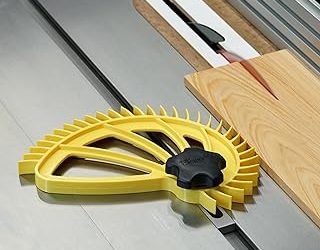
Rockler Small Parts Crosscut Sled
Purpose-built for the cuts most likely to hurt you, this sled combines zero-clearance support with a design that keeps your hands clear while trimming tiny blocks, splines, and box parts. If you build small — jewelry boxes, model work, joinery test pieces — it earns its place faster than any general-purpose platform.
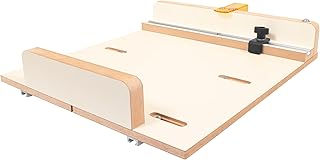
Fulton MDF Crosscut Sled
A traditional shop-built layout executed in stable MDF, with a substantial deck and fence that give you real registration surface for wider panels. It is the most “classic sled” option here, and the honest choice for anyone who wants the performance of a homemade jig without spending a Saturday building one.
Precision Right-Angle Crosscut Sled with Adjustable Stop
At roughly 16″ x 18″, this aluminum-runner sled hits a smart middle ground: enough deck for cabinet parts, compact enough to store on a wall hook. The adjustable stop makes batch-cutting repeat parts genuinely fast, and the transparent guard is a welcome touch for visibility and safety.
POWERTEC 71403 Crosscut Sled Kit
POWERTEC’s kit approach gives you the runners, hardware, and structure to assemble a sled dialed in to your own saw, which is the most reliable path to a perfect slot fit. Budget an hour for setup and the five-cut method, and you will have a sled squarer than most factory-finished options.
Crosscut Sled with Standard 3/4″ x 3/8″ Runners
Built around universal slot dimensions, this sled drops into most DeWalt, Ridgid, and Skil saws without modification and delivers accurate 90-degree and miter cuts up to 13.2″ wide. A sensible pick for the jobsite or contractor saw crowd who need accuracy without a bench-scale footprint.
Frequently Asked Questions
Do I still need a miter gauge if I own a sled?
Keep it for angled cuts on long stock and for quick one-off trims, but for square crosscuts and repeat parts the sled will be more accurate every time. Most woodworkers find the miter gauge stays in the drawer.
How do I check that my sled is truly square?
Use the five-cut method on a scrap panel: rotate the board through four cuts, then measure the error on the fifth offcut and divide by four to isolate the fence deviation. It reveals errors a framing square will never catch.
Will a sled reduce my depth of cut?
Yes. The deck thickness, typically 1/2″ to 3/4″, subtracts directly from blade height, so account for that when cutting thick stock like 8/4 hardwood.
Wood or UHMW runners?
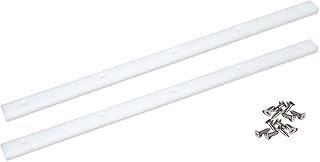
UHMW plastic runners, like the 3/4″ x 3/8″ x 17″ bars sold with predrilled holes, are the more stable option because they ignore seasonal humidity swings and glide with less friction. Wood runners work, but they need re-fitting as the shop changes with the seasons.
Final Thoughts
For most home shops, the Fulton MDF Crosscut Sled is the straightforward answer: generous deck, stable substrate, no assembly guesswork. If your work runs small and safety is the priority, the Rockler Small Parts Sled is the better investment, and the POWERTEC 71403 kit remains the best route for anyone who wants a sled tuned precisely to their own saw’s slots.