Key takeaways
- Swing and throat depth: Swing is twice the distance from spindle center to column, so a 10-inch press reaches the middle of a 10-inch panel. For cabinet doors, drawer fronts, and chair parts, 8 to 10 inches handles most work; 12 inches buys real breathing room on wider stock.
- Quill travel: This is your maximum plunge in one pass. Two inches is usable, 3.2 inches is comfortable, and anything shy of 2 inches means repositioning mid-hole on thicker hardwood — a common source of misalignment.
- Speed range and how you change it: Large Forstner bits want slow speeds around 500 to 700 RPM; small twist bits in metal want faster. Belt-and-pulley presses are cheap and reliable but require opening the head. Variable-speed dials cost more and save real time if you switch bits constantly.
- Table design and tilt: A larger cast iron table with a tilt to 45 degrees opens up angled leg mortises and canted seat joinery. Look for slots or a flat surface that accepts a sacrificial plywood auxiliary top — tear-out control matters more on show surfaces than raw power ever will.
- Cast iron mass and runout: Weight dampens vibration, and vibration is what turns a clean hole into a tapered one. Cast iron heads and bases are a good proxy for build quality; a laser or LED work light is a convenience, not a substitute for a rigid spindle.
What's inside
Anyone who has drilled a row of shelf-pin holes freehand knows the moment of quiet disappointment: the first three look perfect, the fourth drifts, and suddenly a set of floating shelves reads as slightly drunk. Furniture work lives or dies on perpendicular holes — dowel joints, chair rungs, hardware mounting, knife hinges, cable pass-throughs in a media console. A handheld drill can get close. A drill press removes the guesswork entirely, which is exactly why it tends to be the machine home makers buy last and then wonder how they lived without.
The catch is that spec sheets for this category are unusually opaque. Swing, quill travel, throat depth, RPM bands, spindle runout — the numbers matter enormously for woodworking accuracy, and marketing copy rarely explains which ones to weigh. This guide sorts the current benchtop field by the work most home shops actually do: hardwood joinery, sheet goods, the occasional aluminum bracket, and small-scale detail work where a full-size machine is overkill. Below are the models worth your bench space in 2026, plus the buying criteria that separate a genuinely accurate press from a wobbly one.
As an Amazon Associate we earn from qualifying purchases.


How to Choose a Drill Press For Home Shop (2026)
- Swing and throat depth: Swing is twice the distance from spindle center to column, so a 10-inch press reaches the middle of a 10-inch panel. For cabinet doors, drawer fronts, and chair parts, 8 to 10 inches handles most work; 12 inches buys real breathing room on wider stock.
- Quill travel: This is your maximum plunge in one pass. Two inches is usable, 3.2 inches is comfortable, and anything shy of 2 inches means repositioning mid-hole on thicker hardwood — a common source of misalignment.
- Speed range and how you change it: Large Forstner bits want slow speeds around 500 to 700 RPM; small twist bits in metal want faster. Belt-and-pulley presses are cheap and reliable but require opening the head. Variable-speed dials cost more and save real time if you switch bits constantly.
- Table design and tilt: A larger cast iron table with a tilt to 45 degrees opens up angled leg mortises and canted seat joinery. Look for slots or a flat surface that accepts a sacrificial plywood auxiliary top — tear-out control matters more on show surfaces than raw power ever will.
- Cast iron mass and runout: Weight dampens vibration, and vibration is what turns a clean hole into a tapered one. Cast iron heads and bases are a good proxy for build quality; a laser or LED work light is a convenience, not a substitute for a rigid spindle.
The Best Drill Presses For The Home Shop (2026), Reviewed
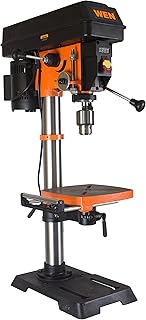
WEN DP1263V 12-Inch Variable Speed Benchtop Drill Press
The most capable benchtop option here for furniture-scale work: 12 inches of swing, a 6.2-amp motor, and infinitely variable speed that lets you dial down for a 2-inch Forstner without touching a belt. If you build casework or chairs regularly, this is the one that stops limiting your designs.
SKIL DP9505-00 10-Inch 5-Speed Benchtop Drill Press
SKIL’s 10-inch press is the sensible middle of the range, pairing a 6.2-amp motor with a laser crosshair and a tool-free belt-tensioning system that makes speed changes far less tedious than the usual wrench-and-swearing routine. A strong pick for a shop that does mixed wood and light metal.
WEN 4206T 8-Inch 5-Speed Benchtop Drill Press
Compact, cast iron, and genuinely accurate for its footprint — this is the press to buy if bench real estate is your binding constraint. The 2.3-amp motor won’t hog through thick stock, but for shelf pins, dowels, and hardware it’s more than adequate.
8-Inch Benchtop Drill Press with Tilting Table
A heavy-duty cast iron head, five speeds from 620 to 3,100 RPM, and a table that both tilts to 45 degrees and adjusts for height make this a flexible small-shop machine. The tilt is the standout feature for anyone doing angled joinery on the cheap.
Dremel 220-01 Rotary Tool Workstation
Not a drill press in the traditional sense, but the smartest 30 dollars in this roundup if you already own a rotary tool. Two inches of travel and adjustable angles make it ideal for inlay, small-parts drilling, and jewelry-scale detail work that a full press handles clumsily.
Frequently Asked Questions
Do I really need variable speed?
Not strictly, but it changes your habits. Belt-change presses tempt you to drill large bits too fast, which scorches end grain and dulls Forstners. If you switch between small twist bits and large boring bits often, variable speed pays for itself in finish quality.
What size drill press suits furniture building?
Ten to twelve inches of swing covers most residential furniture work. Anything smaller starts to fight you on wide panels, though an 8-inch press remains perfectly capable for legs, rails, and hardware installation.
Can I cut mortises with a drill press?
You can rough them with an overlapping series of holes and clean up with a chisel, and many makers do exactly that. Dedicated mortising attachments exist for some models, but check that your specific press supports one before assuming it will.
Benchtop or floor-standing?
Floor models offer more quill travel and vertical capacity, which matters for tall workpieces and metalwork. For a home shop building furniture, a well-built benchtop press mounted to a solid bench is the better use of space.
Final Thoughts
For most home furniture makers, the WEN DP1263V is the clear recommendation — the combination of 12-inch swing and true variable speed removes the two limitations you’d otherwise grow into. The SKIL DP9505-00 is the value pick if you can live with 10 inches and pulley changes, and the WEN 4206T remains the honest answer for tight benches and modest budgets.