Key takeaways
- Surface size and swing: Match the table to your press. A 23 to 24 inch top suits 12 inch and larger machines; on a smaller press, an oversized table can overhang awkwardly and block the column crank.
- Fence and stop system: An extruded aluminum fence stays straighter than wood over the seasons. A flip stop is the feature that actually saves time, letting you drill twenty identical holes without re-measuring once.
- Replaceable insert: Look for a removable center block. It backs up the exit side of your bit for clean, tear-out-free holes, and costs pennies to replace instead of scarring the whole top.
- T-tracks and hold-downs: Tracks along the fence and front edge let you add clamps and feather boards. This is what turns a table into a system rather than a flat board.
- Mounting and material: Confirm the slot pattern lines up with your press’s cast table. Thick MDF is dimensionally stable and dead flat; phenolic-coated tops slide better under heavy stock.
What's inside
A drill press is only as accurate as the surface beneath it. Most benchtop models ship with a small cast-iron platen that was designed for metal shops in the 1950s: no fence, no repeatable stop, and a bare hole in the middle that lets wood fibers blow out the instant the bit exits. If you build furniture, cabinet doors, floating shelves, or anything where a row of shelf-pin holes has to look intentional, that stock table is the weak link in the whole operation.
An aftermarket drill press table fixes it. You get a broad, flat work surface, a straight fence with a flip stop for repeat cuts, T-tracks for clamping, and a sacrificial insert you can swap when it chews out. This guide covers the tables worth bolting on in 2026, plus two benchtop presses and one workbench that pair well with them, so you can put together a drilling station that earns its footprint in a home workshop or a tidy garage studio.
As an Amazon Associate we earn from qualifying purchases.



How to Choose a Drill Press Table (2026)
- Surface size and swing: Match the table to your press. A 23 to 24 inch top suits 12 inch and larger machines; on a smaller press, an oversized table can overhang awkwardly and block the column crank.
- Fence and stop system: An extruded aluminum fence stays straighter than wood over the seasons. A flip stop is the feature that actually saves time, letting you drill twenty identical holes without re-measuring once.
- Replaceable insert: Look for a removable center block. It backs up the exit side of your bit for clean, tear-out-free holes, and costs pennies to replace instead of scarring the whole top.
- T-tracks and hold-downs: Tracks along the fence and front edge let you add clamps and feather boards. This is what turns a table into a system rather than a flat board.
- Mounting and material: Confirm the slot pattern lines up with your press’s cast table. Thick MDF is dimensionally stable and dead flat; phenolic-coated tops slide better under heavy stock.
The Best Drill Press Tables (2026) Reviewed
O’SKOOL DAB022 Drill Press Table
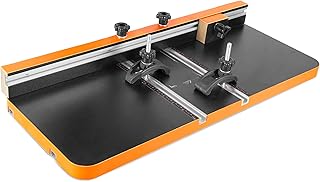
The most complete package here: a 23-5/8 by 15 inch MDF surface an inch thick, an aluminum fence with a flip stop, twin T-tracks, and a replaceable insert. If you want one purchase that turns a 12 inch press into a precision boring station, this is the one to start with.
WEN DPA2513 Drill Press Table
A 24 by 12 inch top with an adjustable fence and stop block, priced as an easy upgrade rather than a project. The slightly narrower depth is a plus in cramped shops, and it handles shelf-pin rows and dowel joinery with no fuss.
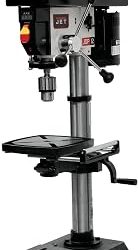
JET JWDP-12 12-Inch Benchtop Drill Press
Variable speed, half a horsepower, and the build quality JET is known for, with minimal runout at the chuck. It is the press to buy if you plan to keep it for twenty years and want your aftermarket table sitting on a genuinely flat casting.
WORKPRO 48″ Adjustable Workbench
A rubberwood top rated to 2,000 pounds, five height settings, and built-in outlets, which means your press, sander, and shop vac plug in at the bench instead of across the room. Set it low and you can stand comfortably over long stock.
VEVOR 12-Inch Benchtop Drill Press (1 HP)
A 6.2 amp motor, 530 to 3140 RPM variable speed, a table that tilts to 45 degrees, plus a laser and LED light. Strong value for mixed wood and metal work, though the tilting table is the part you will want to trade out for a proper wooden top.
Frequently Asked Questions
Will an aftermarket table fit my drill press?
Usually, but check the slot spacing on your cast-iron table before ordering. Most tables bolt through the existing slots; some presses need a simple plywood adapter, which takes about ten minutes to make.
Do I lose drilling depth?
Yes, roughly the thickness of the table, so about an inch. That matters for tall workpieces, so plan on raising the head or removing the auxiliary top for the occasional deep job.
MDF or plywood for the top?
MDF wins for flatness and a smooth sliding surface. Baltic birch plywood is tougher against dings and moisture, which is worth considering in an unheated garage.
Is a dust port worth it?
For repetitive boring in sheet goods, absolutely. Chips pile up fast around a fence and lift your workpiece off the table, which quietly ruins accuracy.
Final Thoughts
For most home woodworkers, the O’SKOOL DAB022 is the upgrade that changes how a drill press feels to use, with the WEN DPA2513 as the leaner, budget-friendly alternative. Pair either with the JET JWDP-12 if you want a press worth building a station around, and you have a setup that produces furniture-grade holes without asking for more bench space than it deserves.