Key takeaways
- Jaw width and opening: A 4″ jaw handles the overwhelming majority of furniture work — table aprons, drawer fronts, hardware blanks, tube stock for hairpin legs. Step up to 6″ only if you regularly clamp wide panels or thick steel plate; the extra mass is real and so is the footprint it steals from your table.
- Profile height: Low-profile bodies matter more than buyers expect. Every inch of vise height is an inch of quill travel you no longer have, which becomes painful the moment you chuck a long brad-point or a Forstner in a benchtop press with modest stroke.
- Body material and machining: Look for ductile or 45-grade steel construction with a ground base and jaws that close flat along their full length. Hold a straightedge against the fixed jaw if you can — cheap castings show daylight, and daylight means your part tilts under clamping pressure.
- Jaw protection: Serrated steel jaws bite beautifully and scar softwood and brass just as beautifully. Multi-groove pads, replaceable liners, or a habit of cutting hardwood cauls will save finished surfaces. Grooved jaws that hold round stock vertically and horizontally are a genuine convenience for dowel and tube work.
- Adjustment and mounting: Quick-release buttons speed up production runs; a plain screw is slower but has fewer things to wear out. Either way, confirm the base slots line up with your drill press table so the vise can actually be bolted down. An unbolted vise is a projectile.
What's inside
Most furniture projects don’t fall apart at the joinery bench. They fall apart at the drill press, in the four seconds it takes for a bit to grab a strip of walnut and spin it into your knuckles. Anyone who has drilled a shelf-pin row, mortised a brass pull, or bored through a steel bracket for a floating console knows the tell: a hole that wanders, an entry that blows out, a workpiece that shifts a hair between the first pass and the fifth. The fix isn’t a steadier hand. It’s a vise that removes hands from the equation entirely.
A drill press vise is one of the least glamorous purchases in a workshop and one of the highest-leverage. It buys you repeatability, square entry, and the confidence to drill hardware for a piece you’ve already spent forty hours building. This guide covers the vises worth putting under your quill in 2026, from low-profile machinist models built for tight quill travel to compound cross-slide units that turn a benchtop drill press into something closer to a light mill. Below, what to look for, then honest notes on each pick.
As an Amazon Associate we earn from qualifying purchases.




How to Choose a Drill Press Vise (2026)
- Jaw width and opening: A 4″ jaw handles the overwhelming majority of furniture work — table aprons, drawer fronts, hardware blanks, tube stock for hairpin legs. Step up to 6″ only if you regularly clamp wide panels or thick steel plate; the extra mass is real and so is the footprint it steals from your table.
- Profile height: Low-profile bodies matter more than buyers expect. Every inch of vise height is an inch of quill travel you no longer have, which becomes painful the moment you chuck a long brad-point or a Forstner in a benchtop press with modest stroke.
- Body material and machining: Look for ductile or 45-grade steel construction with a ground base and jaws that close flat along their full length. Hold a straightedge against the fixed jaw if you can — cheap castings show daylight, and daylight means your part tilts under clamping pressure.
- Jaw protection: Serrated steel jaws bite beautifully and scar softwood and brass just as beautifully. Multi-groove pads, replaceable liners, or a habit of cutting hardwood cauls will save finished surfaces. Grooved jaws that hold round stock vertically and horizontally are a genuine convenience for dowel and tube work.
- Adjustment and mounting: Quick-release buttons speed up production runs; a plain screw is slower but has fewer things to wear out. Either way, confirm the base slots line up with your drill press table so the vise can actually be bolted down. An unbolted vise is a projectile.
The Best Drill Press Vises (2026), Reviewed
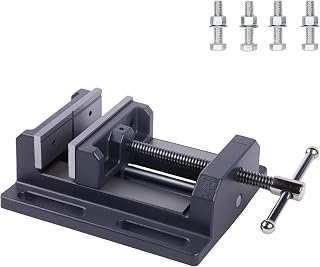
4″ Heavy Duty Bench Vise with Multi-Groove Jaw Pads and Quick Adjustment
The most versatile pick for a mixed woodworking and metal shop: the quick-adjustment button lets you span from thin veneer stock to thick blanks without cranking the screw across its whole range. The multi-groove pads are the standout feature, holding round legs and tube stock securely enough that you can drill cross-holes without a V-block.
Wilton Low-Profile Drill Press Vise (LP4)
Wilton’s LP4 is the reference standard, and it earns that with a genuinely low-slung ductile iron body, 4″ of both jaw width and opening, and machining tolerances that hold square under real clamping force. If you own one vise for the next twenty years, this is the sensible choice.
Precision 6″ Heavy Duty Drill Press Vise
For anyone fabricating steel bases, brackets, or wide panel hardware, the 6″ model brings the clamping surface and mass that a 4″ simply can’t. Expect it to dominate a small table — this is a vise you bolt down and leave there.
4″ Machinist Vise in 45-Grade Steel, Low Profile
A well-priced middle ground: 45 steel construction and a low deck height give you most of the rigidity of a premium vise for considerably less. Sensible pick for a garage shop drilling both hardwood and the occasional metal component.
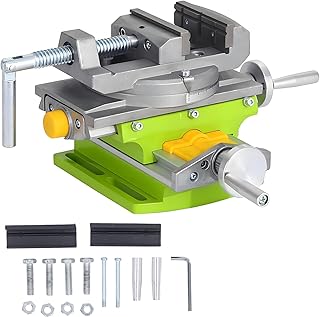
3″ Cross Slide Compound Vise with 90° Rotary Table
The specialist. Two-axis X-Y travel plus a rotary table means you can position holes precisely, cut simple slots, and index circular bolt patterns for custom brass or steel hardware. Not the vise for general clamping, but transformative if you design your own fittings.
Frequently Asked Questions
Do I really need one for furniture work?
Yes, once your projects have hardware. Hand-holding small parts under a drill press is the single most common cause of shop injuries and ruined components, and no clamping alternative gives you the same square, repeatable results.
Should I bolt the vise to the table?
Always, for anything beyond the lightest pilot hole. A bit that grabs will spin an unbolted vise instantly. If your table slots don’t match the base, a simple plywood subtable with T-track solves it.
Can a drill press vise double as a bench vise?
For light holding and filing, sure. For sawing, hammering, or heavy prying, no — these are designed for downward clamping loads, not lateral abuse.
How do I avoid marring brass and softwood?
Cut a pair of hardwood or aluminium cauls to sit inside the jaws, or choose a vise with smooth replaceable pads. It takes five minutes and protects finished surfaces indefinitely.
Final Thoughts
If you want one vise that simply works and never needs revisiting, the Wilton LP4 is the buy — low profile, properly machined, and built to outlast the drill press it sits on. Choose the 4″ quick-adjust with multi-groove pads if you value speed and round-stock versatility, and add the 3″ cross-slide compound vise if you’re designing and drilling your own hardware, where precise positioning turns good furniture into unmistakably custom furniture.