Key takeaways
- Pressure range, not peak PSI: Automotive paint is happiest between roughly 1200 and 1900 PSI at the nozzle. A 3000 PSI machine is fine as long as you pair it with a 25° or 40° tip and keep your distance — the nozzle, not the pump, sets the working pressure.
- Flow rate does the rinsing: GPM moves dirt off the panel; PSI just breaks it loose. Anything from 1.2 GPM up will wash a sedan, but 1.6 to 2.2 GPM rinses foam noticeably faster and cuts total time at the driveway.
- Motor type and noise: Brushless induction motors run quieter, last longer, and handle back-to-back sessions without heat soak. Universal motors cost less and start lighter, but they’re louder in a closed garage.
- Foam delivery: An onboard detergent tank is convenient for quick washes; a dedicated foam cannon on a machine with decent flow gives the thick, clinging layer that lets you clean touch-free before mitt ever meets paint.
- Where it lives between washes: This is the spec buyers skip. Wall-mounted units with retractable hose reels reclaim floor space and eliminate coiling entirely. If you’re going cart-style, look for integrated hose and cord management and a genuinely stable base.
What's inside
Washing a car at home sits in an awkward gap between chore and craft. Too little pressure and road film just smears; too much and you’re driving swirl marks into clear coat or blasting water past a door seal. Most buyers end up choosing on a single number — max PSI — then discover that the loud, hose-tangling unit they bought lives on the garage floor, gets dragged out twice a season, and quietly becomes clutter in a space they’d otherwise keep tidy.
This guide approaches the problem the way we approach any piece that lives in a home: performance first, but with real attention to footprint, storage, and how it looks parked next to everything else. Below are six electric pressure washers worth considering in 2026, from compact cart-style units to wall-mounted systems that disappear into a garage wall, plus the specs that actually matter for automotive paint.
As an Amazon Associate we earn from qualifying purchases.


How to Choose a/an Electric Pressure Washer For Cars (2026)
- Pressure range, not peak PSI: Automotive paint is happiest between roughly 1200 and 1900 PSI at the nozzle. A 3000 PSI machine is fine as long as you pair it with a 25° or 40° tip and keep your distance — the nozzle, not the pump, sets the working pressure.
- Flow rate does the rinsing: GPM moves dirt off the panel; PSI just breaks it loose. Anything from 1.2 GPM up will wash a sedan, but 1.6 to 2.2 GPM rinses foam noticeably faster and cuts total time at the driveway.
- Motor type and noise: Brushless induction motors run quieter, last longer, and handle back-to-back sessions without heat soak. Universal motors cost less and start lighter, but they’re louder in a closed garage.
- Foam delivery: An onboard detergent tank is convenient for quick washes; a dedicated foam cannon on a machine with decent flow gives the thick, clinging layer that lets you clean touch-free before mitt ever meets paint.
- Where it lives between washes: This is the spec buyers skip. Wall-mounted units with retractable hose reels reclaim floor space and eliminate coiling entirely. If you’re going cart-style, look for integrated hose and cord management and a genuinely stable base.
The Best Electric Pressure Washer For Cars (2026)s Reviewed
Giraffe Tools Grandfalls Pressure Washer Pro
The most considered piece here, and the one we’d specify for a garage you actually care about — a 1800W brushless motor, 3700 PSI, and 100 feet of retractable hose all mounted flat to the wall in a light silver housing that reads more fixture than tool. Reach the far side of a driveway, then let the reel swallow the hose; the compromise is a permanent install and a higher spend.
Giraffe Tools G20 Wall Mount
The G20 trades the Pro’s peak pressure for 2.2 GPM, which is arguably the better trade for car washing, and its 180° swivel bracket makes working around a two-bay garage genuinely easy. At 2500 PSI with 65 feet of auto-rewind hose and five quick-connect nozzles, it’s the value entry point into wall-mounted washing.
Greenworks 3000 PSI Brushless
The strongest cart-style performer on this list, with a brushless motor and 2.0 GPM that make short work of wheel wells, salt film, and winter grime. Fit the 40° tip for bodywork and save the narrower nozzles for concrete — treated that way, it’s close to a one-machine solution for the whole property.
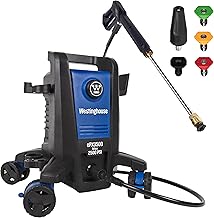
Westinghouse ePX3500
A well-resolved mid-range unit: 2500 PSI, 1.76 GPM, an onboard soap tank, and a pro-style steel wand that feels considerably better in hand than the plastic assemblies at this price. The anti-tipping design is a small detail that matters more than it sounds once you start pulling hose across a sloped driveway.
Sun Joe SPX3000
Still the default recommendation for first-time buyers, and deservedly so — dual detergent tanks, five quick-connect tips, and a 2030 PSI PWMA-rated output that’s genuinely well matched to paint. It’s louder and more plastic than the others, but nothing here does more for the money.
Frequently Asked Questions
Can a pressure washer damage car paint?
Yes, if misused. Keep the nozzle 12 to 18 inches from the panel, use a wide 25° or 40° tip, never a zero-degree or turbo nozzle, and avoid holding the spray on chipped paint, badges, or trim edges where water can lift material.
How much PSI do I actually need?
For cars alone, 1500 to 2000 PSI is plenty. Higher-rated machines are worth buying if you also want to clean siding, fences, or concrete — you simply dial pressure down at the nozzle for automotive work.
Is a wall-mounted model worth the extra cost?
If you wash more than a few times a season, yes. The time saved on setup and teardown compounds, and reclaiming the floor space is a real quality-of-life gain in a garage doing double duty as storage.
Do I need a separate foam cannon?
An onboard soap tank produces a thin solution suited to a quick pre-rinse. For the thick clinging foam that loosens dirt before contact, add a dedicated cannon — it’s an inexpensive upgrade with an outsized effect on finish quality.
Final Thoughts
For most readers, the Greenworks 3000 PSI Brushless is the best all-around buy: quiet, capable, and flexible enough to move from car to driveway without complaint. If garage space and appearance factor into the decision, the Giraffe Tools G20 delivers wall-mounted convenience at a reasonable price, with the Grandfalls Pro as the upgrade for anyone building a garage they want to show off. On a tight budget, the Sun Joe SPX3000 remains hard to argue with.