Key takeaways
- Measure your actual target, not the roofline: Second-story window sills usually sit 13–16 feet up, gutters 16–20 feet. Set at the correct 4:1 lean, a ladder loses roughly a quarter of its length in height, so a 20-foot ladder gives you about 19 feet of usable reach. Roof access needs three extra feet above the eave.
- Match the duty rating to you plus your load: A 330 lb or Type IA 300 lb rating covers your body weight, boots, tools, and a bucket of debris with margin. Treat the rating as a ceiling you never approach, not a target.
- Insist on stabilizers or a wide base: Side sway is what makes height feel frightening. Triangle stabilizer feet and stabilizer bars widen the contact patch and bite into grass or gravel far better than bare rails.
- Choose the material for the job: Fiberglass is non-conductive and mandatory anywhere near service drops or exterior wiring. Aluminum and stainless telescoping designs win on weight and storage but should never go near a live line.
- Weigh storage against rigidity: Telescoping models fold to roughly a yard and slide into a closet or RV bay. Traditional two-section fiberglass ladders feel noticeably stiffer at full extension but demand wall space or a garage rack.
What's inside
A two-story wall is the exact point where most home ladders stop being useful. The 6-foot step ladder in the garage handles light bulbs and paint trim, then leaves you stranded the moment a gutter clogs or a dryer vent needs clearing eighteen feet up. What follows is a scramble: borrowing something too short, propping it at a bad angle, and standing on the top rung — the sequence behind a startling share of home injuries every year.
This guide looks at extension and telescoping ladders sized for second-story access, judged on the things that actually matter once you’re off the ground: rung depth underfoot, base stability on uneven lawn, how honest the stated reach is, and whether the thing collapses small enough that you’ll keep it somewhere accessible instead of buried behind the bikes. Reach math is covered too, because the number printed on the box is rarely the number you can safely work from.
As an Amazon Associate we earn from qualifying purchases.


How to Choose a Extension Ladder For 2 Story House (2026)
- Measure your actual target, not the roofline: Second-story window sills usually sit 13–16 feet up, gutters 16–20 feet. Set at the correct 4:1 lean, a ladder loses roughly a quarter of its length in height, so a 20-foot ladder gives you about 19 feet of usable reach. Roof access needs three extra feet above the eave.
- Match the duty rating to you plus your load: A 330 lb or Type IA 300 lb rating covers your body weight, boots, tools, and a bucket of debris with margin. Treat the rating as a ceiling you never approach, not a target.
- Insist on stabilizers or a wide base: Side sway is what makes height feel frightening. Triangle stabilizer feet and stabilizer bars widen the contact patch and bite into grass or gravel far better than bare rails.
- Choose the material for the job: Fiberglass is non-conductive and mandatory anywhere near service drops or exterior wiring. Aluminum and stainless telescoping designs win on weight and storage but should never go near a live line.
- Weigh storage against rigidity: Telescoping models fold to roughly a yard and slide into a closet or RV bay. Traditional two-section fiberglass ladders feel noticeably stiffer at full extension but demand wall space or a garage rack.
The Best Extension Ladder For 2 Story House (2026)s Reviewed
SocTone 12.5FT Telescoping Ladder with Stabilizers
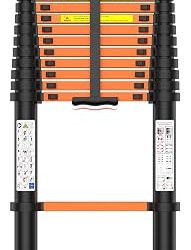
The sweet spot for second-story windows, siding repairs, and low eaves, with stabilizer feet that settle confidently on turf and a 330 lb rating. It collapses to about 32 inches, which is why it tends to get used rather than avoided.
Louisville FE3216 16-Foot Fiberglass Extension Ladder
The conventional choice, and still the one to buy if any of your work sits near electrical service entries — Type IA fiberglass rails, 300 lb capacity, and rungs that feel dead solid underfoot. Heavier and bulkier than any telescoping rival, which is the fair trade for that rigidity.
20FT Multi-Position A-Frame Ladder with Wheels
The most versatile pick here: it locks as an A-frame, a straight extension, or a stairwell configuration, so one purchase covers interior stairs and exterior gutters. Wheels and a stabilizer bar make repositioning around a house manageable for one person.
Soctone 17.5FT Multi-Position A-Frame Ladder
A lighter, tidier take on the same multi-position idea, with a stabilizer bar and 330 lb rating that suit gutter cleaning and second-story trim painting. The orange rails are genuinely practical — you spot the ladder, and anyone walking past does too.
8.5FT Stainless Steel Telescoping Ladder
Too short for eave work, but the smartest companion ladder in the group: stainless construction resists coastal corrosion, and dual triangle stabilizers make it dependable for RV roofs, garage ceilings, and interior stairwells.
Frequently Asked Questions
What ladder length do I need for a two-story house?
For gutters at 18 feet, plan on a 24-foot extension ladder; for second-story windows around 14 feet, a 16 to 20-foot ladder works. Always add length for the lean angle, and three feet more if you intend to step onto the roof.
Are telescoping ladders safe at that height?
Reputable ANSI or EN 131-certified models with proper rung locks are safe when fully extended and locked, with every latch visually confirmed. Verify each section engaged before you climb — partial extension is the common failure mode.
Can I use an aluminum ladder outdoors?
Yes, provided you stay well clear of power lines, service drops, and weatherheads. If your work is anywhere near incoming electrical service, use fiberglass instead.
How should I set the base on grass or slope?
Level the footing with a stable board or ladder leveler, never loose bricks, and follow the 4:1 rule — one foot of base offset per four feet of height. Tie off the top when you’ll be up there a while.
Final Thoughts
For most two-story homes, the 20FT Multi-Position A-Frame Ladder covers the widest range of jobs from stairwells to gutters, while the Louisville FE3216 remains the safer answer wherever electrical service is in play. If storage space is the real constraint, the SocTone 12.5FT Telescoping Ladder handles window-height work and disappears into a closet afterward.