Key takeaways
- Step count vs. freeboard: Measure from the deck surface to the waterline at its lowest seasonal point, then plan on roughly 10 inches per step with at least two steps fully submerged. Low floating docks are happy with four steps; fixed docks with real tidal swing or a high deck usually need five to seven.
- Tread width and depth: Anything under 16 inches wide feels precarious with wet feet. Look for 20-inch spans and 4-inch-deep treads with a molded or punched non-slip surface — that depth is what lets you climb with your heels down instead of toe-hooking each rung.
- Alloy and fastener quality: Marine-grade aluminum is the baseline, but the failure point is almost always the hardware. Stainless steel bolts, bushings, and hinge pins are non-negotiable in brackish or salt water; mixed-metal assemblies seize and streak within a season or two.
- Rated capacity and frame geometry: Capacity ratings from 300 to 750 pounds tell you less than the tube profile does. Welded frames and round-tube rails flex least under load, and a slanted stringer is meaningfully easier to climb than a vertical one, especially for kids and older swimmers.
- Lock-down mechanism: A quick-release safety pin that secures the ladder both down and stowed is the feature people miss most. Pull ropes, integrated handrails, and pre-drilled mounting plates all shorten install time and reduce the chance of a mid-climb surprise.
What's inside
Waterfront design usually gets judged from the shore: the decking, the railing profile, the way the boards meet the water. Then someone actually swims, and the whole composition hinges on a single detail nobody planned for. A ladder that stays submerged all season turns into a slick, algae-furred hazard within weeks. One that’s too narrow forces a knuckle-white climb. One bolted flat to the frame becomes a shin-catcher the moment the water drops or the ice comes in. It’s the smallest piece of hardware on the dock and the one that dictates whether people use the water at all.
A flip-up ladder solves the problem structurally rather than cosmetically. Hinged at the deck, it rotates clear of the waterline when you’re done, drying the treads, sparing the hardware, and clearing the swim lane for boats and lines. This guide covers what actually separates a good flip-up model from a rattling one, then walks through six aluminum ladders worth specifying in 2026 — from compact four-step units for low freeboard to tall welded frames built for serious lift.
As an Amazon Associate we earn from qualifying purchases.


How to Choose a Flip-Up Dock Ladder (2026)
- Step count vs. freeboard: Measure from the deck surface to the waterline at its lowest seasonal point, then plan on roughly 10 inches per step with at least two steps fully submerged. Low floating docks are happy with four steps; fixed docks with real tidal swing or a high deck usually need five to seven.
- Tread width and depth: Anything under 16 inches wide feels precarious with wet feet. Look for 20-inch spans and 4-inch-deep treads with a molded or punched non-slip surface — that depth is what lets you climb with your heels down instead of toe-hooking each rung.
- Alloy and fastener quality: Marine-grade aluminum is the baseline, but the failure point is almost always the hardware. Stainless steel bolts, bushings, and hinge pins are non-negotiable in brackish or salt water; mixed-metal assemblies seize and streak within a season or two.
- Rated capacity and frame geometry: Capacity ratings from 300 to 750 pounds tell you less than the tube profile does. Welded frames and round-tube rails flex least under load, and a slanted stringer is meaningfully easier to climb than a vertical one, especially for kids and older swimmers.
- Lock-down mechanism: A quick-release safety pin that secures the ladder both down and stowed is the feature people miss most. Pull ropes, integrated handrails, and pre-drilled mounting plates all shorten install time and reduce the chance of a mid-climb surprise.
The Best Flip-Up Dock Ladders Reviewed (2026)
Extreme Max 3005.4227 Slanted 4-Step Aluminum
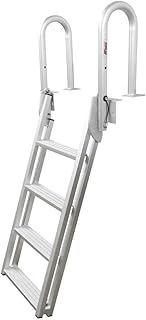
The slant angle here is the point: round-tube rails and a raked stringer make the climb feel closer to a stair than a ladder, which matters when you’re hauling yourself up one-handed. At 300 pounds capacity it’s the lightest-duty pick on this list, best suited to floating docks and family swim use rather than heavy daily traffic.
VEVOR 4-Step Flip-Up Dock Ladder
The value option that doesn’t feel like one, with wide non-slip treads and a pull-rope assist that makes flipping it up from the water genuinely easy. Fit and finish trail the premium brands slightly, so budget an hour for careful alignment during install — get the hinge square and it operates cleanly for years.
RecPro Marine 4-Step, 20″ Wide
RecPro’s 20-inch span is the widest four-step here, and that extra breadth changes the feel of the climb more than any spec sheet suggests. It’s also configurable as flip-up or stationary, which makes it a smart choice for pontoons and docks where you may want to change the setup later.
JIF Marine Hinged 4-Step, 750 lb
A 750-pound rating on a four-step frame is genuinely overbuilt, and it shows in the extra-wide 4-inch treads and the confident quick-release pin. This is the one to specify for a busy shared dock where multiple people climb out every hour and nobody is gentle with the hardware.
Dockmate Wide 5-Step with Handrails
Dockmate’s integrated handrails are the standout detail — they give you something to hold above the deck line, which is exactly where most ladder exits go wrong. The corrosion-resistant build and 750-pound capacity make it the strongest all-round choice for salt water and taller fixed docks.
Frequently Asked Questions
How many steps do I actually need?
Count on two submerged steps at minimum. Measure deck-to-water at the lowest point of the season and divide by 10 inches, then add two. Deep-set fixed docks often land on the Dock Edge 7-step; most floating docks are fine with four.
Will an aluminum ladder survive salt water?
Marine-grade aluminum handles salt well; the fasteners are what fail. Choose a model with stainless hardware, rinse it after use, and flip it up so the treads and hinge dry between swims.
Can I install one myself?
Yes, if your dock has solid framing at the mount point. You’ll need a drill, marine sealant, and stainless through-bolts with backing plates. Fastening into decking alone is the most common install mistake.
Why not just leave it in the water?
Submerged treads grow algae and biofouling fast, hardware corrodes quicker, and in freezing climates ice can bend or shear a fixed ladder off the frame. Flipping up eliminates all three.
Final Thoughts
For most waterfronts, the JIF Marine 4-step hits the best balance of overbuilt capacity, wide treads, and clean flip-up action at a sensible price. Step up to the Dockmate 5-step if you’re in salt water or want handrails at the deck exit, and consider the Extreme Max slanted model if an easy, stair-like climb matters more than maximum load rating.