Key takeaways
- Voltage and circuit capacity: A 120V outlet caps you at roughly 1,500W, which is fine for a single-car bay you use in short bursts. Anything above that needs a dedicated 240V circuit and, in most cases, a licensed electrician. Confirm your panel has room before shopping.
- Wattage matched to volume, not floor area: Budget around 10 watts per square foot in an insulated garage and closer to 15 in an uninsulated one. High ceilings and a tall door push you toward the 5,000W to 7,500W range.
- Mounting style: Ceiling and wall mounts reclaim floor space and keep the unit clear of sawdust, solvents, and vehicle traffic. Portable units win when you want heat aimed at a specific bench rather than the whole room.
- Convection versus radiant heat: Fan-forced convection warms the entire volume of air and suits long sessions. Radiant quartz heats objects and people almost instantly, which is the better call for drafty spaces or brief visits.
- Controls and safety listings: Look for a digital thermostat, a timer, tip-over and overheat protection, and an ETL or UL listing. A remote sounds like a luxury until the unit is bolted twelve feet overhead.
What's inside
A garage is the one space in the house that gets designed last and used constantly. Bare concrete pulls heat straight out of the room, an uninsulated roll-up door leaks warmth all winter, and the standard 120V heater from the hallway closet simply cannot keep up with 400 square feet of cold slab. The result is a workshop you avoid in January, a home gym that goes unused, and a hobby bench that sits under a dust sheet until spring.
This guide looks at garage heating the way we look at any other fixture: as something that should perform hard and disappear visually. Below are six electric heaters worth your attention in 2026, spanning hardwired 240V ceiling units for serious square footage, radiant quartz panels with integrated task lighting, and plug-in wall models for smaller bays. We cover the wiring realities first, then the picks, so you know what your panel can actually support before you commit.
As an Amazon Associate we earn from qualifying purchases.


How to Choose a Garage Electric Space Heater (2026)
- Voltage and circuit capacity: A 120V outlet caps you at roughly 1,500W, which is fine for a single-car bay you use in short bursts. Anything above that needs a dedicated 240V circuit and, in most cases, a licensed electrician. Confirm your panel has room before shopping.
- Wattage matched to volume, not floor area: Budget around 10 watts per square foot in an insulated garage and closer to 15 in an uninsulated one. High ceilings and a tall door push you toward the 5,000W to 7,500W range.
- Mounting style: Ceiling and wall mounts reclaim floor space and keep the unit clear of sawdust, solvents, and vehicle traffic. Portable units win when you want heat aimed at a specific bench rather than the whole room.
- Convection versus radiant heat: Fan-forced convection warms the entire volume of air and suits long sessions. Radiant quartz heats objects and people almost instantly, which is the better call for drafty spaces or brief visits.
- Controls and safety listings: Look for a digital thermostat, a timer, tip-over and overheat protection, and an ETL or UL listing. A remote sounds like a luxury until the unit is bolted twelve feet overhead.
The Best Garage Electric Space Heaters (2026) Reviewed
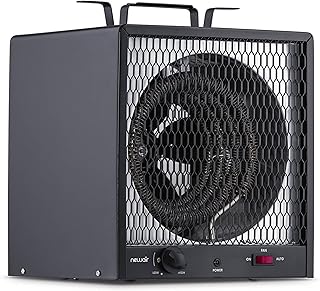
NewAir 240V Portable Garage Heater
NewAir’s industrial-grade portable is the pick for anyone who wants 240V output without committing to a permanent install, delivering serious heat to sheds, shops, and warehouse corners. The all-black housing is refreshingly restrained for a utility appliance, and the portability means one heater can follow you between workspaces.
Comfort Zone 5000W Ceiling Mounted Heater
This is the straightforward, no-drama workhorse of the group: three heat settings, overheat protection, ETL listing, and a grey enclosure that reads as infrastructure rather than furniture. There is no remote or digital display, so plan your mounting height around reachable controls.
5000W Fan-Forced Heater with Remote and Digital Thermostat
Rated for roughly 500 square feet, this fan-forced unit adds the conveniences the Comfort Zone leaves out, including a digital thermostat, a one to nine hour timer, and remote operation. Wall or ceiling mounting gives you flexibility in tight bays, and it doubles nicely as greenhouse heat.
TEMPWARE 7500W Hardwired Garage Heater
The highest-output option here, and the right answer for three-car garages, tall workshops, and warehouse space where lesser heaters just stir cold air around. It is hardwired only, so factor in electrician time, but the 12-hour timer and digital thermostat make it genuinely set-and-forget.
Shinic 1500W Radiant Quartz Heater with Work Light
A smart dual-purpose choice: ceiling-mounted radiant quartz heat with 90-degree rotation, five modes, and an integrated work light that earns its keep over a bench or under a hood. At 1500W it runs on a standard circuit, making it the easiest install on this list.
Frequently Asked Questions
Do I need an electrician for a 240V garage heater?
In almost every case, yes. A 240V heater requires a dedicated circuit sized to its amperage draw, and hardwired models like the TEMPWARE have no plug at all. Expect a modest install cost on top of the heater.
How many watts do I need for a two-car garage?
A typical insulated two-car garage of 400 to 500 square feet is well served by a 5,000W unit. If the space is uninsulated or has a high ceiling, size up rather than hoping a smaller heater will catch up.
Is radiant or fan-forced heat better for a garage?
Fan-forced is better for raising the temperature of the whole room over hours. Radiant quartz is better when you want immediate warmth on your body in a drafty or frequently opened space.
Can I leave a garage heater running unattended?
Use the built-in thermostat and timer rather than leaving a unit on indefinitely, keep the intake and outlet clear of clutter, and never operate a heater near stored fuel, solvents, or aerosols.
Final Thoughts
For most two-car garages, the 5000W fan-forced heater with remote and digital thermostat hits the sweet spot of output, control, and install complexity. Step up to the TEMPWARE 7500W if you are heating a large or poorly insulated shop, and choose the Shinic radiant quartz unit if you want quick, targeted warmth plus task lighting on a standard circuit.