Key takeaways
- Load rating over thickness: A tile’s advertised load capacity matters more than its profile. Look for figures in the tens of thousands of pounds if you’re parking a truck or SUV, and confirm the number is per tile, not per pack.
- Read your slab first: Interlocking tiles float over hairline cracks, minor spalling, and old paint without prep, which is their real advantage. Coatings and epoxies do not, and will fail on a slab with moisture intrusion.
- Drainage or absorption, not both: Open-grid tiles let meltwater and washdown pass through to the concrete and dry from below. Absorbent mats trap fluids on top. Choose grids for wet climates and wash bays, mats for oil containment under a leaky classic.
- Plan for reversibility: Modular systems are the only garage floor you can take with you or reroute around a new workbench. Buy a pack size with 10 percent overage so you can cut edge pieces without a second order.
- Use color to open the room: Garages are chronically under-lit. Mid-gray reads clean and hides dust; a saturated red or a checkerboard layout gives the space a deliberate, showroom quality that flat concrete never will.
What's inside
The garage is the last room in the house to get designed, and it shows. Most start as a slab of bare concrete that dusts, stains, and telegraphs every oil drip and road-salt puddle from November onward. Sealing it is a weekend of prep and a decade of hoping the coating doesn’t peel; ignoring it means a space that reads like storage no matter how tidy the shelving looks. What buyers actually want is a floor that arrives, goes down over an afternoon, and makes the room feel intentional.
That’s where modular flooring has quietly gotten good. Interlocking polypropylene tiles, drainage grids, and containment mats now handle real vehicle weight, resist the fluids that wreck concrete, and can be lifted and reconfigured when the layout changes. This guide covers the six options worth your money in 2026, sorted by how they behave in daily use, plus how to match the right system to your slab, your climate, and how you actually use the space.
As an Amazon Associate we earn from qualifying purchases.



How to Choose Garage Flooring (2026)
- Load rating over thickness: A tile’s advertised load capacity matters more than its profile. Look for figures in the tens of thousands of pounds if you’re parking a truck or SUV, and confirm the number is per tile, not per pack.
- Read your slab first: Interlocking tiles float over hairline cracks, minor spalling, and old paint without prep, which is their real advantage. Coatings and epoxies do not, and will fail on a slab with moisture intrusion.
- Drainage or absorption, not both: Open-grid tiles let meltwater and washdown pass through to the concrete and dry from below. Absorbent mats trap fluids on top. Choose grids for wet climates and wash bays, mats for oil containment under a leaky classic.
- Plan for reversibility: Modular systems are the only garage floor you can take with you or reroute around a new workbench. Buy a pack size with 10 percent overage so you can cut edge pieces without a second order.
- Use color to open the room: Garages are chronically under-lit. Mid-gray reads clean and hides dust; a saturated red or a checkerboard layout gives the space a deliberate, showroom quality that flat concrete never will.
The Best Garage Flooring Ideas (2026), Reviewed
Garage Mats Oversize Parking Mat, 8.8 x 22 Ft
The simplest fix for a car that marks its territory: a single absorbent, waterproof-backed sheet sized to swallow an entire parking bay, snow melt and all. It’s the right call for renters and anyone who wants containment without committing to a full-floor install.
Interlocking Garage Floor Tiles, 12″ x 12″, 48-Pack
A solid-top modular tile with a 40,000 lb load rating and genuine oil and stain resistance, which puts it in vehicle-duty territory rather than gym-mat territory. The 48-tile pack covers roughly 48 square feet, so measure carefully and order in bays.
VEVOR Garage Floor Tiles, Red, 50-Pack
At 0.53 inches with double-sided texture, these are the pick for a designed garage rather than a purely functional one. Flip a few tiles for a subtle tonal shift, or alternate red with a second color for a graphic checkerboard that costs nothing extra to execute.
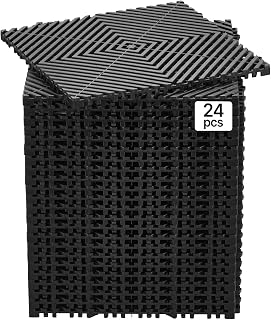
VEVOR Interlocking Drainage Mat, 24-Pack
Open-grid PP tiles that keep shoes, tools, and knees out of standing water, ideal for the wash zone or the strip beside a utility sink. Cushioned enough to stand on for a long session at the bench.
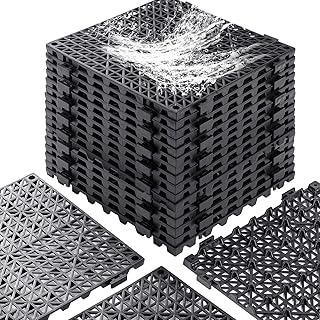
Jocoevol 60-Pc Self-Drainage Interlocking Tile
The best value for covering serious square footage in drainage tile, with 60 heavy-duty pieces and enough versatility to carry the same look from garage to patio to poolside. Non-slip when wet, which is the whole point.
Frequently Asked Questions
Will interlocking tiles work over cracked concrete?
Yes, and that’s their strongest use case. Because they float rather than bond, they bridge hairline cracks and old coatings. Fill anything deeper than a quarter inch first so the tiles sit flat.
Can I park on drainage tiles?
Open-grid tiles are built for foot traffic, wet zones, and workshop standing. For vehicle weight, use solid-top tiles with a published load rating and keep the grid tiles to perimeter and wash areas.
What about hot tire pickup?
This is a coating problem, not a tile problem. Polypropylene tiles don’t adhere to tire rubber, which is why they outlast peeling epoxy in hot climates and short-trip driving.
How hard is cleanup?
Sweep or shop-vac solid tiles; hose grid tiles and let them drain. Lift a section any time you need to get at the slab underneath.
Final Thoughts
For most garages, the 48-pack interlocking tiles with the 40,000 lb rating are the safest all-round investment, with the VEVOR red tiles worth the small premium if you want the room to look designed rather than merely covered. If a single leaky vehicle is the whole problem, skip the tiles and put the oversize 8.8 x 22 ft parking mat down instead.