Key takeaways
- Steel gauge and door behavior: Thin panels announce themselves. Press the center of a door in a showroom or read reviews for flex and rattle. Doors that twist will never latch cleanly, and a cabinet that will not latch stops getting used.
- Footprint before height: Measure the depth you can lose along a wall with the car parked, then check ceiling clearance for door swing and any garage door track. A 75-inch cabinet needs headroom above it to be assembled upright.
- Shelf adjustability and rated load: Look for shelves that reposition on a punched channel rather than fixed welds, and confirm the per-shelf rating. Batteries, paint, and power tools are dense; 100 pounds per shelf is a practical floor.
- Locking that actually secures: A keyed two-door latch keeps solvents and blades away from kids. Treat it as a safety feature first and theft deterrence second, since sheet steel is not a safe.
- Fixed or mobile: Casters buy you flexibility in a garage that doubles as a workshop. Anchored cabinets buy you stability for heavy loads. Decide which problem you are solving before you pay for wheels.
What's inside
The garage is the last room most of us design and the first one that gives up. Tools migrate to the floor, seasonal bins stack into towers that lean, and open shelving turns every wall into visual noise you have to look at every time you come home. The fix is rarely more shelves. It is enclosure: solid doors that hide the clutter, a steel shell that shrugs off a dropped wrench, and a footprint that respects the space a car actually needs to park.
This guide covers full-height steel cabinets and modular workshop systems in the range most homes can absorb, roughly 71 to 130 inches wide, all with lockable doors and adjustable interior shelving. We weighed door rigidity, shelf load, assembly reality, and finish quality, and we paid attention to how each piece reads visually once it is installed. Matte black steel done well looks intentional. Done badly, it looks like a school locker.
As an Amazon Associate we earn from qualifying purchases.



How to Choose a Garage Storage Cabinet (2026)
- Steel gauge and door behavior: Thin panels announce themselves. Press the center of a door in a showroom or read reviews for flex and rattle. Doors that twist will never latch cleanly, and a cabinet that will not latch stops getting used.
- Footprint before height: Measure the depth you can lose along a wall with the car parked, then check ceiling clearance for door swing and any garage door track. A 75-inch cabinet needs headroom above it to be assembled upright.
- Shelf adjustability and rated load: Look for shelves that reposition on a punched channel rather than fixed welds, and confirm the per-shelf rating. Batteries, paint, and power tools are dense; 100 pounds per shelf is a practical floor.
- Locking that actually secures: A keyed two-door latch keeps solvents and blades away from kids. Treat it as a safety feature first and theft deterrence second, since sheet steel is not a safe.
- Fixed or mobile: Casters buy you flexibility in a garage that doubles as a workshop. Anchored cabinets buy you stability for heavy loads. Decide which problem you are solving before you pay for wheels.
The Best Garage Storage Cabinets of 2026, Reviewed
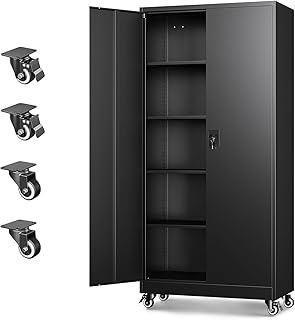
72″ Metal Garage Storage Cabinet with Lock, 5 Adjustable Shelves
The cleanest single-unit answer here: a full-height black steel locker with five repositionable shelves and a keyed two-door latch, which covers everything from paint cans to shop vacs behind one flat plane. It is the pick if you want the garage to read as quiet storage rather than a workshop.
Rolling Metal Garage Cabinet with Wheels, 75″ H
Same locking, adjustable-shelf logic on casters, which matters in a garage where the layout changes with the season. Load it lighter than a fixed cabinet and lock the wheels before you open the doors, and it earns its keep in flexible spaces.
Torin 9-Piece Garage Storage Cabinet System
At nearly 130 inches wide, this black and grey set combines wall cabinets, a rolling drawer chest, and a locking cabinet into a continuous run that finally looks like a designed wall. Best for a dedicated bay where you can commit the full length.
10-Piece Heavy Duty Steel Garage Cabinet System
The most complete build here, pairing upper and lower cabinets with a work surface so tools and tasks share one zone instead of scattering. Plan a full afternoon for assembly and a second set of hands for the uppers.
Guizeeopo 71″ Metal Storage Cabinet with Adjustable Shelves
A quietly versatile 71-inch cabinet that works as well in a pantry or home office as it does in the garage, which makes it easy to justify. The slightly shorter height also clears low garage ceilings that defeat 75-inch models.
Frequently Asked Questions
Do I need to anchor the cabinet to the wall?
Yes, for any tall fixed unit. Full-height steel cabinets are top-heavy once loaded, and most include a bracket for a stud or masonry anchor. Skip it only on caster-mounted models, and keep heavy items on the lowest shelves.
Steel or resin cabinets?
Steel wins on shelf load, dent resistance, and lockability. Resin resists moisture and salt better, so it makes sense in coastal or damp unheated garages where condensation is constant.
Will powder-coated steel rust in an unconditioned garage?
Not quickly, provided the coating stays intact. Touch up scratches, keep the base off standing water, and avoid storing wet gear inside with the doors shut, since trapped humidity is the real culprit.
One tall cabinet or a modular system?
Start with one cabinet if you are consolidating clutter. Move to a modular set like the Torin or 10-piece system when you need a work surface and drawers, not just enclosed volume.
Final Thoughts
For most homes, the 72-inch locking cabinet with five adjustable shelves is the efficient choice: enclosed, secure, and visually calm. If your garage is genuinely a workshop, the Torin 9-Piece system or the 10-Piece steel set turns a wall into organized infrastructure, while the Guizeeopo 71-inch cabinet is the smart fit under low ceilings.