Key takeaways
- Read capacity per shelf, not per unit: An 8,000-pound total rating across four tiers means 2,000 pounds per shelf, and that figure assumes evenly distributed weight. Concentrated loads like an engine block or a stack of pavers behave very differently from spread-out bins.
- Match depth to your walkway: A 24-inch deep rack swallows storage totes beautifully but claims two feet of floor. In a single-car bay, an 18-inch depth often preserves the clearance you need to open a car door without turning sideways.
- Look at the uprights: One-piece posts and welded side bracing resist racking far better than stacked, bolt-together legs. Check for supporting ribs or cross-braces under each deck, which is where most cheap units start to bow.
- Decide between solid and wire decks: Solid steel or laminate decks hold small hardware and loose items without anything slipping through. Wire shelving breathes, sheds dust, and lets overhead light pass down through the tiers, which keeps lower shelves usable.
- Confirm the finish and adjustability: Powder-coated or rust-resistant steel matters in unconditioned spaces where condensation is normal. Adjustable shelf spacing is what lets one rack hold both bike helmets and a shop vac without wasted air.
What's inside
Most garages don’t fail because they lack space. They fail at the perimeter, where paint cans, sports gear, and half-used bags of potting soil migrate outward until the floor disappears and the car parks in the driveway. Vertical storage is the fix, but the flat-pack racks sold as “utility shelving” tend to sag under a few boxes of tile, and particleboard decks swell the first time humidity creeps in. What you actually need is a rack rated for real weight, built from steel that won’t flex when you load one end.
This guide looks at heavy duty garage shelving through a design lens as much as a structural one: how a unit reads in an open garage, how deep it can go before it eats walking clearance, and whether the finish will still look intentional in five years. Below are six racks worth considering in 2026, spanning 3,200 to 8,000 pounds of stated capacity and widths from 55 to 77 inches, followed by what to weigh before you commit.
As an Amazon Associate we earn from qualifying purchases.




How to Choose Heavy Duty Garage Shelving (2026)
- Read capacity per shelf, not per unit: An 8,000-pound total rating across four tiers means 2,000 pounds per shelf, and that figure assumes evenly distributed weight. Concentrated loads like an engine block or a stack of pavers behave very differently from spread-out bins.
- Match depth to your walkway: A 24-inch deep rack swallows storage totes beautifully but claims two feet of floor. In a single-car bay, an 18-inch depth often preserves the clearance you need to open a car door without turning sideways.
- Look at the uprights: One-piece posts and welded side bracing resist racking far better than stacked, bolt-together legs. Check for supporting ribs or cross-braces under each deck, which is where most cheap units start to bow.
- Decide between solid and wire decks: Solid steel or laminate decks hold small hardware and loose items without anything slipping through. Wire shelving breathes, sheds dust, and lets overhead light pass down through the tiers, which keeps lower shelves usable.
- Confirm the finish and adjustability: Powder-coated or rust-resistant steel matters in unconditioned spaces where condensation is normal. Adjustable shelf spacing is what lets one rack hold both bike helmets and a shop vac without wasted air.
The Best Heavy Duty Garage Shelving of 2026, Reviewed
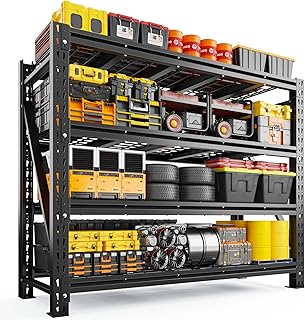
Bepatio 8000LBS 77″ 4-Tier Heavy Duty Shelving
At 77 inches wide and 24 inches deep, this is the pick for a full wall run where you want fewer units and fewer seams. The 8,000-pound rating and rust-proof coating suit unheated garages and commercial storage, though you’ll want two people and a level floor for assembly.
71.3″ W 5000LBS 4-Tier Metal Storage Shelves, Black
A well-proportioned workhorse at 71.3 by 24 by 70 inches, with the matte black finish that disappears against a dark garage wall rather than competing with it. Four adjustable tiers handle bulk totes and paint inventory comfortably, and the industrial profile looks deliberate next to a workbench.
Romorgniz 5000LBS Steel Rack, 4-Tier
The structural details are the story here: one-piece uprights, side braces, and 16 supporting ribs beneath the solid steel decks. That combination is what keeps a loaded rack from swaying, making it the most confident choice for dense, heavy items like tool chests and fluid cases.
REIBII 3200LBS 5-Tier Wire Shelving, 55.5″
The most adaptable unit on this list, and the only one I’d put in a pantry or basement as readily as a garage. Five tiers at 18 inches deep keep the footprint tight, and the open wire decks let air and light move through, which helps when the rack sits against an exterior wall.
RAVIGIN 5000LBS 71″ Garage Shelving
A straightforward 71-by-24-by-70-inch rack with fully adjustable shelves and a clean black finish, positioned as the value entry among the 5,000-pound units. Good choice when you’re outfitting two or three walls and want visual consistency across the room.
Frequently Asked Questions
How much weight can heavy duty garage shelving really hold?
Divide the advertised total by the number of tiers to get the practical per-shelf figure, then load conservatively and keep the heaviest items on the bottom two levels. Ratings assume distributed weight on a flat, level surface.
Do I need to anchor these racks to the wall?
Freestanding units with wide bases and side bracing are stable when loaded correctly, but anchoring is smart in seismic areas, in homes with children, or whenever a rack is loaded top-heavy.
Will steel shelving rust in an unheated garage?
Powder-coated and rust-resistant finishes hold up well in most climates. In coastal or persistently damp spaces, keep the rack an inch off the wall for airflow and avoid setting wet gear directly on the decks.
How long does assembly take?
Most boltless four-tier units go together in 30 to 60 minutes with two people. Wider 71- to 77-inch racks are unwieldy alone, so plan for help rather than fighting the uprights solo.
Final Thoughts
For a full-wall installation with maximum capacity, the Bepatio 8000LBS 77″ unit is the strongest anchor. If you want the best structural engineering at a mid-size footprint, the Romorgniz 5000LBS steel rack earns it with one-piece uprights and ribbed decks, while the REIBII 3200LBS 5-tier wire unit is the one to choose when depth is tight and versatility matters more than raw capacity.