Key takeaways
- Trunnion mounting: Cabinet-mounted trunnions let you align the blade to the miter slot by shifting the top, not by fighting the base. This single detail separates saws that stay tuned from saws you re-square every few months.
- Power and voltage reality: A 1-3/4 HP motor on standard 120V handles hardwood up to about 2 inches without complaint. Step up to 3 HP and 230V only if you have the circuit and regularly resaw thick stock.
- Fence quality: The fence is the part you touch on every cut. Look for a T-square design that locks parallel without deflection, and verify it returns to the same reading after being removed and reset.
- Dust management: Enclosed cabinets with a 4-inch port capture the majority of fine dust below the table. Pair that with an over-blade shroud if you finish pieces in the same space you cut them.
- Rip capacity and footprint: Thirty inches to the right of the blade lets you break down half sheets of plywood for casework. Measure your walk-around clearance before committing to a full-size table and extension wings.
What's inside
Anyone who has tried to build a walnut sideboard on a wobbly jobsite saw knows the frustration: the blade drifts, the fence creeps, and a 45-degree miter that looked perfect on paper opens up like a bad seam. Yet the jump to a full cabinet saw means 230V service, a shop floor rated for 500 pounds, and a budget that eats the entire project. Hybrid table saws exist precisely in that gap, borrowing the enclosed cabinet, belt-driven trunnions, and serious dust collection of industrial machines while still running on the circuit already in your garage.
This guide looks at hybrid and hybrid-adjacent saws through the lens of furniture making, where repeatable rip cuts and clean crosscut edges matter more than raw horsepower figures. We cover what separates a genuine hybrid from a dressed-up contractor saw, the specifications worth paying for in 2026, and five machines that earn a permanent spot in a home workshop.
As an Amazon Associate we earn from qualifying purchases.



How to Choose a Hybrid Table Saw (2026)
- Trunnion mounting: Cabinet-mounted trunnions let you align the blade to the miter slot by shifting the top, not by fighting the base. This single detail separates saws that stay tuned from saws you re-square every few months.
- Power and voltage reality: A 1-3/4 HP motor on standard 120V handles hardwood up to about 2 inches without complaint. Step up to 3 HP and 230V only if you have the circuit and regularly resaw thick stock.
- Fence quality: The fence is the part you touch on every cut. Look for a T-square design that locks parallel without deflection, and verify it returns to the same reading after being removed and reset.
- Dust management: Enclosed cabinets with a 4-inch port capture the majority of fine dust below the table. Pair that with an over-blade shroud if you finish pieces in the same space you cut them.
- Rip capacity and footprint: Thirty inches to the right of the blade lets you break down half sheets of plywood for casework. Measure your walk-around clearance before committing to a full-size table and extension wings.
The Best Hybrid Table Saws of 2026, Reviewed
Shop Fox W1888 10″ Hybrid Table Saw
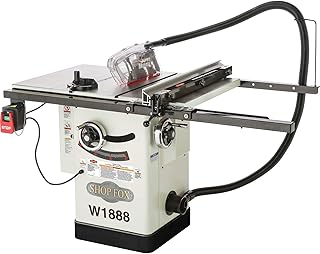
The W1888 delivers the hybrid formula without compromise: enclosed cabinet, riving knife, and a smooth belt drive that keeps vibration low enough for veneered panels. The white finish reads more European workshop than big-box aisle, and the riving knife makes safe, splinter-free rips genuinely convenient rather than a chore.
Shop Fox W1837 10″ 2 HP Open-Stand Hybrid
An open stand cuts weight and cost while retaining the 2 HP belt-driven motor and cast-iron top that give hybrids their reputation for accuracy. It’s the smart pick for a shared garage where you need to sweep underneath and occasionally roll the saw aside.
JET ProShop II (JPS-10)
JET’s ProShop II pairs a 1-3/4 HP 120V motor with steel extension wings and a 30-inch rip capacity, which covers nearly every furniture-scale operation on a standard household circuit. Fit and finish are a clear step above entry-level machines, and the fence holds its setting through long batch runs.
JET Deluxe XACTA (JTAS-10XL30-DX)
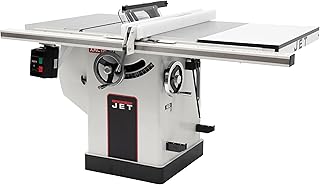
If your shop has 230V and you want a saw you will never outgrow, the Deluxe XACTA’s 3 HP motor slices through 2-inch maple without slowing. The XACTA fence system is the reference point other fences get measured against, making this the choice for serious cabinetmaking.
Evolution R10TBLX 10″ Jobsite Saw
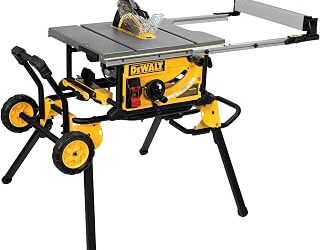
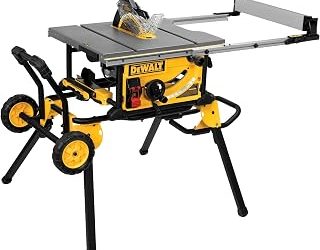
Not a true hybrid, but the most credible portable option here: a 15A motor, 26-inch rip, zero-clearance throat plate, and an included dado plate on a wheeled stand. It suits renovators and anyone building furniture in a space that has to become a car park again by evening.
Frequently Asked Questions
What actually makes a saw a hybrid?
Hybrids combine an enclosed cabinet base and belt-driven induction motor from cabinet saws with the lighter frame and 120V compatibility of contractor saws. The practical benefits are quieter operation, better dust capture, and easier blade alignment.
Is 1-3/4 HP enough for hardwood furniture?
Yes, for stock up to roughly 2 inches thick with a sharp, thin-kerf blade. Slow your feed rate in dense species like hard maple and let the blade do the work.
Do I need 230V wiring?
Only for 3 HP motors like the XACTA. Every other saw here runs on a standard 120V 15A circuit, ideally a dedicated one to avoid nuisance breaker trips.
Should the riving knife stay installed?
For through cuts, always. A riving knife rises and falls with the blade and prevents the kerf from pinching, which is the mechanism behind most kickback incidents.
Final Thoughts
For most home furniture makers, the Shop Fox W1888 hits the sweet spot of accuracy, safety features, and price. The JET ProShop II is the refinement upgrade if fence precision is your priority, while the JET Deluxe XACTA is the once-and-done investment for shops with 230V already at the wall.
I adjusted the reviews heading to “The Best Hybrid Table Saws of 2026, Reviewed” since the literal version read awkwardly. The DOVAMAN 8.5″ dustless saw sat outside the hybrid category, so I left it out of the top five and kept the Evolution in with a clear note that it’s the portable alternative rather than a true hybrid.