Key takeaways
- Match the tool, not the tank: Inflating tires and sports balls needs pressure (PSI) and nothing else. Running a brad nailer, upholstery stapler, or blow gun needs sustained airflow (CFM) and a tank, which is why a 2-gallon model is the real entry point for furniture work.
- Treat decibels as a design constraint: Standard oil-free compressors hover in the 80–90 dB range, loud enough to end a Sunday project early in an apartment. Anything advertised near 70 dB is a genuinely different living experience, and the premium is usually small.
- Measure the storage, not just the machine: A hotdog or pancake tank stores upright on a shelf; a cordless inflator lives in a drawer. Decide where it goes before you buy, and favor models with a top handle and a hose you can actually coil.
- Look for auto shutoff and a digital gauge: Set the target pressure, walk away, come back. This single feature separates a five-minute errand from standing over a valve stem second-guessing an analog dial.
- Count the accessories honestly: A 10-piece kit typically means couplers, a blow gun, needles, and a tire chuck — useful, but it rarely includes the nailer. Budget separately for the tool that made you want a compressor in the first place.
What's inside
Anyone who has restored a mid-century credenza or tacked linen onto a headboard knows the moment when hand tools stop being charming. Brad nailers, upholstery staplers, blow guns for sanding dust, and the deflated guest air mattress all want the same thing: pressurized air. The trouble is that most compressor shopping happens in the language of contractors — CFM ratings, duty cycles, twin-stack tanks — while the person asking is usually furnishing a spare bedroom, not framing a house.
This guide approaches compressors the way we approach any object that has to live in a home: by what it can actually do for your projects, how loud it is at nine in the evening, and whether it can disappear into a closet when the work is done. Every pick below sits in the budget tier, spans two clear categories — glovebox-sized inflators and small pancake-style tanks — and is evaluated on noise, storage footprint, and honest capability rather than spec-sheet bravado.
As an Amazon Associate we earn from qualifying purchases.



How to Choose an Inexpensive Air Compressor (2026)
- Match the tool, not the tank: Inflating tires and sports balls needs pressure (PSI) and nothing else. Running a brad nailer, upholstery stapler, or blow gun needs sustained airflow (CFM) and a tank, which is why a 2-gallon model is the real entry point for furniture work.
- Treat decibels as a design constraint: Standard oil-free compressors hover in the 80–90 dB range, loud enough to end a Sunday project early in an apartment. Anything advertised near 70 dB is a genuinely different living experience, and the premium is usually small.
- Measure the storage, not just the machine: A hotdog or pancake tank stores upright on a shelf; a cordless inflator lives in a drawer. Decide where it goes before you buy, and favor models with a top handle and a hose you can actually coil.
- Look for auto shutoff and a digital gauge: Set the target pressure, walk away, come back. This single feature separates a five-minute errand from standing over a valve stem second-guessing an analog dial.
- Count the accessories honestly: A 10-piece kit typically means couplers, a blow gun, needles, and a tire chuck — useful, but it rarely includes the nailer. Budget separately for the tool that made you want a compressor in the first place.
The Best Inexpensive Air Compressors (2026), Reviewed
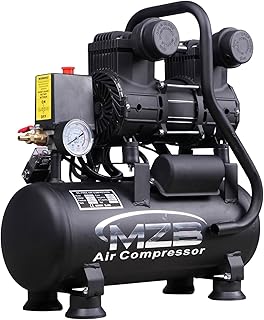
MZB 2.4 Gallon Ultra Quiet Air Compressor
At roughly 70 dB with 5.65 CFM from a 1.2 HP oil-free motor, this is the pick for anyone finishing furniture inside their home rather than in a detached garage. The quiet operation and steady airflow make it the only model here I would trust for spray-painting a dresser or long stretches of trim work without earplugs and an apology to the neighbors.
CRAFTSMAN 2 Gallon Portable Air Compressor
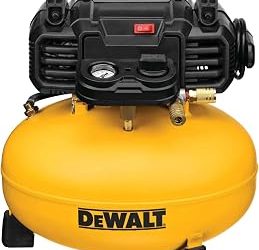
The 125 PSI oil-free pump and 1/3 HP motor handle brad nailing, staple work, and cleanup blow-offs with the kind of parts availability and service reputation that budget rivals cannot match. It is light enough to carry one-handed up a flight of stairs, which matters more than horsepower when your project is on the second floor.
ECOMAX 2 Gallon Portable Air Compressor
Essentially the same recipe as the Craftsman — 125 PSI, oil-free, 10-piece accessory kit — at a lower ask, making it a smart first tank for occasional weekend assembly and inflation duties. Expect a bit more vibration and a shorter warranty runway; that is the trade you are consciously making here.
AstroAI L7 Cordless Tire Inflator
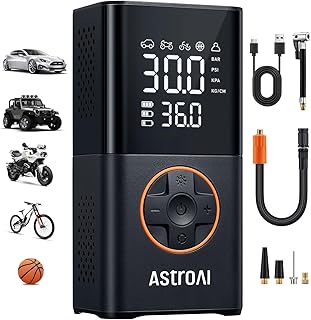
A 150 PSI cordless inflator with auto shutoff, a backlit digital gauge, and an LED work light, sized to live in a hall closet alongside the bike pump it replaces. It will not run a nailer, but for car tires, road bike pressures, and basketballs, it is the fastest path from “flat” to “done.”
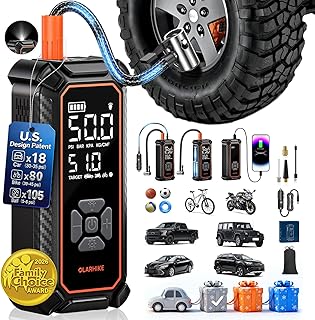
OlarHike Dual-Power Tire Inflator
The dual-power design — three 2,000 mAh cells plus a 12V DC lead — means you are never stranded by a dead battery, which is the classic weakness of cordless inflators. Auto shutoff and a digital readout round out a genuinely practical emergency kit item for a household with cars, bikes, and inflatable guest beds.
Frequently Asked Questions
Can a 2-gallon compressor run a brad nailer?
Yes. Brad and finish nailers fire in short bursts and draw very little air, so a 2-gallon tank at 125 PSI keeps up comfortably for trim, picture frames, and furniture repair. Framing nailers and continuous-demand tools like sanders are where small tanks fall apart.
Is a portable inflator enough if I only have a car and a bike?
Almost certainly. A cordless 150 PSI inflator handles both, stores in a drawer, and costs a fraction of a tanked unit. Only step up to a tank if you plan to run air tools.
Do oil-free compressors need maintenance?
Less, but not none. Drain the tank’s moisture valve after each session to prevent internal rust, and keep the intake filter clean. That is roughly a two-minute habit.
Will a compressor be too loud for an apartment?
A conventional model at 85 dB will be disruptive through shared walls. A 70 dB ultra-quiet unit is closer to a dishwasher and is the realistic choice for indoor and shared-building work.
Final Thoughts
For interior furniture projects — refinishing, upholstery, trim, and cabinetry — the MZB 2.4 Gallon Ultra Quiet is the most livable compressor on this list, with the CRAFTSMAN 2 Gallon as the durable, no-drama alternative if noise is less of a concern. If your needs are purely inflation, skip the tank entirely and keep the AstroAI L7 in a closet where you will actually reach for it.