Key takeaways
- Size it to the island, not the cooktop: Because an island hood pulls air from all four sides, aim for a canopy at least as wide as your cooktop and ideally 3 to 6 inches wider. A 30-inch cooktop is well served by a 36-inch hood if the island footprint allows it.
- Read CFM against how you actually cook: Island installations lose capture efficiency to cross-drafts, so budget more airflow than you would for a wall hood. Wok cooking, cast iron, and gas benefit from 700 to 1200 CFM; induction and light sautéing are comfortable near 380 to 400 CFM.
- Decide ducted or ductless before you buy: Ducted venting through the ceiling is always the better performer. If joists or a flat roof rule that out, choose a convertible model and factor in ongoing charcoal filter replacements, since ductless recirculates heat and humidity back into the room.
- Prioritize baffle filters and dishwasher-safe parts: Stainless baffle filters outlast mesh, look far better at eye level, and go straight into the dishwasher. Multi-layer filter stacks trap more grease but need more frequent attention.
- Treat controls and lighting as design elements: Gesture sensing keeps fingerprints off a hood you’ll be walking around all day, and dual-sided panels matter when the island is approached from both directions. Look for four LEDs rather than two so the cooking surface is evenly lit.
What's inside
An island cooktop is the design move that reorganizes a whole kitchen: suddenly the cook faces the room instead of a wall, and the backsplash becomes a conversation. The complication arrives overhead. With no cabinetry to hide behind and no wall to brace against, an island hood hangs in the middle of your sightlines, doing structural work for the room’s proportions while it captures steam, smoke, and aerosolized grease. Choose poorly and you get a stainless box that fights the pendants, drones through dinner, and still lets a seared ribeye set off the smoke alarm.
This guide looks at island hoods the way a designer does and the way a cook does, at the same time. Below you’ll find current standouts across the sizes that matter most (30 and 36 inches), from high-extraction 1200 CFM workhorses to slimmer 380 CFM canopies suited to gentler cooking and ductless conversions. After the picks, there’s a plain-language sizing and airflow primer plus answers to the questions that trip up first-time island-hood buyers.
As an Amazon Associate we earn from qualifying purchases.



🛒 Best Price Today on Amazon
Prime members get fast, free shipping on everything above, plus member-only deals. New members get a 30-day free trial — cancel anytime.
How to Choose an Island Kitchen Hood (2026)
- Size it to the island, not the cooktop: Because an island hood pulls air from all four sides, aim for a canopy at least as wide as your cooktop and ideally 3 to 6 inches wider. A 30-inch cooktop is well served by a 36-inch hood if the island footprint allows it.
- Read CFM against how you actually cook: Island installations lose capture efficiency to cross-drafts, so budget more airflow than you would for a wall hood. Wok cooking, cast iron, and gas benefit from 700 to 1200 CFM; induction and light sautéing are comfortable near 380 to 400 CFM.
- Decide ducted or ductless before you buy: Ducted venting through the ceiling is always the better performer. If joists or a flat roof rule that out, choose a convertible model and factor in ongoing charcoal filter replacements, since ductless recirculates heat and humidity back into the room.
- Prioritize baffle filters and dishwasher-safe parts: Stainless baffle filters outlast mesh, look far better at eye level, and go straight into the dishwasher. Multi-layer filter stacks trap more grease but need more frequent attention.
- Treat controls and lighting as design elements: Gesture sensing keeps fingerprints off a hood you’ll be walking around all day, and dual-sided panels matter when the island is approached from both directions. Look for four LEDs rather than two so the cooking surface is evenly lit.
The Best Island Kitchen Hoods (2026) Reviewed
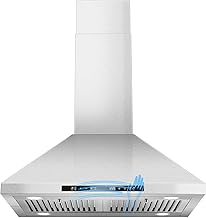
36″ Island Range Hood, 1200 CFM Stainless Steel
This is the pick for serious heat: 1200 CFM across four speeds clears a full sear or a hard boil before the smoke can drift toward the dining table. The gesture sensing and touch panel, timer, and four LEDs make it feel considered rather than industrial, and the dishwasher-safe filters keep maintenance honest.
VIKIO HOME 30″ Island Range Hood, 390 CFM
A restrained 30-inch canopy for kitchens where the hood should recede, this one pairs 390 CFM with three stainless baffle filters and dual-sided touch and gesture controls, so it reads the same from either approach. Best matched to induction or moderate everyday cooking.
Cosmo Lumin 30″ Ducted Island Range Hood, 380 CFM
The glass visor gives the Lumin Collection a lighter visual footprint than solid stainless, which helps when the hood sits directly in a sightline. Soft-touch controls, three speeds, and permanent dishwasher-safe baffle filters make it a tidy, low-fuss choice for ducted installs.
36″ Black Stainless Island Range Hood, 700 CFM
Black painted stainless is the quietest way to make a large canopy disappear against dark ceilings or bridge a matte-black fixture scheme. At 700 CFM with gesture and touch control and convertible venting, it balances presence and capability well for most home kitchens.
30″ Island Range Hood, 700 CFM Gesture Control
Strong airflow in a compact width, this is the practical answer for a narrow island that still sees high-heat cooking. Three speeds, a timer, four LEDs, and stainless baffle filters cover the essentials without pushing the price into premium territory.
Frequently Asked Questions
How high should an island hood hang?
Most manufacturers specify 28 to 36 inches above the cooking surface. Go higher and capture drops noticeably; go lower and tall cooks will knock into it. Confirm the spec sheet, since chimney extensions are sized for specific ceiling heights.
Is ductless worth it for an island?
It’s a reasonable compromise, not an equal. Charcoal filtration removes odor and grease but returns heat and moisture to the room, so expect to run the fan longer and replace filters every few months.
Will an island hood be loud?
Noise scales with airflow. The workaround is headroom: a higher-CFM hood run on speed one or two is typically quieter than a smaller unit pushed to maximum.
Can I install one myself?
Ceiling-mount hoods need blocking between joists to carry the weight, plus ductwork and a dedicated circuit. Mounting is DIY-adjacent; the venting and electrical usually aren’t.
Final Thoughts
For high-output cooking under an open ceiling, the 36-inch 1200 CFM stainless hood is the one that won’t be outpaced. If the priority is a canopy that stays visually quiet, the Cosmo Lumin 30-inch with its glass visor is the most elegant of the group, while the 36-inch black stainless 700 CFM model splits the difference between real extraction power and a hood that blends into a darker, more contemporary palette.