Key takeaways
- Working height, not total height: Your usable reach is roughly the ladder’s extended length minus the top three rungs, plus your own arm span. A 13.5 ft telescoping ladder gets most people comfortably to a second-story soffit; a 20 ft model handles roofline and tall stairwell work.
- Certification and load rating: Look for EN131 or ANSI Type 1A markings and a stated capacity, typically 330 lbs. That figure covers you plus tools plus whatever you’re carrying up, so treat it as a ceiling rather than a target.
- Configuration flexibility: Straight telescoping ladders excel against walls. Multi-position A-frame designs free-stand, work on stairs, and split into two independent sections, which matters if you don’t always have a wall to lean on.
- Stabilizers and locking feel: A stabilizer bar widens the base and dramatically reduces side-to-side sway. Retraction should be staged and controlled rather than a single dropping collapse, and locking pins should seat with an audible, unambiguous click.
- Collapsed footprint and weight: Around 36 lbs is typical for a full-height aluminum telescoping ladder. Check the closed dimensions against your actual storage spot, whether that’s a closet shelf, a coat cupboard, or an RV bay.
What's inside
Ladders are the one piece of home hardware nobody wants to look at, which is exactly why so many of us end up with the wrong one. The wobbly aluminum relic in the garage is too short for the stairwell light and too long to store anywhere sensible, so it leans against the wall behind the bikes and slowly becomes furniture. Meanwhile the gallery wall stays unhung, the gutters stay clogged, and the smoke detector chirps into its third week. The friction isn’t laziness. It’s that most ladders are sized for one job and stored in a space that was never designed to hold them.
This guide looks at ladders the way we’d look at any other object entering your home: footprint first, then capability. Telescoping and multi-position designs have quietly solved the storage problem, collapsing to roughly the height of a carry-on while extending well past two stories. Below we’ve gathered the strongest current deals on aluminum telescoping and A-frame convertible ladders, with notes on load ratings, certifications, and which configuration actually earns its keep in a smaller home. Whether you need reach for exterior work or a compact four-step for interior projects, there’s a right answer here.
As an Amazon Associate we earn from qualifying purchases.


How to Choose a Ladder Deals (2026)
- Working height, not total height: Your usable reach is roughly the ladder’s extended length minus the top three rungs, plus your own arm span. A 13.5 ft telescoping ladder gets most people comfortably to a second-story soffit; a 20 ft model handles roofline and tall stairwell work.
- Certification and load rating: Look for EN131 or ANSI Type 1A markings and a stated capacity, typically 330 lbs. That figure covers you plus tools plus whatever you’re carrying up, so treat it as a ceiling rather than a target.
- Configuration flexibility: Straight telescoping ladders excel against walls. Multi-position A-frame designs free-stand, work on stairs, and split into two independent sections, which matters if you don’t always have a wall to lean on.
- Stabilizers and locking feel: A stabilizer bar widens the base and dramatically reduces side-to-side sway. Retraction should be staged and controlled rather than a single dropping collapse, and locking pins should seat with an audible, unambiguous click.
- Collapsed footprint and weight: Around 36 lbs is typical for a full-height aluminum telescoping ladder. Check the closed dimensions against your actual storage spot, whether that’s a closet shelf, a coat cupboard, or an RV bay.
The Best Ladder Deals (2026)s Reviewed
Telescoping Aluminum 20.3 FT Extension Ladder
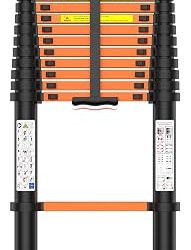
At 6.2 meters extended and 36 lbs on the shoulder, this is the reach-first choice for gutters, rooflines, and cathedral ceilings, with detachable hooks that add real security on eaves and edges. EN131 certification and a 330 lbs capacity give it credibility, though at full extension you’ll want a helper footing the base.
Telescoping A-Frame Ladder, 22 FT Multi-Position
The most versatile ladder here: it free-stands as an A-frame, extends to 22 ft as a straight ladder, and handles stair treads without improvisation. Wheels and a stabilizer bar make repositioning genuinely painless, which is what separates a ladder you use from one you avoid.
LANBITOU 14 FT A-Frame 4-Step Ladder
Our pick for interiors and mid-sized homes. It folds to a slim, closet-friendly package, converts between a stable four-step A-frame and a 14 ft extension, and the anti-slip treads inspire confidence on tile and hardwood where lightweight ladders often skate.
Prime 13.5 FT Telescopic Extension Ladder
ANSI Type 1A certification is the headline, and it’s the spec worth paying for if you want the highest common duty rating. Included stabilizers, a controlled retraction action, and a highly practical 13.5 ft height make this the best all-round telescoping ladder for typical two-story homes.
SocTone 12.5 FT Telescoping Ladder with Stabilizers
The compact value option, and a favorite for RVs, vans, and apartments where every inch of storage is contested. It gives up a little reach for a smaller collapsed footprint while keeping the 330 lbs rating and stabilizer feet intact.
Frequently Asked Questions
Are telescoping ladders as safe as traditional extension ladders?
Yes, provided they carry EN131 or ANSI certification and you use them as designed. Confirm every section is locked before climbing, set the base on level ground, and keep your hips between the rails.
What height ladder do I need for a two-story house?
For gutter or soffit access on a standard two-story home, 12.5 to 13.5 ft covers most work. Roofline access or taller architecture calls for 20 ft or more.
Can I use these ladders on stairs?
Multi-position A-frame models are designed for it, because each side adjusts independently to sit level across different tread heights. A straight telescoping ladder should not be used on stairs.
How should I store and maintain an aluminum ladder?
Store it fully collapsed, upright or flat, somewhere dry. Wipe grit from the rails occasionally, since dirt in the tracks is the usual cause of sticky locking mechanisms.
Final Thoughts
If you want one ladder to cover nearly everything, the 22 FT Multi-Position A-Frame is the most adaptable option on this list, with stair capability and wheels that make it easy to live with. For most two-story homes, the Prime 13.5 FT Telescopic Extension Ladder hits the sweet spot of certification, reach, and storability, while the LANBITOU 14 FT A-Frame is the smarter buy if your work is mainly indoors and closet space is the real constraint.