Key takeaways
- Lumens matched to square footage: Budget roughly 50 lumens per square foot for a working garage. A standard two-car bay of about 400 square feet wants 20,000 lumens or more, which is why these high-output deformable bulbs have become the default rather than a splurge.
- Color temperature: 6500K daylight is the standard here for good reason — it renders color accurately, reduces eye fatigue during detail work, and makes a concrete-and-drywall space feel clean rather than cavernous. Warmer 3000K bulbs belong in living spaces, not over a workbench.
- Panel count and articulation: Three panels give you broad, simple coverage. Six or 6+1 configurations let you aim light into corners, along shelving, or down toward a car hood. More panels also means more surface area for heat dissipation, which matters for longevity.
- Fixture clearance and depth: Measure from the socket to the joist and outward before you buy. Deformable bulbs need room to unfold, and a low-clearance ceiling or an enclosed dome fixture will limit how far the panels can swing.
- Base type and quantity: Confirm you have an E26/E27 medium screw base — the most common in North American garages. Then count your sockets. Multi-packs are dramatically better value if you’re lighting a workshop, basement, and garage in one pass.
What's inside
Most garages inherit their lighting by accident. A single builder-grade socket dangles from the joists, throws a weak yellow pool onto the concrete, and leaves the corners — where the tool chest, the bike rack, and the recycling bins actually live — in permanent dusk. You end up working in your own shadow, squinting at socket sizes, hauling a task lamp across the floor for anything more involved than checking tire pressure. The frustrating part is that the wiring is rarely the problem. The bulb is.
Deformable LED garage lights solve this without an electrician, a new fixture, or a ceiling cut. They thread into the existing E26/E27 socket you already have, then fan out into adjustable panels that push light sideways as well as down — filling the room instead of spotlighting one square of floor. This guide covers the models worth your money in 2026, what the lumen and Kelvin numbers actually mean once they’re overhead, and how to match output to ceiling height so your garage reads bright and even rather than harsh and glaring.
As an Amazon Associate we earn from qualifying purchases.


How to Choose a Light Bulbs For Garage Ceiling (2026)
- Lumens matched to square footage: Budget roughly 50 lumens per square foot for a working garage. A standard two-car bay of about 400 square feet wants 20,000 lumens or more, which is why these high-output deformable bulbs have become the default rather than a splurge.
- Color temperature: 6500K daylight is the standard here for good reason — it renders color accurately, reduces eye fatigue during detail work, and makes a concrete-and-drywall space feel clean rather than cavernous. Warmer 3000K bulbs belong in living spaces, not over a workbench.
- Panel count and articulation: Three panels give you broad, simple coverage. Six or 6+1 configurations let you aim light into corners, along shelving, or down toward a car hood. More panels also means more surface area for heat dissipation, which matters for longevity.
- Fixture clearance and depth: Measure from the socket to the joist and outward before you buy. Deformable bulbs need room to unfold, and a low-clearance ceiling or an enclosed dome fixture will limit how far the panels can swing.
- Base type and quantity: Confirm you have an E26/E27 medium screw base — the most common in North American garages. Then count your sockets. Multi-packs are dramatically better value if you’re lighting a workshop, basement, and garage in one pass.
The Best Light Bulbs For Garage Ceiling (2026)s Reviewed
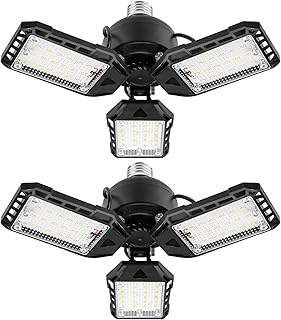
32000LM LED Garage Ceiling Lights, 6-Panel (2-Pack)
At 32,000 lumens across six deformable panels, this is the brightest option on the list and the one to reach for in a deep three-car bay or a high-ceilinged workshop. Two of these will genuinely erase shadows from a large space, though in a small single garage you may find the output more than you need.
TANBABY Deformable LED Garage Light (30000LM, 2-Pack)
The 6+1 panel layout is the smart detail here — that seventh downward-facing panel keeps light directly beneath the fixture instead of leaving a dim spot under the socket. Well-balanced brightness and a reliable pick for garages that double as storage.
20000LM Garage Ceiling Light, 6+1 Panels (2-Pack)
Twenty thousand lumens is the sweet spot for most standard two-car garages, delivering even, glare-controlled coverage without the wash-out that can come with higher-output bulbs in a compact room. A sensible, no-drama upgrade.
200W LED Garage Bulb (6-Pack)
If you’re outfitting multiple rooms — garage, basement, attic, utility area — the six-pack is the clear value play, bringing per-bulb cost well down while keeping the same 20,000-lumen, 6500K performance. Ideal for anyone with several bare sockets to fill.
AUDLES 200W LED Shop Light (2-Pack)
AUDLES pairs 20,000 lumens with a well-machined 6+1 panel hinge that holds its position rather than drifting over time. A tidy, dependable choice for barns and workshops where you’ll want to re-aim light as the layout changes.
Frequently Asked Questions
Do these bulbs need an electrician to install?
No. They screw into any standard E26/E27 socket exactly like a conventional bulb, then unfold by hand. Turn the power off at the switch, install, and adjust the panels.
How many bulbs do I need for a two-car garage?
Two 20,000-lumen bulbs are typically plenty for a standard 400-square-foot bay. If you have only one ceiling socket, choose the highest-output single bulb your clearance allows.
Will they work in an enclosed fixture?
Generally not. Deformable panels need open air to unfold and to shed heat, so they perform best in open sockets or bare-socket keyless fixtures.
Are they dimmable?
Most high-output deformable garage bulbs are not dimmable and can flicker or buzz on a dimmer switch. Pair them with a standard on/off switch.
Final Thoughts
For most garages, the 20000LM 6+1 Panel two-pack hits the right balance of coverage and comfort, while the 32000LM six-panel set is the one to choose for tall ceilings and deep bays. If you have several sockets waiting across a garage, basement, and attic, the 200W six-pack is the most economical way to light the whole footprint at once.