Key takeaways
- Motor setup: Dual-motor designs with independent switches let you run a blade on one spindle and a sanding or grinding head on the other, so you stop swapping tooling mid-project. Single-motor units are simpler and often quieter, but expect more downtime between operations.
- Cut depth versus stock: Most of these saws top out between 12mm and 26mm. Measure the thickest material you regularly use — hardwood dowels and layered plywood eat depth fast — and buy with headroom rather than exactly at your limit.
- Variable speed: Seven-step or fully variable control is not a luxury here. Acrylic melts at high RPM, PCB substrate chips at low RPM, and softwood wants something in between. Fixed-speed models force you to compensate with feed rate alone.
- Fence and angle accuracy: Check that the fence locks square and stays there under light pressure, and that the tilt mechanism has positive stops. A saw that drifts half a degree over a 100mm cut will show in any joined assembly.
- Accessories you will actually reach for: A 122-piece kit sounds generous, but count the useful items: spare blades in two tooth counts, sanding discs, a push block, and collets that match your existing bits. Volume alone tells you little about quality.
What's inside
Anyone who works at small scale knows the frustration: a full-size table saw is overkill for a 3mm basswood strip, a craft knife wanders off the line, and a rotary tool freehand leaves edges that need twenty minutes of sanding to look intentional. Miniature work — dollhouse trim, model dioramas, custom drawer dividers, laser-cut acrylic inlays — demands cuts measured in millimetres, not inches. That gap is exactly where the mini table saw lives, and the category has matured fast enough in the last two years to be genuinely worth a spot on your bench.
The catch is that this corner of the market is crowded with near-identical listings, wildly different motor specs, and accessory counts used as a substitute for build quality. This guide sorts the field by what actually matters for craft work: motor configuration, cut depth, fence and mitre accuracy, and how much of the included kit you will realistically use. Below are the models worth considering in 2026, plus a short buying framework so you can judge any listing on its merits.
As an Amazon Associate we earn from qualifying purchases.
![Mini Table Saw for Crafts & Hobbyists [Dual 795 Motors & Switches] 200W/12,000RPM/26mm Adjustable Height with Accessories – Perfect for DIY Crafts, Handmade Gifts & Exploring Hobbies](https://m.media-amazon.com/images/I/71yotzYsRaL._AC_UL320_.jpg)

![Super Mini Table Saw for Crafts & Hobbyists, [Dual Motor & Switches] 7 Speeds 200W Max, Multifunctional, 122+ Accessories, Cut/Engrave/Polish/Drill, Compact for Model Making, Gift for Creators](https://m.media-amazon.com/images/I/71XhPTpz18L._AC_UL320_.jpg)

How to Choose a Mini Table Saw For Crafts (2026)
- Motor setup: Dual-motor designs with independent switches let you run a blade on one spindle and a sanding or grinding head on the other, so you stop swapping tooling mid-project. Single-motor units are simpler and often quieter, but expect more downtime between operations.
- Cut depth versus stock: Most of these saws top out between 12mm and 26mm. Measure the thickest material you regularly use — hardwood dowels and layered plywood eat depth fast — and buy with headroom rather than exactly at your limit.
- Variable speed: Seven-step or fully variable control is not a luxury here. Acrylic melts at high RPM, PCB substrate chips at low RPM, and softwood wants something in between. Fixed-speed models force you to compensate with feed rate alone.
- Fence and angle accuracy: Check that the fence locks square and stays there under light pressure, and that the tilt mechanism has positive stops. A saw that drifts half a degree over a 100mm cut will show in any joined assembly.
- Accessories you will actually reach for: A 122-piece kit sounds generous, but count the useful items: spare blades in two tooth counts, sanding discs, a push block, and collets that match your existing bits. Volume alone tells you little about quality.
The Best Mini Table Saw For Crafts (2026)s Reviewed
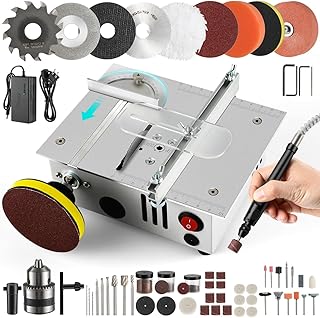
Mini Table Saw with Dual 795 Motors & Switches
The 200W dual-795 layout and 26mm adjustable height make this the most capable pick for anyone cutting hardwood offcuts or stacked ply rather than balsa alone. Independent switches are the standout feature — you can leave a grinding head mounted and ready without touching the blade side.
MIMYTH Multifunctional Portable Tablesaw
MIMYTH’s strength is breadth: cutting, grinding and sanding from one compact frame, with angle, speed and depth all adjustable. It suits mixed-media makers who move between wood, foam and light plastics in a single session and want one machine handling all of it.
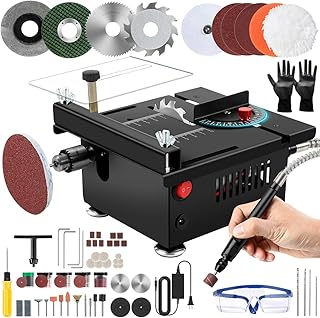
Super Mini Table Saw with 122+ Accessories
Seven speeds, dual motors and a genuinely deep accessory kit make this the strongest starting point for someone equipping a bench from scratch, or buying a gift for a new hobbyist. The cut, engrave, polish and drill range covers model-making workflows end to end without immediate upgrades.
MXBAOHENG Mini Table Saw S3
This is the precision-first option: a 1/2″ adjustable cut depth and seven-speed supply aimed squarely at miniature woodworking where repeatability beats raw power. If your work is dollhouse-scale trim or fine joinery, the tighter tolerances justify the narrower capability.
Mini Multi Functional Table Saw (Dual-Motor, Wood/PCB/Acrylic)
Explicitly specced for PCB and acrylic alongside wood, this dual-motor model is the pick for electronics and prototyping work where board edges need to come out clean. Adjustable speed and angle round it out as a sensible all-rounder at modest cost.
Frequently Asked Questions
Can a mini table saw cut hardwood?
Thin hardwood, yes — within the stated depth and with a slow, steady feed. These are 200W-class tools, so treat anything above roughly 15mm of dense stock as a job for a bandsaw or full-size saw.
Do I need dust extraction?
Not a dedicated system, but sawdust at this scale is fine and airborne. Work near a small shop vac nozzle, and wear a mask when sanding MDF or cutting plastics.
How accurate are the included fences?
Adequate out of the box, better after a five-minute check with a small engineer’s square. Many owners eventually add a shop-made zero-clearance insert and a taller auxiliary fence — both easy upgrades.
Are these safe for beginners?
Reasonably, provided you use a push stick, keep fingers outside the blade line, and never cut freehand without the fence. The small blade reduces severity, not risk. Eye protection is non-negotiable.
Final Thoughts
For most craft benches, the Dual 795 Motor mini saw offers the best balance of depth capacity and workflow flexibility, while the Super Mini Table Saw with 122+ accessories is the smarter buy if you are starting fresh and want tooling included. Precision-focused miniaturists should look first at the MXBAOHENG S3, which trades some versatility for the repeatable, fine cuts that scale work depends on.