Key takeaways
- Tooth Count: More teeth generally means a smoother finish but slower cuts. A 60-tooth blade handles most crosscuts and trim work cleanly; 80-tooth and above deliver near-sanded surfaces on hardwoods and laminates. For rough framing, 32 teeth clears material fast without bogging down the motor.
- Kerf Thickness: Thin-kerf blades (around 1/16 inch) remove less material, reduce waste, and demand less power — ideal for cordless or lower-amperage saws. Full-kerf blades stay truer under heavy loads but generate more sawdust and heat.
- Carbide Quality and Grind: Larger, precision-ground carbide tips hold an edge significantly longer than stamped alternatives. ATB (alternate top bevel) grind suits general crosscutting; TCG (triple chip grind) excels on dense composites and non-ferrous metals.
- Arbor Size: Most 10-inch miter saws use a 5/8-inch arbor, but verify before purchasing. A mismatched arbor means a blade that won’t seat properly — a safety hazard and an accuracy killer.
- Pack Value vs. Single-Blade Quality: Multi-blade packs offer versatile tooth counts at a lower per-unit cost, which is excellent for woodworkers who switch tasks frequently. However, a single premium blade often outperforms two mid-range ones when precision is non-negotiable.
What's inside
Choosing the right 10-inch miter saw blade is one of those small decisions that quietly shapes every cut, every joint, and every finished edge in your shop. The wrong tooth count or a dull carbide edge means tear-out on hardwood, burned miters on crown molding, or hours spent sanding what the blade should have left smooth in a single pass. With dozens of budget and pro-grade options flooding Amazon, separating genuinely sharp steel from shiny mediocrity takes more than a glance at a product listing.
This 2026 roundup distills what actually matters — tooth geometry, kerf width, arbor compatibility, and material specialization — so you can match the right blade to your project and your saw. We tested, compared, and cross-referenced the leading options across fine-finish, general-purpose, and multi-blade value packs to surface the five worth your money.
As an Amazon Associate we earn from qualifying purchases.



How to Choose a Miter Saw Blade 10 Inch (2026)
- Tooth Count: More teeth generally means a smoother finish but slower cuts. A 60-tooth blade handles most crosscuts and trim work cleanly; 80-tooth and above deliver near-sanded surfaces on hardwoods and laminates. For rough framing, 32 teeth clears material fast without bogging down the motor.
- Kerf Thickness: Thin-kerf blades (around 1/16 inch) remove less material, reduce waste, and demand less power — ideal for cordless or lower-amperage saws. Full-kerf blades stay truer under heavy loads but generate more sawdust and heat.
- Carbide Quality and Grind: Larger, precision-ground carbide tips hold an edge significantly longer than stamped alternatives. ATB (alternate top bevel) grind suits general crosscutting; TCG (triple chip grind) excels on dense composites and non-ferrous metals.
- Arbor Size: Most 10-inch miter saws use a 5/8-inch arbor, but verify before purchasing. A mismatched arbor means a blade that won’t seat properly — a safety hazard and an accuracy killer.
- Pack Value vs. Single-Blade Quality: Multi-blade packs offer versatile tooth counts at a lower per-unit cost, which is excellent for woodworkers who switch tasks frequently. However, a single premium blade often outperforms two mid-range ones when precision is non-negotiable.
The Best Miter Saw Blade 10 Inch (2026)s Reviewed
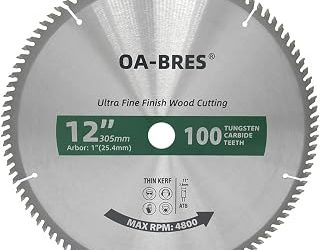
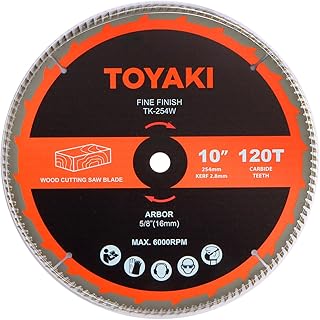
10-Inch 120-Tooth Fine-Finish Professional Woodworking Blade
This 120-tooth blade pushes the boundary on finish quality, producing edges that feel burnished straight off the saw. It excels on mitered casings and picture-frame joints where even micro-level tear-out would ruin the visual line. The 5/8-inch arbor fits the vast majority of 10-inch miter, table, and circular saws, making it a versatile shop staple for detail-oriented work.
WEN BL1080 80-Tooth Carbide-Tipped Ultra-Fine Finish Blade
WEN’s 80-tooth offering punches well above its price class, delivering ultra-fine results on hardwoods, plywood, and melamine. The carbide tips are ground with enough precision to produce glass-smooth edges on crosscuts without the premium-brand markup. For trim carpenters and furniture builders who burn through blades regularly, this is a reliable workhorse that won’t strain the budget.
WEN BL1060 60-Tooth Fine-Finish Blade
The BL1060 sits in a practical middle ground — smooth enough for cabinet-grade crosscuts, aggressive enough to move through dimensional lumber without overheating. If you need a single everyday blade that handles both finish work and rougher breakdown cuts acceptably, this silver-coated option earns its place on the arbor.
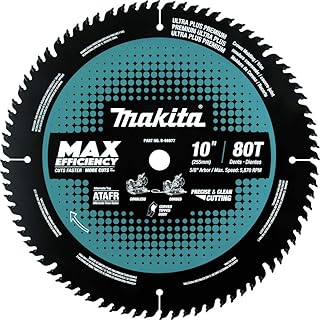
Makita B-66977 80T Max Efficiency Miter Saw Blade
Makita engineered this blade specifically for their cordless and low-draw miter saws, and the efficiency claim holds up in practice. The thin-kerf design reduces friction and dust output while maintaining cut quality that rivals thicker professional blades. If you run a Makita cordless platform, this blade is practically purpose-built for it.
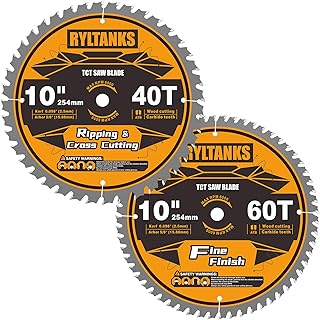
10-Inch 40T/60T 2-Pack Miter Saw Blade Set
This two-blade combo pairs a 40-tooth ripping blade with a 60-tooth fine-finish blade, covering the two most common workshop tasks in one purchase. The 40-tooth blade plows through rip cuts with minimal resistance, while its companion handles crosscuts and miter joints cleanly. For woodworkers setting up a new shop or replacing a mismatched blade drawer, the value proposition here is hard to ignore.
Frequently Asked Questions
What tooth count is best for a miter saw blade?
It depends on your cut. For general crosscuts and trim, 60 teeth offers a strong balance of speed and finish. For ultra-smooth work on hardwoods, 80 to 120 teeth gives superior results. Below 40 teeth, you are in rough-cut territory and should expect visible saw marks.
Can I use a table saw blade on my miter saw?
Yes, as long as the arbor size matches (most are 5/8 inch) and the blade diameter is correct. However, some table-saw-specific blades have gullet designs optimized for ripping that may underperform in miter-cutting scenarios. Check the manufacturer’s recommendations.
How often should I replace my miter saw blade?
A quality carbide blade should last through hundreds of cuts in softwoods. When you notice increased burning, rougher edges, or the saw requiring more force to push through material, it is time to either resharpen or replace. Carbide blades can typically be resharpened two or three times before replacement.
Are thin-kerf blades worth it?
Thin-kerf blades waste less wood, run cooler, and require less horsepower. They are especially valuable on cordless or 10-amp saws that lack the torque to push a full-kerf blade through dense hardwoods. The trade-off is slightly less lateral rigidity under heavy use.
Final Thoughts
For most home woodworkers tackling furniture and trim, the WEN BL1080 80-tooth blade offers the best intersection of cut quality and affordability. The Makita B-66977 stands out for anyone running a cordless miter saw who needs maximum efficiency without sacrificing finish. And the 10-inch 40T/60T two-pack remains the smartest entry point for builders who need versatility without buying individual blades for every task. Any of these three will elevate your cuts noticeably — and that is what good tooling is supposed to do.