Key takeaways
- Wheel diameter: Small casters are fine on smooth concrete and useless everywhere else. Look for wheels of at least 6 inches if you’ll cross thresholds, gravel driveways, or lawn between the garage and the job.
- Material support length: Extension arms determine whether you can cut 8-foot crown or fight it. Aim for 8 feet of total support with adjustable rollers or stops, especially for casing and baseboard runs.
- Mounting system: Universal rails with quick-release brackets let you swap saws without drilling. Confirm the rail spacing works with your saw’s base before buying, since off-brand and older saws sometimes need extra holes.
- Folded footprint and setup motion: Gravity-rise and one-motion folding designs go from stored to standing in seconds. Tripod-style stands are lighter but need more floor space and more fiddling.
- Load capacity and onboard power: A 300-pound-plus rating handles heavier sliding compound saws with material on the wings. Built-in outlets are a genuine convenience when extension cords are already stretched thin.
What's inside
Anyone who has installed baseboards, built a floating shelf, or trimmed out a doorway knows the real bottleneck isn’t the cut, it’s the setup. A miter saw balanced on sawhorses or perched on a garage floor turns a two-hour project into an all-day negotiation with gravity. Boards sag, cuts drift out of square, and every time you need to move rooms you’re carrying a 60-pound tool in one arm and a folding table in the other. For renovators working in finished spaces, that’s how walls get scuffed and floors get gouged.
A rolling miter saw stand solves the problem by turning the saw into a single wheeled unit you can park in a corner and pull out when the trim delivery arrives. This guide breaks down what actually matters in a wheeled stand for home projects, from wheel diameter and material support to how gracefully the thing folds when your garage doubles as storage. Below are the models worth your attention in 2026, with honest notes on where each one fits.
As an Amazon Associate we earn from qualifying purchases.


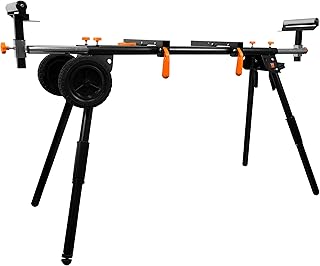

How to Choose a Miter Saw Stand With Wheels (2026)
- Wheel diameter: Small casters are fine on smooth concrete and useless everywhere else. Look for wheels of at least 6 inches if you’ll cross thresholds, gravel driveways, or lawn between the garage and the job.
- Material support length: Extension arms determine whether you can cut 8-foot crown or fight it. Aim for 8 feet of total support with adjustable rollers or stops, especially for casing and baseboard runs.
- Mounting system: Universal rails with quick-release brackets let you swap saws without drilling. Confirm the rail spacing works with your saw’s base before buying, since off-brand and older saws sometimes need extra holes.
- Folded footprint and setup motion: Gravity-rise and one-motion folding designs go from stored to standing in seconds. Tripod-style stands are lighter but need more floor space and more fiddling.
- Load capacity and onboard power: A 300-pound-plus rating handles heavier sliding compound saws with material on the wings. Built-in outlets are a genuine convenience when extension cords are already stretched thin.
The Best Miter Saw Stands With Wheels (2026), Reviewed
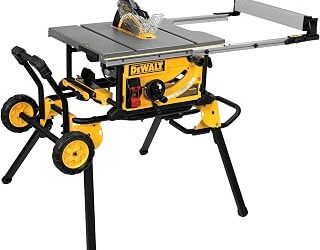
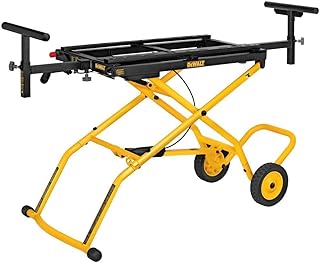
DEWALT DWX726 Rolling Miter Saw Stand
The DWX726 is the reference point for a reason: 8 feet of material support, tool-free universal rails, and pneumatic-style wheels that clear a threshold without complaint. It’s heavier than a tripod stand, but the steel frame stays dead flat under a big slider, which is exactly what you want when you’re cutting mitered returns that have to close tight.
Bosch T4B Gravity-Rise Stand
Bosch’s gravity-rise mechanism is the smoothest deployment in the category, tipping from rolling cart to work height in one fluid motion with the saw still attached. The large wheels handle rough terrain better than most, making it the pick for anyone moving between a garage bay and an unfinished addition.
BORA Portacube PM-8000
The Portacube is the outlier and the most interesting option for design-minded DIYers, because its rotating top lets you flip between a mounted miter saw and a flat workbench surface. If your shop is a single stall and you need a sanding, assembly, and finishing station in the same footprint, this earns its space.
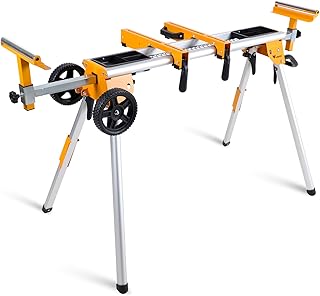
POWERTEC MT4000V
POWERTEC pairs quick-release brackets with 8-inch wheels and a triple-outlet power strip, hitting a lot of the DEWALT’s feature list at a friendlier number. The folding design tucks tight against a wall, and the 330-pound capacity is honest for the sliders most homeowners run.
WEN MSA330 Collapsible Rolling Stand
The MSA330 is the value entry, with three onboard outlets and a collapsible frame that stores in a closet-sized gap. It’s less rigid than the steel heavyweights, so treat it as the right call for occasional trim and shelving work rather than daily framing.
Frequently Asked Questions
Will any miter saw fit these stands?
Most use universal mounting rails that accept the majority of 10- and 12-inch saws, but always check your saw’s base dimensions and bolt pattern. Quick-release brackets, like those on the POWERTEC and DEWALT, make swapping saws far less painful.
How much material support do I actually need?
For interior trim, 8 feet of combined support handles standard baseboard and casing without a second helper. Shorter stands work if you’re mostly cutting studs and framing lumber.
Are wheeled stands stable enough for precision cuts?
Yes, provided you deploy the leg locks and set the stand on reasonably level ground. Steel-frame models with wide stance legs show almost no flex, which is what preserves a clean 45-degree miter.
Can I use a rolling stand indoors on finished floors?
Large rubber or pneumatic wheels roll over hardwood and tile without marking, though a drop cloth is still smart. Check the wheel material before rolling anything across a newly finished floor.
Final Thoughts
For most home renovators, the DEWALT DWX726 remains the safest investment: rigid, well supported, and easy to move. Choose the Bosch T4B if effortless one-motion setup matters more than anything else, or the BORA Portacube if you need a rotating workbench and a saw station to share the same square footage.