Key takeaways
- Mounting compatibility: Universal rails with adjustable brackets accept nearly any saw, while proprietary systems bolt up faster but lock you to one brand. Measure your saw’s base footprint and mounting hole spacing before you commit.
- Material support length: Extension arms determine how much stock you can hold flat. Roughly 40 inches of beam handles trim and shelving; 8 feet of support is what you want for door casing, deck boards, and long baseboard runs.
- Weight capacity and frame rigidity: Look past the headline rating and check the leg geometry. A wide stance and gusseted steel tubing keep the saw from walking during aggressive crosscuts, which matters more than a big number on the box.
- Portability and setup: Fold-flat stands under 40 pounds carry easily and store vertically against a wall. Wheeled stands weigh more but roll up a tailgate ramp solo, and gas-strut or lift-assist mechanisms spare your back when the saw stays mounted.
- Stops and repeatability: Adjustable material stops on the extension arms turn a stand into a production tool. If you cut multiples, that feature saves more time than anything else on the spec sheet.
What's inside
Anyone who has cut crown molding on a pair of sawhorses knows the moment it goes wrong: the offcut tips, the workpiece flexes, and a joint that should have closed tight opens up by a hair. A miter saw is only as accurate as the plane it sits on, and in most home workshops that plane is improvised. Add the reality of the modern shop, which is usually a garage bay shared with bikes and bins, and the stand becomes the piece of equipment that decides whether a project gets finished at all.
This guide looks at miter saw stands the way we look at any piece of shop infrastructure: as something you set up, tear down, and store dozens of times a season. We compare compact folding stands, wheeled units built for job-site abuse, and standalone roller supports that extend whatever bench you already own. Below you will find the models worth your money in 2026, plus a short framework for matching a stand to the saw and the space you actually have.
As an Amazon Associate we earn from qualifying purchases.



How to Choose a Miter Saw Stand (2026)
- Mounting compatibility: Universal rails with adjustable brackets accept nearly any saw, while proprietary systems bolt up faster but lock you to one brand. Measure your saw’s base footprint and mounting hole spacing before you commit.
- Material support length: Extension arms determine how much stock you can hold flat. Roughly 40 inches of beam handles trim and shelving; 8 feet of support is what you want for door casing, deck boards, and long baseboard runs.
- Weight capacity and frame rigidity: Look past the headline rating and check the leg geometry. A wide stance and gusseted steel tubing keep the saw from walking during aggressive crosscuts, which matters more than a big number on the box.
- Portability and setup: Fold-flat stands under 40 pounds carry easily and store vertically against a wall. Wheeled stands weigh more but roll up a tailgate ramp solo, and gas-strut or lift-assist mechanisms spare your back when the saw stays mounted.
- Stops and repeatability: Adjustable material stops on the extension arms turn a stand into a production tool. If you cut multiples, that feature saves more time than anything else on the spec sheet.
The Best Miter Saw Stands (2026) Reviewed
DEWALT DWX724 Compact Stand
The most sensible pick for a garage shop: it folds to a slim profile, weighs little enough to carry in one hand, and still supports 500 pounds with a beam that extends to 40 inches. If your work is furniture, trim, and shelving rather than framing, this is the stand that will actually get used.
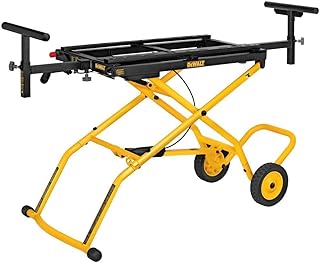
DEWALT DWX726 Rolling Stand
Built for people who move the saw as often as they use it, with all-terrain wheels, adjustable working height, and 8 feet of material support for long stock. The tradeoff is bulk and weight, so it earns its keep for renovation work and light commercial use more than for a tidy basement bench.
Evolution MCSSTAND Chop Saw Stand
Designed around Evolution’s heavier metal-cutting saws, the gas-strut Powerlift assist takes the strain out of raising a mounted machine, and the steel frame stays planted through steel and aluminum cuts. Confirm your saw appears on the compatibility list, since this is a purpose-built platform rather than a general-purpose one.
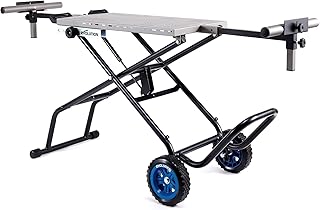
BORA PM-4000 Portable Stand
A genuinely universal stand with generous mounting adjustability and a heavy-duty frame that punches above its price. Setup takes a moment longer than a proprietary system, but you can move it from saw to saw for years without buying again.
BORA Adjustable Roller Stand
The most useful accessory in this roundup and the cheapest fix for sagging stock. Set one on each side of the saw or use it to feed a table saw, and long boards track smoothly instead of dragging or dropping.
Frequently Asked Questions
Do I need a dedicated stand if I already have a workbench?
A solid bench works if the saw sits at a comfortable height and you have room for infeed and outfeed support. Most people run short on the second part, which is where a pair of roller stands, such as the Trend adjustable roller, solves the problem for far less than a full stand.
Will a universal stand fit my saw?
Almost certainly, provided the saw base fits within the rail span and you can reach the mounting holes. Sliding compound saws with deep bases are the most common exception, so check dimensions rather than assuming.
Are wheeled stands worth the extra weight?
Only if you transport the saw. Wheels shine when you are loading a vehicle or crossing a job site, but in a fixed shop they add mass and cost you storage space.
What working height should I aim for?
Most people cut best with the saw table around 32 to 36 inches off the floor, which puts the workpiece near hip height. Adjustable-height stands let you fine-tune this and match the stand to an existing bench or outfeed table.
Final Thoughts
For the majority of home workshops, the DEWALT DWX724 hits the right balance of capacity, rigidity, and easy storage, while the BORA PM-4000 is the smarter buy if you want one frame that will host whatever saw you own next. If your saw travels, step up to the DEWALT DWX726 and let the wheels do the work.