Key takeaways
- Pipe material: HDPE tubing paired with aluminum fittings gives you corrosion resistance, low friction loss, and push-to-connect assembly. Skip PVC entirely — it becomes brittle and can fragment under pressure. Reserve black iron for permanent industrial installs where you already own the threading tools.
- Interior diameter: 3/4″ ID is the sweet spot for a home or two-bay shop. It carries enough volume to run a die grinder or a plasma cutter without starving at the far end of a long run, and it costs little more than 1/2″.
- Run length and outlet placement: Measure your intended path, then add 20 percent for elbows, drops, and the inevitable rerouting. Sketch outlet positions before ordering so you can match your kit’s included tee and elbow count instead of making a second hardware run.
- Pressure rating and gauges: Look for a 200 PSI rating to give yourself headroom above typical 120–150 PSI compressor output. Kits with integrated gauges at the outlet blocks make it far easier to diagnose a leak or a regulator problem later.
- Fitting quality and count: Aluminum outlet blocks with brass internals seal better over years of temperature swings than all-plastic connectors. A generous piece count also means fewer trips to the store when your layout changes.
What's inside
Anyone who has run a shop from a single coiled rubber hose knows the compromise: dragging fifty feet of line across the floor, fighting pressure drop at the tool, and rerouting around whatever project happens to be on the bench. Hard-piping the compressed air in a garage or workshop fixes all three, but the pipe you choose determines whether the job takes a weekend or a month. Black iron corrodes and demands threading. Copper needs soldering skill. PVC is a genuine safety hazard under compressed air and has no business in a shop. That leaves modern HDPE-and-aluminum kits, which have quietly become the default for anyone building out a home workspace without a pipefitter on retainer.
This guide looks at complete air line kits rated for real shop pressure, judged on what actually matters once the tubing is on the wall: outlet block quality, fitting count, honest length coverage, and whether the system holds pressure overnight without a soap-bubble hunt. Below are the kits worth your money in 2026, plus a short framework for matching one to your space.
As an Amazon Associate we earn from qualifying purchases.




How to Choose a Pipe For Air Compressor Lines (2026)
- Pipe material: HDPE tubing paired with aluminum fittings gives you corrosion resistance, low friction loss, and push-to-connect assembly. Skip PVC entirely — it becomes brittle and can fragment under pressure. Reserve black iron for permanent industrial installs where you already own the threading tools.
- Interior diameter: 3/4″ ID is the sweet spot for a home or two-bay shop. It carries enough volume to run a die grinder or a plasma cutter without starving at the far end of a long run, and it costs little more than 1/2″.
- Run length and outlet placement: Measure your intended path, then add 20 percent for elbows, drops, and the inevitable rerouting. Sketch outlet positions before ordering so you can match your kit’s included tee and elbow count instead of making a second hardware run.
- Pressure rating and gauges: Look for a 200 PSI rating to give yourself headroom above typical 120–150 PSI compressor output. Kits with integrated gauges at the outlet blocks make it far easier to diagnose a leak or a regulator problem later.
- Fitting quality and count: Aluminum outlet blocks with brass internals seal better over years of temperature swings than all-plastic connectors. A generous piece count also means fewer trips to the store when your layout changes.
The Best Pipe For Air Compressor Lines (2026)s Reviewed
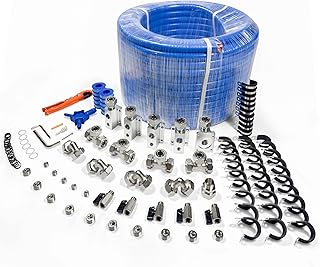
200 ft HDPE Air Piping System, 53-Piece Kit
The most complete option here for a larger two- or three-bay garage, pairing 200 feet of 3/4″ HDPE with aluminum outlet blocks and enough fittings to branch in several directions. The 200 PSI rating and generous hardware count mean you can lay out a proper loop system rather than a single dead-end run.
3/4″ × 100 ft Pressure Gauge Shop Air Line Kit
The integrated pressure gauges are the standout feature, letting you verify delivery at the tool instead of guessing from the tank. A smart pick for a single-bay shop where diagnosing a slow leak matters more than raw coverage.
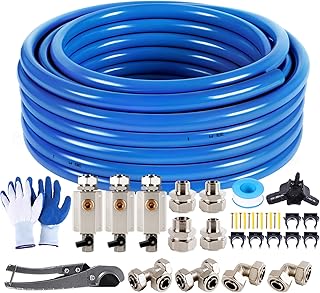
3/4″ × 100 ft Piping System, 37-Piece Kit
The leanest kit on this list and the most sensible entry point for a first hard-piped install. You get aluminum outlet blocks and enough tubing for a typical one-car garage perimeter without paying for fittings you may never use.
Modular Shop Air Line Kit, 100 / 200 / 300 ft
The flexible length options make this the best fit for anyone unsure of their final layout, and the included right-angle and tee fittings handle the awkward corners most shops present. A solid mid-range choice for phased installations.
300 ft 5-Way Multi-Outlet Manifold Kit
Individual pressure gauges on a five-way aluminum manifold make this the pick for shops running multiple tools simultaneously — think a paint station, a bench setup, and a lift all drawing at once. It is more system than most home users need, which is exactly why serious hobbyists gravitate to it.
Frequently Asked Questions
Can I use PVC pipe for compressed air?
No. PVC degrades with UV exposure, vibration, and heat cycling, and can fail suddenly by shattering rather than splitting. HDPE with aluminum fittings costs slightly more and eliminates the risk.
Do I need a moisture trap or drip leg?
Yes. Compressed air carries water vapor that condenses in the lines. Pitch your runs slightly toward a drain point and add a filter or drip leg before any tool sensitive to moisture, especially spray equipment.
How much pipe should I buy?
Measure your planned wall route, add drops for each outlet, then add roughly 20 percent. Extra tubing is inexpensive; running short mid-install is not.
Are push-to-connect fittings reliable long-term?
Quality aluminum and brass push-connect fittings hold up well for years when the tubing is cut square and fully inserted. Pressure-test the system before closing up any walls.
Final Thoughts
For most home shops, the 100 ft 37-piece HDPE kit delivers everything you need at the lowest entry cost, while the 3/4″ × 100 ft Pressure Gauge Kit is worth the small upcharge for its built-in diagnostics. If you are outfitting a larger space or running several tools at once, step up to the 200 ft 53-piece system or the 300 ft 5-way manifold kit and build the layout once, properly.