Key takeaways
- Clean cut vs. max cut: Buy on the clean-cut number, not the headline max. A 3/8″ clean rating handles the 10-gauge to 1/4″ steel most furniture frames, brackets, and table bases use, with the max figure held in reserve for severance work you will grind anyway.
- Voltage flexibility: Dual-voltage 120V/240V machines let you rough out parts on a household circuit and move to a dryer outlet when you need full amperage. Single-voltage 240V units deliver more consistent output but tie you to one location.
- Pilot arc type: Non-touch pilot arc lets you start on rusted, painted, or expanded metal without dragging the tip, which matters for reclaimed stock. Drag-cut designs trade that for steadier freehand tracking on curves and lettering.
- Air quality and duty cycle: Built-in compressors run warm, so look for a rear filter or moisture separator and a stated duty cycle at your working amperage. Expect shorter continuous runs than tank-fed setups and plan cuts in stages.
- Consumable ecosystem: Torches based on common patterns like IPT40 or PT31 keep tips and electrodes cheap and easy to source. Proprietary torches can double your long-term cost on a machine you use weekly.
What's inside
Anyone who has tried to fabricate a raw steel console base or a blackened-metal shelf bracket in a home workshop knows where the project stalls: the air supply. A plasma cutter is only half the equation, and the other half is usually a 60-gallon tank bolted to the garage floor, drinking power and filling the room with noise. For makers working out of a spare bay, a basement studio, or a shared building where a dedicated compressor simply is not happening, that requirement quietly kills a lot of good furniture ideas before the first cut.
Integrated-compressor plasma cutters solve that constraint by putting the air source inside the case. Plug in, wait for pressure, cut. This guide looks at the machines worth trusting in 2026 for design-led metalwork: cut capacity on the gauges you will actually use, duty cycle honesty, consumable availability, and how clean the edge comes off the plate when you plan to leave that edge visible.
As an Amazon Associate we earn from qualifying purchases.


How to Choose a/an Plasma Cutter With Built In Air Compressor (2026)
- Clean cut vs. max cut: Buy on the clean-cut number, not the headline max. A 3/8″ clean rating handles the 10-gauge to 1/4″ steel most furniture frames, brackets, and table bases use, with the max figure held in reserve for severance work you will grind anyway.
- Voltage flexibility: Dual-voltage 120V/240V machines let you rough out parts on a household circuit and move to a dryer outlet when you need full amperage. Single-voltage 240V units deliver more consistent output but tie you to one location.
- Pilot arc type: Non-touch pilot arc lets you start on rusted, painted, or expanded metal without dragging the tip, which matters for reclaimed stock. Drag-cut designs trade that for steadier freehand tracking on curves and lettering.
- Air quality and duty cycle: Built-in compressors run warm, so look for a rear filter or moisture separator and a stated duty cycle at your working amperage. Expect shorter continuous runs than tank-fed setups and plan cuts in stages.
- Consumable ecosystem: Torches based on common patterns like IPT40 or PT31 keep tips and electrodes cheap and easy to source. Proprietary torches can double your long-term cost on a machine you use weekly.
The Best Plasma Cutter With Built In Air Compressor (2026)s Reviewed
FLARING 240V 45A Plasma Cutter
The 45-amp output on a dedicated 240V circuit gives this one the most headroom in the category, with a genuine 3/8″ clean cut and 5/8″ severance for heavier structural stock. It is the pick if your bench work leans toward angle iron, plate feet, and thicker frame members rather than thin decorative sheet.
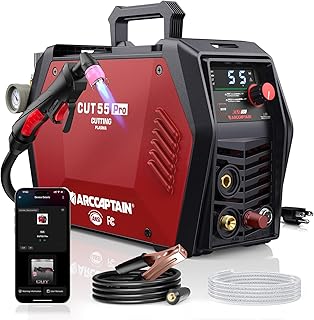
ARCCAPTAIN iControl CUT55 Pro
At 55 amps with dual voltage, app-based control, and 2T/4T trigger modes, this is the most capable and most configurable machine here, cutting a clean 1/2″ and severing 3/4″. The non-touch pilot arc and 1/4 NPT fitting also mean you can bypass the internal compressor and run shop air later if your setup grows.
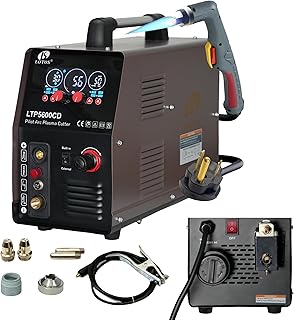
LTP5600CD 56A Drag-Cut
The drag-cut design is the quiet standout for anyone doing metal art, perforated screens, or freehand curves, since resting the tip on the work steadies your line better than holding a standoff gap. It handles rusty and painted reclaimed sheet up to 5/8″ without a tank in the room.
YESWELDER CUT-55DS PRO
Non-HF starting makes this the safest choice near sensitive electronics, and the rear air filter plus IP21 rating show real attention to the moisture problem that plagues integrated compressors. The IPT40 torch keeps consumables inexpensive and widely stocked.
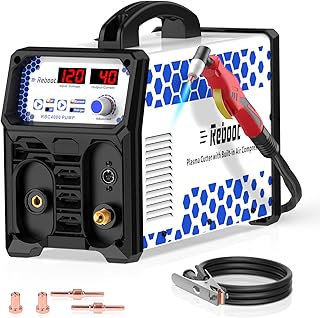
Reboot 40A 120V Plasma Cutter
Running on a standard 120V household outlet, this is the entry point for occasional work: brackets, small legs, decorative panels, and light repair up to a 3/8″ clean cut. Accept the modest 40-amp ceiling and it is a sensible first machine for an apartment-adjacent workshop.
Frequently Asked Questions
Do built-in compressors really eliminate the need for a tank?
For intermittent work, yes. These units supply enough pressurized air for short cutting sequences, though heavy production runs will outpace the internal pump and benefit from external shop air where a fitting is provided.
How thick can I cut for furniture projects?
Most designer-scale work sits between 16-gauge sheet and 1/4″ plate, comfortably inside every machine listed. Reserve the 55A and 56A units for 3/8″ and thicker frame stock.
Will the cut edge be clean enough to leave exposed?
With correct amperage, travel speed, and fresh consumables, plasma leaves a narrow dross line that a quick flap-disc pass removes. Expect to finish edges on anything visible.
Can these cut aluminum and stainless?
Yes, plasma cuts any conductive metal. Aluminum and stainless produce rougher edges than mild steel and typically need more post-cut cleanup.
Final Thoughts
For most home fabricators building furniture and architectural metal, the ARCCAPTAIN iControl CUT55 Pro offers the best balance of capacity, dual-voltage flexibility, and future-proofing. Choose the LTP5600CD if your work is freehand and artistic, or the FLARING 240V 45A if you have the circuit and want maximum thickness for the money.