Key takeaways
- Power source: Cordless units win on convenience, 12V DC units win on stamina. Dual-power models give you both, which is the sensible default unless you already own a cordless tool platform, in which case a bare tool that shares your existing batteries is the cleaner buy.
- Battery capacity: Think in terms of tires per charge rather than raw milliamp-hours. Roughly 2000 to 6000mAh handles bikes, balls, and light top-offs. Around 9600mAh covers a full sedan set. Push toward 12000mAh if you are inflating truck, SUV, or RV tires from low.
- Pressure ceiling and real throughput: Nearly everything advertises 150 or 160 PSI, which is plenty for passenger vehicles. Inflation speed matters far more day to day, so weigh the flow rate and how the unit behaves near its upper limit, where cheap pumps stall.
- Auto shut-off and gauge accuracy: Preset your target PSI, let the compressor stop itself, and stop guessing. A backlit digital readout you can trust is the difference between a tool you use monthly and one you avoid.
- Form, storage, and light: An integrated LED turns a roadside stop into a manageable one. Look for a housing that stows its own hose and nozzles, since loose accessories are how these things get lost between the ski bag and the paint cans.
What's inside
The garage has quietly become part of the home. It holds the bikes, the stroller, the sports gear, the car that gets you to the trailhead, and in a lot of houses it doubles as workshop and overflow storage. Which is why a wheezing gas-station air pump feels so out of step with the rest of a considered home: you notice the wobbly shelving, you notice the tangle of extension cords, and you definitely notice the Sunday morning when a soft tire derails the whole plan. Tire pressure is one of those small maintenance rituals that pays back in ride quality, fuel economy, and tread life, and it should not require leaving the driveway.
A portable air compressor solves this the way good design usually does, by shrinking a chore down to something you can do in four minutes with one hand. The current crop is cordless, battery-powered, digital, and small enough to live in a drawer or a door pocket instead of eating a shelf. This guide covers the models worth your counter space in 2026, what actually separates them once you strip away the spec-sheet noise, and how to match a unit to the vehicles and gear you own.
As an Amazon Associate we earn from qualifying purchases.


How to Choose a Portable Air Compressor (2026)
- Power source: Cordless units win on convenience, 12V DC units win on stamina. Dual-power models give you both, which is the sensible default unless you already own a cordless tool platform, in which case a bare tool that shares your existing batteries is the cleaner buy.
- Battery capacity: Think in terms of tires per charge rather than raw milliamp-hours. Roughly 2000 to 6000mAh handles bikes, balls, and light top-offs. Around 9600mAh covers a full sedan set. Push toward 12000mAh if you are inflating truck, SUV, or RV tires from low.
- Pressure ceiling and real throughput: Nearly everything advertises 150 or 160 PSI, which is plenty for passenger vehicles. Inflation speed matters far more day to day, so weigh the flow rate and how the unit behaves near its upper limit, where cheap pumps stall.
- Auto shut-off and gauge accuracy: Preset your target PSI, let the compressor stop itself, and stop guessing. A backlit digital readout you can trust is the difference between a tool you use monthly and one you avoid.
- Form, storage, and light: An integrated LED turns a roadside stop into a manageable one. Look for a housing that stows its own hose and nozzles, since loose accessories are how these things get lost between the ski bag and the paint cans.
The Best Portable Air Compressors (2026) Reviewed
OlarHike Dual Power Tire Inflator
The generalist of the group, pairing three 2000mAh cells with a 12V DC lead so you are never stranded by a dead battery. Fast, genuinely light, and the digital gauge plus auto shut-off make it forgiving enough to hand to anyone in the household.
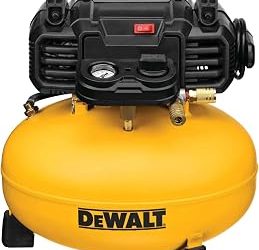
DEWALT 20V MAX Inflator (DCC020IB)
If you already keep DEWALT batteries on a charger, this is the obvious pick, and the tool-only price reflects that. Build quality and the high-volume hose feel a tier above the consumer field, though remember the battery is sold separately.
Ipflin 9600mAh Cordless Inflator
A well-judged middle option: enough cell capacity to walk around a full set of car tires without a recharge, rated to 160 PSI, and still dual-power for longer sessions. Strong value when it is discounted, which it frequently is.
OlarHike 12000mAh Heavy Duty Inflator
Built for larger rubber, with the reserve capacity and airflow to take pickup, Jeep, SUV, and RV tires from properly low back to spec. Bigger and heavier than the rest, and worth that tradeoff only if your driveway holds something substantial.
AstroAI H2 Pro Cordless Inflator
The most design-forward unit here, with a compact yellow body, clean interface, and quick top-off performance across cars, motorcycles, bikes, and sports gear. It also makes a legitimately good gift, which is rare in this category.
Frequently Asked Questions
How often should I check tire pressure?
Monthly, and before any long drive. Tires lose roughly 1 PSI per month naturally and more as temperatures drop, so a cold snap is usually why your dashboard light appears.
Can these inflate a completely flat tire?
Most can, but slowly, and battery-only mode will struggle. For a full flat, run the unit on 12V DC and expect several minutes per tire. Larger-capacity models handle this far better.
Do I need a separate pump for bikes and sports balls?
No. Every model here ships with Presta or Schrader adapters and a needle, though high-pressure road bike tires are where accurate gauges earn their keep.
Are cordless models safe to store in the car?
Generally yes, but lithium cells lose capacity in extreme heat and cold. If your car bakes in summer, store the unit indoors and bring it out when needed.
Final Thoughts
For most households, the OlarHike Dual Power inflator is the right balance of speed, size, and price, and the AstroAI H2 Pro is the one to choose if you want a tool you are happy leaving in plain sight. Owners of larger vehicles should size up to the OlarHike 12000mAh, and anyone already invested in a cordless platform should simply buy the DEWALT DCC020IB and skip the extra charger.